
Shining Stones
Britain's Native 'Marbles'
Graham Lott and David Smith
 |
||
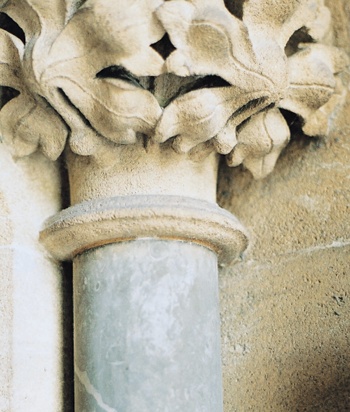
| A shaft made of Frosterley Marble in the North Porch of Bristol Cathedral |
Britain’s historic buildings can often prove to be a treasure trove for the marble enthusiast. High status buildings like royal palaces or stately homes may have colourful marble-lined halls, grand marble staircases, or extravagantly carved fireplaces. Our cathedrals and churches can show an even more diverse use of marbles from simple memorial tablets, intricately carved tombs, pulpits, fonts, decorative columns, colourful marbled floors to loud and extravagant Victorian graveyard statements. In the 19th century marbles became decorative status symbols in the newly established banks and commercial headquarters of our major towns and cities.
In the main, the marbles on view are imported varieties, a trade which has grown since Roman times. Mingled among them, however, particularly in our parish churches and lesser buildings, are many equally attractive native ‘marbles’. Strictly defined, marbles are metamorphosed limestones that in their raw state tend, like most rocks, to look rather drab and uninteresting. However, if they are cut and carefully polished they are transformed into the extravagantly colourful and patterned ‘shining stones’ (the term marble derives from the Greek word for shining or sparkling) that have been coveted for decoration and ornament since they were first exploited and displayed by the Greeks and Romans.
Anyone who has travelled in Europe, particularly to Greece or Italy, and visited the great churches and cathedrals, cannot fail to be attracted, or at the very least distracted, by the sheer range and magnificence of the decorative marble-work on display. One imagines that the same impact was felt by earlier travellers from Britain for whom it was considered an essential part of their education to spend time on the continent. Among these visitors were many of the great architects, artists and intellectuals who subsequently influenced styles and tastes throughout British life. How disappointed some of them must have been to find that on returning to Britain they could find no marbles available to rival those of the Mediterranean area: no white Carrara (Tuscany), no Verde Antico (Thessaly), no Rouge Languedoc (Carcassone) and no Port d’Oro (Gulf of Spezia).
WHY DOESN'T BRITAIN HAVE ITS OWN RANGE OF METAMORPHIC MARBLES?
 |
|
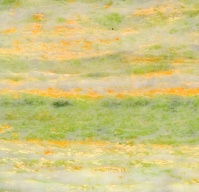
| Iona |
The simple answer is that Britain’s geological history has been very different from that of the Mediterranean area. The marbles of the Mediterranean region were formed by the alteration of beds of sedimentary limestones over long periods of geological time. They began life as sediments, formed from the skeletal remains of calcareous fossils, shells and coral fragments, in ancient tropical seas. Subsequently these limestones were deeply buried and subjected to pressures and temperatures high enough to cause all of this skeletal material to recrystallize, destroying any signs of the original sedimentary fabric. The extravagantly coloured marbles we see today are now fine crystal mosaics of calcium or magnesium carbonate, sometimes veined and fractured, but showing little sign of their sedimentary origins.
Britain’s geological succession also has many thick beds of limestone. They principally occur in the Pre-Cambrian, Cambrian, Devonian, Carboniferous, Jurassic and Cretaceous rocks (see table, below). However, with the exception of the Pre-Cambrian and Cambrian limestones of Scotland and North Wales, they have not been subjected to the same pressures and temperatures over geological time and, consequently, are less altered. Though now hard and cemented, internally they remain today much as when they were deposited – tropical marine sediments packed with unaltered calcitic fossil fragments.
The colour variations so characteristic of true marbles are part of this same alteration process (metamorphism) which redistributes the various chemical compounds present in the original limestone throughout the new crystalline fabric. Reds and yellows are a result of the presence of various iron compounds, blacks contain organic carbon, greens include copper compounds and whites are almost pure calcium or magnesium carbonate.
MARBLES OF GREAT BRITAIN |
|
| GEOLOGICAL AGE | 'MARBLE' |
| QUARTERNARY | |
| TERTIARY | |
| CRETACEOUS, UPPER | |
| CRETACEOUS, LOWER | Sussex, Petworth, Bethersden, Charlwood, Small Paludina, Large Paludina |
| JURASSIC, UPPER | Purbeck, Melbury |
| JURASSIC, MIDDLE | Forest, Alwalton, Yeovil, Bowden, Crackemont, Stamford, Weldon Rag, Raunds, Stanwick |
| JURASSIC, LOWER | Ammonite, Marston, Banbury |
| TRIASSIC | Cotham, Draycott, Alabaster |
| PERMIAN | |
| CARBONIFEROUS | Frosterley, Dent, Nidderdale, Poolvash*, Swaledale, Orton Scar, Halkyn, Penmon, Pembroke, Mumbles, Ashford, Furness, Duke’s Red, Rosewood, Birdseye, Muscle Shoal, Hopton Wood*, Monyash, Derby Fossil, Tournai |
| DEVONIAN | Ashburton*, Plymouth, Petitor, Ipplepen, Radford, Ogwell, Bradley Wood |
| SILURIAN | Ledbury |
| ORDOVICIAN | |
| CAMBRIAN | Ledmore*, Skye, Tiree, Swithland Slate |
| PRE-CAMBRIAN | Iona, Mona |
| KEY Native ‘marble’ (mostly limestones) True marble *active quarries |
|
BRITISH 'MARBLES'
Historically, the only true marbles produced in Britain were quarried in north-west Scotland on the isles of Iona, Tiree and Skye. Iona Marble is predominantly white with greenish veining and mottling and though known to have been worked since the 13th century, for Iona Cathedral, it was never a large industry. Iona Marble can still be seen in a number of churches in southern Scotland and was one of many marbles used to decorate Westminster Cathedral in London. Today the metamorphosed Durness Limestone is quarried near Ullapool to produce Britain’s sole remaining true marble, the variegated greenish white Ledmore Marble.
Historically, this scarcity of indigenous marble was overcome by importing European marbles for high quality decorative work. Such European marbles are well known from many Roman sites in Britain. Presumably the high cost of such a trade meant that alternative sources of decorative stone were soon sought out and the local hard sedimentary limestones were quickly exploited for decorative and ornamental work. Although rarely as extravagantly coloured as their Mediterranean counterparts, Britain’s native ‘marbles’ were available in a variety of colours and textures, and by medieval times were extensively used in cathedrals, churches and great houses.
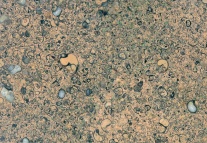
The best known is undoubtedly Purbeck Marble a dark greenish grey, reddish or dark grey fossiliferous limestone that is found only in thin beds on the Isle of Purbeck in Dorset. First exploited by the Romans, there are few medieval cathedrals and churches of southern England that do not have some Purbeck Marble decoration in the form of columns, coffin lids, tombstones or fonts (such as Salisbury, Ely, Llandaff and Winchester). Cathedrals as far afield as Lincoln, York, Beverley and Durham as well as a number of churches in Leeds also have Purbeck Marble decorative stonework.
 |
||
| Purbeck | ||
 |
||
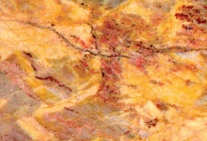
| Petitor | ||
 |
||
| Derby Fossil |
Purbeck Marble is, however, very much a southern stone. Elsewhere, other limestones were often exploited for such decorative work. In northern England, at Weardale, a beautiful black limestone studded with large white corals, known as Frosterley Marble, appears in Durham, York and Norwich cathedrals and in a number of churches in Yorkshire, such as St Mary’s in Beverley and St John’s in Leeds. In more recent times, Frosterley Marble was used in Bristol and St Albans cathedrals and to provide a pulpit for Bombay Cathedral.
Black limestones were always very much sought after and other later regional examples include the Ashford Black from Derbyshire (worked from the 17th century), Pembroke (coralline), Nidderdale (crinoidal) and Poolvash (black) from the Isle of Man. These native ‘marbles’ had to compete not only with Mediterranean varieties but also with a vibrant trade in the famous Tournai Marble (Belgian Black or Touchstone). Belgian ‘marbles’ were extensively imported around the 12th century for use as fonts and grave slabs in many of our cathedrals and larger churches (Winchester, Lincoln and Ely cathedrals). Black ‘marbles’ from Ireland were also imported, such as Kilkenny Black (crinoidal) and Galway Black (pure black). The expense of importing such limestone meant that occasionally other materials were substituted, for example polished dark grey Swithland Slate memorial slabs are common in some churches in the East Midlands.
More colourful native ‘marbles’ were also widely worked for decorative purposes. Many of the great houses, stately homes and palaces of Britain contain some marble decoration perhaps as flooring or commonly for elaborately decorated fire surrounds. The Dukes of Devonshire, over many centuries, exploited a variety of colourful limestones from their estates in Derbyshire. Houses like Chatsworth, Haddon Hall, Hardwick Hall and Bolsover Castle all contain decoration carved from local limestones such as the Duke’s Red (as at Great Longstone Church, Derbyshire and St John’s Chapel, Cambridge), Birdseye (crinoidal), Rosewood (finely layered) and Muscle Shoal (Bolsover Castle; a shelly limestone from the Coal Measures). Furness Marble, a grey-brown crinoidal variety, was also produced from the Devonshire estates in Lancashire.
The Carboniferous limestones of the Derbyshire area are notable for another famous limestone, the Hopton Wood Stone. This pale, buff-grey crinoidal limestone is still produced and has a long history of use for memorial and ornamental work. It was particularly widely used for the construction of war memorials after both World Wars, and was one of a limited number of stones selected for the manufacture of stone crosses to commemorate the war dead in tens of thousands of graves across Europe and further afield in North Africa.
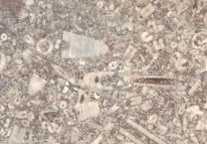
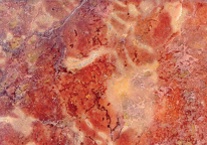
Other local ‘marbles’ include the buff coloured, coarsely fossiliferous crinoidal limestone beds such as Monyash, Derby Fossil (Derbyshire), Swale Dale Fossil, (Yorkshire) and Orton Scar (Cumbria); the grey to buff, white veined Mumbles variety from Swansea; and the grey-brown, veined Penmon and Halkyn (crinoidal) marbles from North Wales.
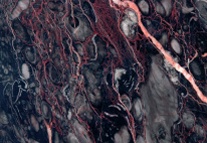
During the 19th century some of the most important sources of native ‘marbles’ were the limestones outcropping in the Plymouth, Ipplepen and Torquay areas of Devon. Though still not true marbles they commonly show fabrics and textures which suggest they have locally been subjected to the high pressures and temperatures associated with earth movements in this area. These compact limestones show a wide range of colours from light grey to black with shades of red, cross-cut by veins of white, yellow and red. They are often characterised by a variety of large fossils (corals, crinoids, bivalves, stromatoporoids and ammonoids) and consequently sometimes termed Madrepore marbles (coral-rich), but may also be veined, fractured or brecciated and when polished produce a wide range of distinctive marble-like textures and patterns. They are known by a variety of local names (26 or more) including Plymouth (black, grey and red), Petitor (yellow pink and grey), Ipplepen (reddish grey and white), Radford, Ogwell and Bradley Woods. The best known are probably those of Ashburton (dark grey to black, coral-rich with red and white veining). Fine examples of their use can be seen in Keble College Chapel at Oxford, Chichester Cathedral (Ashburton) and Brompton Oratory (Radford).
 |
||
| Ashburton | ||
 |
||
| Penmon | ||
 |
||
| Alabaster |
Locally important in some parts of Britain were thin beds of fossiliferous limestones that were hard enough to work for decorative or ornamental purposes. The obvious added value of a good polished stone meant that many such limestones formed the basis of small local industries and commonly appear in local churches and houses. Some examples include Ledbury Marble (mottled red, purple white and blue) a coral-crinoid rich limestone outcropping in the Malverns and Cotham Marble from Somerset. Cotham is a buff coloured limestone with dark, dendritic, tree-like mineralised growths, hence its alternative name, Landscape Marble. From the Lower Jurassic rocks came the Ammonite or Marston Marble at Yeovil and Banbury Marble in Oxfordshire; from the Middle Jurassic rocks Stamford Marble and Weldon Rag (Lincolnshire Limestone) and Raunds or Stanwick Marble (Blisworth Limestone) in Northamptonshire. Alwalton Marble was produced from thin shelly limestone beds in the Middle Jurassic succession of the Peterborough area, the best examples of which can be seen in the 12th century tomb of Abbot Benedict at Peterborough Cathedral. The so-called Forest Marble (Yeovil Marble in Somerset; Bowden or Crackement marbles in Dorset) is also a hard, thin, shelly limestone, once extensively used for paving and roofing in Wiltshire and Gloucestershire, but also polished to provide decorative fire surrounds. Fractured limestone nodules (septaria) from the Oxford Clay in Dorset, known as Melbury Marble, were once cut and polished for decorative slabs.
A number of thin bands of blue-grey limestones outcrop in the Weald of south-east England. They were known by a variety of local names including, Sussex, Petworth, Charlwood, Bethersden Small and Large Paludina marbles. These limestones, like the Purbeck Marble, formed in freshwater lakes, and because they contain numerous coiled gastropod shells are commonly confused with it, despite the larger size of the fossils. Unlike Purbeck, however, these Wealden ‘marbles’ were only used locally (as at Canterbury and Chichester cathedrals, and at churches in Arundel, Burton, Horsham, Lavant, Pulborough and Stopham) and are rarely found further afield.
OTHER BRITISH 'MARBLES'
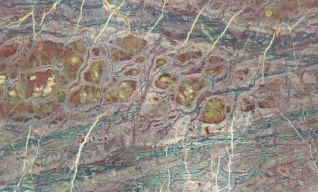
A number of stones which carry the epithet ‘marble’ cannot even be classified as limestones. Draycott Marble (brecciated) was quarried in Somerset. This reddish coloured rock originally formed as an accumulation of coarse, angular limestone and sandstone fragments subsequently cemented together by carbonate and known by geologists as a breccia. The original quarries were recently re-opened to provide new stone for the conservation of Bristol Temple Meads railway station. The metamorphic alteration of some igneous rocks, particularly those of basic composition i.e. those rich in the green mineral olivine and lacking quartz, produces the rock type commonly termed serpentinite. The Mona Marble from the Pre-Cambrian Mona Complex at Roscolyn in Anglesey is variegated dark green, white veined serpentinite (a metamorphised gabbro) that was apparently the basis of a small London-based industry in the early 19th century. Polyphant from Launceston in Cornwall is also a dark green serpentinite (a metamorphosed picrite) which, when polished, has a rich, marble-like finish. It was used decoratively in many local churches and can be seen in Truro, Canterbury and Exeter cathedrals.
 |
|
| Serpentine |
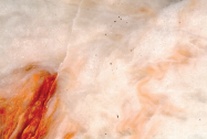
Alabaster is often confused with marble. Alabaster is a hard, compact, finely crystalline form of gypsum (calcium sulphate) which is usually white, translucent or mottled red in colour. Although beds of gypsum are common in the Triassic successions of Britain, the alabaster variety, used for carved ornamental work is much rarer. The most important sources of alabaster for monumental work were along the Nottinghamshire-Derbyshire border at Chellaston and Red Hill, and at Fauld in Staffordshire. Alabaster from the Derbyshire pits was carved into a large number of fine medieval sepulchral monuments, for export around England and to France. Local churches in the East Midlands include many fine alabaster figures and carvings as tomb monuments (Swarkestone, Radcliffe-on-Soar and Bottesford for example) as do several of our cathedrals (Lichfield, Canterbury, Worcester and Southwell). Alabaster from these pits was also used for the massive white and red mottled columns of Holkham Hall (the so-called Marble Hall) in Norfolk and Kedleston in Derbyshire. In the 19th century architects like Robert Adam produced fire surrounds carved from white alabaster.
MARBLE COLLECTIONS
The wide range of colours and rock fabrics that characterise British marbles make their identification something of a problem to the untrained eye. There are fortunately, however, a number of outstanding collections of European marbles in Britain which should be the first port of call if identification is a problem. The largest collections are held by the Natural History Museum in London and the Oxford Museum of Natural History. In addition to these collections, both buildings have used marbles for decorative effect in the original Victorian display areas.
The Natural History Museum’s Collection of Building and Decorative
Stones includes over 4,000 polished samples from international sources,
representing the use of marble since the mid 19th century. It is hoped
that a searchable database of digital images of these specimens will
be available on the Internet by 2002. The Oxford Museum houses
the famous Corsi Collection of European marbles and the Watson
Collection that includes many British varieties. As an added bonus,
the museum also has a fine display of clearly labelled marble columns
lining the corridors surrounding the main gallery. Both these collections
can be viewed by appointment with the curators. Though not strictly
a collection, the wide range of marbles used to decorate Westminster
Cathedral provide one of the few British examples of decorative
marble-work on a scale to rival the great churches in Rome.
~~~
Recommended Reading
- RL Austin, Mumbles Marble and its Association with Swansea and District, Minerva, Journal of Swansea History, 1999
- JA Ashurst and FG Dimes, Conservation of Building and Decorative Stone, Vol 1 Butterworth-Heinemann, 1990
- JG Blacker and M Mitchell, The Use of Nidderdale Marble and other Crinoidal Limestones in Fountain’s Abbey, North Yorkshire, The Leeds Philosophical and Literary Society, 1998
- JM Tomlinson, Derbyshire Black Marble, Peak District Mines Historical Society Special Publication No 4, 1996
- J Young, Alabaster, Derbyshire Museum Service, 1990