
Sourcing Roofing Slates
Terry Hughes
 |
|
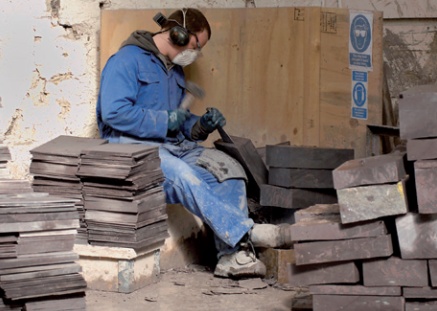
| Splitting Welsh slates for roofing (Photo: Welsh Slate Ltd) |
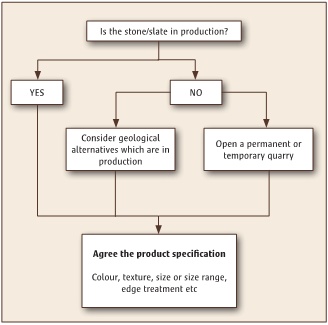
While the process of identifying and obtaining the appropriate slate or stone for roof repairs is sometimes straightforward, it can turn into a long and interesting journey. Which route you take will depend on whether the required material is still in production and, if not, on whether its source can be identified and production reestablished either temporarily or permanently.
It is important to obtain authentic material for historic repairs for both aesthetic and environmental reasons. Ideally, the same slate or stone should be sourced from the same quarry or from a nearby and geologically similar source.
If the slates or stone-slates are still in production and the quarry is using traditional methods, little more is required than to specify colour, thickness, size (or size range for random slates) and quantity. It is always wise to agree a delivery date, especially when dealing with small producers who may not be able to cope with a sudden increase in demand.
All metamorphic slate quarries have adopted some modern production techniques and as a result the range of products and some of their characteristics may have changed. However, they will all produce traditional sizes and styles on request. The key to success with unusual slate is to agree a specification with the quarry.
The roofing companies listed below cover most of the traditional sources. Attempts are being made to re-open slate quarries at Swithland in Leicestershire and, in Scotland, at Ballachulish and at Foundland in Macduff.
| METAMORPHIC SLATES | |
| Gwynedd | Welsh Slate |
| JW Greaves | |
| Twll LLwyd | |
| Cumbria | Burlington |
| Honister | |
| Hodge Close | |
| Cornwall | Delabole |
| Mill Hill & Trevillet | |
Many stone-slates are available but because their production never really moved from vernacular to supplying on a national scale, the operating delphs (or small-scale quarries) are more numerous but much smaller than for slates.
| SANDSTONES | ||
| Northumberland | Ladycross Stone Co | Carboniferous Coal Measures |
| Cumbria | Alston Natural Stone | Carboniferous Millstone Grit |
| Herefordshire | Pennsylvani and Grigland Quarries | Devonian: Old Red Sandstone |
| Black Hill Quarry | Devonian: Old Red Sandstone | |
| High House Quarry | Devonian: Old Red Sandstone | |
| Sussex | Historic Horsham Stone | Wealden |
| Caithness | Caithness Flagstone: A&D Sutherland Ltd | Devonian: Old Red Sandstone |
| Caithness Stone Industries | Devonian: Old Red Sandstone | |
| Angus | Denfind stone may soon be able to produce Carmyllie roofing | |
| LIMESTONES | ||
| Cotswold Region | Goldhill Quarry | Jurassic Forest Marble |
| Knockdown Stone | Jurassic Forest Marble | |
| Downs Stone Co Ltd | Chipping Norton Limestone | |
| Cotswold Stone Quarries | Jurassic: Fullers Earth and Taynton Stone | |
| Cotswold Stone and Tile | Jurassic Forest Marble | |
| Natural Stone Market Ltd | Jurassic: Fullers Earth and Taynton Stone | |
| Soundborough Quarries Ltd | Jurassic Fullers Earth | |
| Isle of Purbeck | J Suttle Quarries | Jurassic Purbeck |
| Lander's Quarry Ltd | Jurassic Purbeck | |
| HF Bonfield & Sons | Jurassic Purbeck | |
| Cobbs Quarry | Jurassic Purbeck | |
| Harden Bros | Jurassic Purbeck | |
| Keates Quarry | Jurassic Purbeck | |
| D&P Lovell Quarries | Jurassic Purbeck | |
If a slate or stone is no longer produced it may be possible to re-open the original quarry or a new one nearby. This has been done many times in the Cotswolds region, the Welsh Marches and in the Pennines. The first step is to identify the rock type. Most local authority building conservation departments will know what stones have been used in their region in the past but if the identity of the required type of stone is still a mystery, a geologist will be able to help. The Stone Roofing Association or specialist books will also be useful (see the recommended reading section at the bottom of the page).
The Strategic Stone Study The English Heritage funded Strategic Stone Study is in two parts. The British Geological Survey is developing a database of quarries using Ordnance Survey maps and other records from the 19th century to the present day. In a parallel initiative, historic building specialists and geologists are gathering as much local knowledge as is available on building stones and the buildings in which they have been used to add to the database. The data is being compiled on a county basis and will be uploaded to a free access website to be hosted by The British Geological Survey (www.bgs.ac.uk) starting in Autumn 2009. |
Once the stone has been identified, the location of the old quarries will need to be researched. This should start with a literature search: the British Geological Survey (BGS) publications, the BGS library and local historical groups will be the best sources. English stone-slate and Scottish slate sources are well researched (see the author’s ‘Stone Roofing in England’ and JA Walsh’s Scottish Slate Quarries in the recommended reading section) and the list of specific sources for the former will be expanded when the English Heritage Strategic Stone Study is complete. There are many books about the old Welsh slate quarries but a good overview is provided in AJ Richards’ A Gazetteer of the Welsh Slate Industry.
Once the historic sources have been
identified it will be necessary to walk the
ground. The amount of work involved will
vary enormously. When the nave of Pitchford
church was re-roofed in 1999 the fieldwork took
only two days, whereas researching the old
stone-slate quarries in Derbyshire and the Peak
Park covered 196 delphs and took
six months.
The objective is to shortlist sites which might still have workable rock. Confirming this will involve trial digging or core drilling. The former will usually be suitable for stone-slates, which are typically found in shallow beds. In the case of slate, deeper rock always splits more thinly and lasts longer, so core drilling is appropriate. Whichever method is used, the rock should then be split to see if it produces suitable thicknesses. Besides establishing the existence of suitable rock, the investigation should be designed to define the size of the resource (area and bed thickness) and the depth of the overburden (the unusable rock which will be used later to backfill the quarry). The latter is critically important: it is expensive to remove overburden and can make or break an operation.
 |
 |
|||
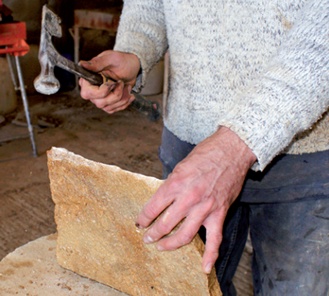
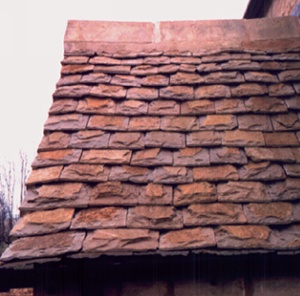
| Above left: the way in which stone-slate edges are dressed is regionalised and is crucial to the roof’s appearance. Above right: Although it can be acceptable to saw the slates to size, the square-cut edges must be completely dressed off. Stone-slates which look like this are never acceptable. | ||||
It is very likely that the completed research
will have identified a fairly small area in
which suitable stone is available. Hopefully,
it will have an amenable land owner and an
entrepreneur will be found willing to risk the
cost. The next step is to obtain a technical
assessment of the stone from a building stone
geologist. Although this will not be an infallible
indication of durability, it will almost always
identify serious problems with the stone.
Once all of these steps have been completed,
an application for planning permission can
be prepared. It will be critical to be able
to demonstrate the need for the products,
although this may be unquantifiable. Early
discussions between the applicant and the local
authority’s building conservation and minerals
planning departments will solve many of the
issues which could
delay the process later on.
Two of the most important issues will be environmental protection and controls on production. Common sense should prevail in both cases. Limitations such as the location of the delph, the types of product that it can supply, and the quantities it can produce should be realistic. In some cases, in order to protect a skyline, delving has been restricted to an area where there turned out to be no suitable rock. The main constraint on quarrying is not negotiable: regardless of environmental or planning objectives, slates can only be obtained where there is suitable rock.
 |
|
|||||||||||||
| Whichever route is adopted for sourcing a roofing slate or stone, it will always involve agreeing a product specification with the producer. | ||||||||||||||
 |
||
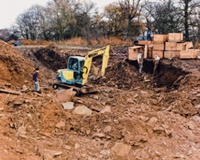
| Delving for stone-slates is usually shallow and always small-scale. The Harnage stone delph for re-roofing the nave of Pitchford church was worked for only seven weeks. Planning permission has been renewed ready for the next of the remaining 20 Harnage roofs. | ||
 |
||
| All quarries will make special slates for building conservation: this 1m x 1.5m Patent
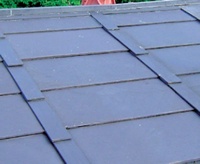
slating from Welsh Slate’s Penrhyn Quarry was produced for St Michael in the Hamlet, Aiburth, Liverpool |
If it proves impossible to source a local stone, an alternative source may be suitable. The most appropriate would be one from a very similar geology. Carboniferous Pennant sandstone slates from South Wales or around Bristol are currently unavailable so some carboniferous sandstones from the Pennines have been used in the past few years although, again, a product specification is essential, especially for the edge dressing. Care is also needed to ensure the weathered appearance matches the original stone.
If the slates or stone-slates are produced from a new quarry it will be important to check whether they will be durable. Slates should be checked against EN12362-1. This process was described in The Building Conservation Directory article ‘Testing Roofing Slates’ in 2004. Since then further guidance on the level of conformity which is suitable for the UK has been adopted by the National House Builders Council. Similar advice will be published by the National Federation of Roofing Contractors later this year.
For stone-slates the situation is not so straightforward because there is no formal quality standard. The best evidence of durability is experience in use. If the source is completely new it would be wise to expose the stone-slates to the weather for a trial period. This testing process was used prior to the re-roofing of Dore Abbey in 2002. The stone-slates were stacked on edge on pallets and left exposed to the elements through one summer and one winter. A few of them cracked and were replaced by the supplier but the remainder were installed and have performed completely satisfactorily. Once a track record has been demonstrated this precaution can be dispensed with.
This may seem to be a long and tortuous process but it has been successfully carried out many times over the past ten years and there is plenty of help and advice available. The key to success, however, remains the involvement of a group of committed local people with the willingness to see the project through.
Recommended Reading
- G Emerton, The Pattern of Scottish Roofing, Historic Scotland, 2000
- English Heritage, Stone Slate Roofing, Technical Advice Note, 2005
- English Heritage, Identifying and Sourcing Stone for Historic Buildings, Technical Advice Note, 2006
- English Heritage, Mineral Extraction and the Historic Environment, 2008
- D Hart, The Building Slates of the British Isles, Building Research Establishment, Watford 1991
- TG Hughes, ‘Stone Roofing in England’ in C Wood (ed), Stone Roofing: Conserving the Materials and Practice of Stone Slate Roofing in England, English Heritage Research Transactions Vol 9, 2003
- TG Hughes, ‘Vernacular Slate and Stone Roofs in England’ in P Doyle et al (eds), England’s Heritage in Stone, English Stone Forum, Folkestone 2008
- TG Hughes, ‘Testing Roofing Slates’ in The Building Conservation Directory 2004 (available online here)
- TG Hughes, ‘Sourcing Stone for Building Conservation’ in The Building Conservation Directory 2006, (available online here )
- AJ Richards, A Gazetteer of the Welsh Slate Industry, Gwasg Carreg Gwalch, Llanrwst 1991
- A Sierakowski, Stone slate delphs: a guide to making a planning application for a stone slate quarry or delph, Stone Roofing Association/Institute for Historic Building Conservation, 2005
- Stone Roofing Association, Horsham Stone Roofs, 2008
- JA Walsh, Scottish Slate Quarries, Historic Scotland 2000