
Adhering to the Point
The use of adhesives in stained glass restoration
Roberto Rosa
 |
|
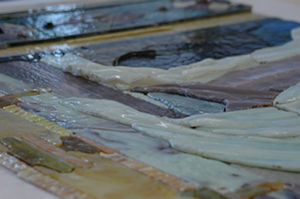
| Stained glass window of an angel by Louis Comfort Tiffany (above); and a detail of the multi-layered construction which is typical of this type of work (below) | |
 |
|
 |
|
| A badly damaged lamb before (above) and after epoxy edge-gluing (below) | |
 |
|
When involved in the restoration of stained glass windows, it is of the utmost importance to retain as much of the original fabric as possible. Modern adhesives make this task easier.
Stained glass windows expand and contract with variations in temperature. As they age the lead matrix deteriorates and the window begins to deflect (buckle), and the glass often cracks due to the stress and pressure imposed by this cycle.
Before new and advanced techniques were introduced to our craft, small pieces of lead were inserted in cracked pieces of glass found during restoration. This is (still today in some cases) good practice, as the responsible craftsman retains the original glass, rather than replacing it with ‘a good match’. The downside of this ‘lead repair’ is that it can, and most likely does, interrupt the original design intent with the extraneous lead lines used to repair the cracked glass. Also, to make room for the lead between the two broken pieces, one of the two pieces may have to be slightly trimmed.
Although, over the years, the basic restoration techniques have not changed much, they have certainly evolved, allowing the conscientious and responsible craftsman to use these procedures for the benefit of the stained glass window being restored. New materials, techniques and procedures have been introduced to our craft, particularly over the past few decades, which have certainly made a difference to the aesthetic outcome. These include: epoxy edge-gluing; silicone edge-gluing and copper-foil repair.
It’s important to know that these techniques differ from each other in reversibility, strength, and visual effect, and to determine the appropriate repair method to be used on a case-by-case basis.
EPOXY EDGE-GLUING
Edge-gluing broken pieces of glass with an epoxy produces a nearly invisible line. This attribute is particularly valuable where focal points of a window such as a face have been damaged. Furthermore, epoxy resins can be tinted with fine pigments to match the glass, reducing the light transmission and refraction. Epoxy can also be used for infusing microscopic cracks.
This technique produces a very strong repair, but will most likely deteriorate in sunlight therefore requiring a secondary glazing to protect it from UV degradation. Epoxy is the least reversible of the three techniques and the most time consuming.
The type of epoxy resin used is not to be confused with epoxies found on the shelves of local hardware stores. It is specifically made for glass conservation. Serpentino Stained and Leaded Glass studio has been using Hxtal NYL-1 epoxy, which is an ultra pure resin that seems to remain clear and transparent over time and with exposure to direct light. Hxtal is supplied in two liquid parts (A and B), both of low viscosity. It is to be weighed accurately, (one part, by weight, of part B plus three parts, by weight, of part A). After the two parts have been weighed into a mixing jar, they must be mixed thoroughly. This part requires a lot of patience and must not be rushed. As the Hxtal is mixed, numerous tiny air bubbles will be seen to rise and pop. This is normal and to be expected, but be mindful that the bubbles will never totally disappear. The best way to eliminate the bubbles is with the use of a small vacuum chamber to suck the air out of the glue. This is called ‘de-gassing’ the glue. Small vacuum chambers are not very expensive and are quite useful.
Freshly mixed Hxtal has a very low viscosity. If it seems too thin, let it stand (covered), and over a period of several hours it will thicken. Thin Hxtal, however, will penetrate cracks making them virtually disappear. The best results are obtained when the glass is warmed to about 49°C/120°F (a hair dryer or some other heat source can be used, taking care that the glass being repaired is not heated too much or too quickly). Since edge-gluing of cracked glass is performed over a light table, I turn on the light table several hours before repairing the cracks. This will evenly warm the glass surface of the light table, aiding the penetration of the epoxy into the cracked glass, as the heat from the light table draws the epoxy into the cracks.
Hxtal sets slowly at about 24°C/75°F. It requires about one week to achieve its final bond strength. However, ordinarily it sets after 24 hours, enough to hold the two parts together as long as no stress is applied to the repaired glass. Any excess epoxy should be removed with a sharp razor blade. The use of solvents is not recommended as they may seep through the epoxy and could have a long-term effect on the repaired piece.
SILICONE EDGE-GLUING
Silicone has very different properties from epoxy and provides a useful alternative for edge-gluing. This repair technique has the lowest strength of the three methods and should be used when a flexible joint is desirable. For instance, in situations where the window will be under continuous stress or in the case of plated, multi-layered windows such as ones designed and fabricated by the American renowned artists John La Farge and Louis Comfort Tiffany. As all components of a building expand and contract, so do stained glass windows. In the case of plated, multi-layer windows, as glass is stacked on top of each other, during the expansion/contraction cycle it is best to have a repaired crack that flexes with the expansion phase, so that it can return to its original position unaltered following the contraction phase of the cycle.
 |
||
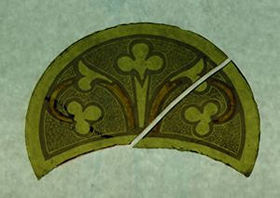
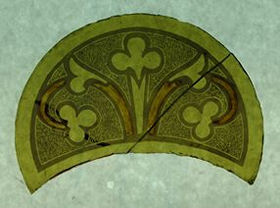
| Copper foiling, before (above) and after repair (below) | ||
 |
||
 |
||
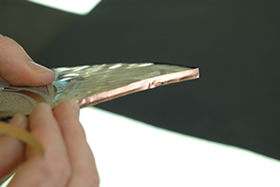
| Copper foil being applied | ||
One of the benefits of using silicone to repair cracked glass is that it is easily reversible. A sharp razor blade and some acetone will easily remove the silicone from the edges of the glass. An important factor to be understood is that silicone repair (edge-gluing), is not the same as smearing silicone over the surface of the glass, thus covering the crack. Silicone is almost as clear as epoxy, but it refracts light differently, making it detectable at times. The same coloured pigments used with epoxy, can be used with the silicone method reducing the light transmission and refraction.
I particularly like to use silicone for glass repair when working on opalescent glass windows. A variety of small batches mixed with dyes of different colours can be easily mixed and manipulated to match the depth and hue of the opalescent glass and its marble-like striations and appearance for which it is so well known. Unlike Hxtal epoxy, UV light does not affect silicone; therefore, a secondary glazing to the exterior is not necessary. For the last 12 years, I have been using, with excellent results, clear silicone RTV 732 by Dow Corning. They supply it in small 2oz tubes, which makes it easy to work with, with little or no waste.
COPPER FOILING
The technique with the longest history is copper foiling, and this is generally the best option when a piece of glass has only one or two cracks. Copper foil is a thin adhesive tape which is applied along each side of the cracked piece, trimmed to a minimal width on the surface of the glass, and soldered. The Tiffany Studios introduced copper foil to stained glass craft where it was used for the manufacturing of their lamps as well as in their stained/ opalescent glass windows, especially in and around organic, nature scenes. The craftsmen of the Tiffany Studios mastered the use of copper foil, producing extremely thin lines within their lamps and windows. As restorers, we adopted their technique and material within the restoration field. Copper foil produces a strong repair, is totally reversible and has a negligible aesthetic impact. The final repaired crack should have a thin line no more than 1mm in width.
All three methods are recommended for the repair of cracked glass during restoration. It is the craftsman’s responsibility to examine the entire project and the relevant issues at hand before deciding which method to use on each piece. The most important factor is that each method is reversible. As a craftsman, I look forward to the future and for new techniques and materials to evolve in this ‘old craft’ of ours. As long as we keep an open mind, and are willing to learn, we will be able to restore and preserve our beautiful stained glass windows and their history for generations to come.
~~~
Recommended Reading
- R Newton and S Davison, Conservation of Glass, Butterworth-Heinemann
Ltd, Oxford, 1989
- Y Shashoua and D Ling, ‘Comparison of Fynebond, Araldite 2020 and Hxtal Nyl-1 Adhesives for Glass and Porcelain Conservation’, Conservation News, 66, 1998