Stanley Park
and the Gladstone Conservatory, Liverpool
Adrian Pearson
 |
|
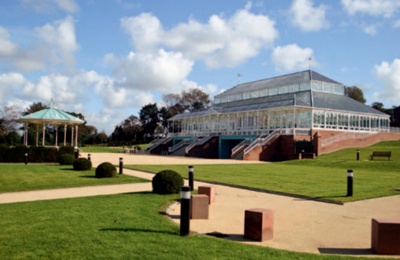
| View of the restored conservatory and bandstand in its new landscape setting |
Stanley Park, a Grade II registered landscape, is located some two miles north-east of Liverpool city centre in a predominantly late-19th and 20th-century residential area. The site is approximately 45 hectares, and slopes away from its southern boundary.
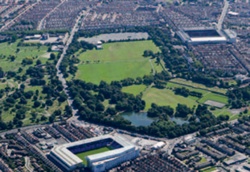
The park’s surroundings are dominated by the football stadiums of Liverpool Football Club and Everton Football Club. Liverpool’s ground, Anfield, abuts Anfield Road on the Park’s southern boundary, while Everton’s Goodison Park lies across Walton Lane beyond its north-west corner.
STANLEY PARK
Stanley Park was one of three municipal parks conceived together in the mid-19th century to provide Liverpool with attractive open space for citizens of all classes, but specifically for the working class. At that time the city was growing at a phenomenal rate in a generally unplanned and uncoordinated manner. Public open space was extremely limited. The successful development of the highly influential Birkenhead Park (1843-7) by the towns’s local rivals provided the spur for the development of a grand plan to form a ring of parks around the city limits. Although not fully realised, the plan’s outcome was the creation of three great Victorian municipal parks: Sefton in the south (André and Hornblower, 1872), Newsham in the east (Kemp, 1868) and Stanley in the north (Kemp and Robson, 1870).
Stanley Park is arguably the most architecturally significant of the city’s parks. The park and adjacent Anfield Cemetery were designed by Edward Kemp, a pupil of Joseph Paxton who had assisted with the design of the landscape at both Chatsworth House and Birkenhead Park. His proposals combined many of the features laid out at Birkenhead Park and Sefton Park. The result was a superb composition of three distinct zones (formal, informal and ‘picturesque’ landscape), carefully and subtly interrelated, that exploited the south to north fall of land across the site. Kemp’s plan was enhanced by the successful fusion of landscape and built form through the buildings and structures designed by ER Robson, then the city architect. The partnership proved very successful and led to further collaborations (including Saltwell Park in Gateshead) before Robson went on to become the school boards architect for London.
Stanley Park was formally opened on Saturday, 14 May 1870 to great acclaim. The event was sufficiently grand to secure coverage in the Illustrated London News (28 May 1870), which reported:
Stanley Park which was formally opened by the Mayor Mr Joseph Hubback on Saturday the 14th inst will be a valuable boon to the inhabitants of the north end of the town... The ground taken for this new Park is very high, commanding a panorama of South Lancashire and Cheshire with the sea coast: the distant mountains of North Wales as far as Snowdon on the one hand: the mountains of Westmorland and Cumberland on the other: some of the North Yorkshire Hills: Blackstone Edge and the Peak of Derbyshire: but the last of these are often obscured by the smoke of the factory districts. The park is greatly laid out with a terrace, lawns and shrubberies, a lake and bridges over it arranged by Mr Kemp; landscape gardener of Birkenhead.
Sadly, the impact of the original layout had been greatly diluted by subsequent alterations, which have almost entirely been made without consideration or sympathy for Kemp’s aims. These changes included the insertion of bowling greens and tennis courts as well as the use of a large area of the ‘middle ground’ for football pitches, all contributing to the loss of clarity of Kemp’s vision.
 |
||
| Aerial view of the park with Goodison (Everton FC) in the foreground and Anfield (Liverpool FC) in the top right (English Heritage) | ||
 |
||
 |
||
 |
||
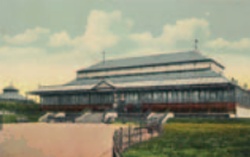
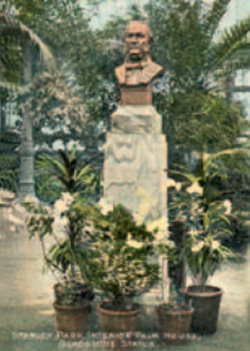
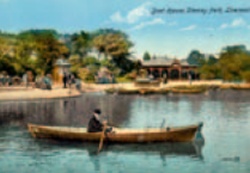
| Historical postcards from the park’s heyday (Liverpool City Council) |
The buildings and other structures in the park were originally set within a carefully composed and balanced landscape but its fabric and integrity have suffered, as have the built elements it incorporates. Tree planting, predominantly concentrated along the park’s northern and western boundaries, had been poorly managed over many years resulting in the loss of many fine views, both within and out of the park. The landforms remained much as they were laid out by Kemp, although insensitive re-grading around the lakes had created an inward looking and detached zone, cutting off views and compromising pedestrian safety.
Through the latter half of the 20th century the landscape and structures fell victim to the cycle of chronic underfunding and endemic misuse that has affected many municipal parks. This was exacerbated by well-intentioned but ill-advised changes to the structure of the park and its facilities. Not long after opening, one of the lakes was filled in, presumably in response to a problem with the lake lining. A sunken garden (the Audley Gardens) was created and furnished with statues depicting characters from fairy tales and mythology donated from a Liverpool benefactor, George Audley. From 1923 until the early 1960s an outdoor swimming pool occupied a section of the original lake formation.
Later, the brutal design of the leisure facilities on the eastern section of the park delivered an unsightly backdrop to the decaying historic features of the central core. Finally, an attempt to reuse the conservatory as a public house only hastened its demise and encouraged misuse of the western end of the terraces.
Outside the three zones of the park’s original core a fourth component, the eastern park, was of considerably less interest. Not only did this section fit awkwardly with Kemp’s historic core, it had been subject to the most aggressive change. The area was dominated by the large municipal sports hall previously mentioned and now demolished, accompanied by a vast expanse of tarmac that provided match day parking for the nearby football grounds. This presented the ideal location for the planned new stadium, which in turn would provide the catalyst for the landscape restoration and regeneration of the park.
By the turn of the new millennium little positive activity was being generated by those who were using the park, although it was clearly still much loved by local people. There was an accepted need to change the cycle of misuse and encourage local people to reclaim possession of the park. In other urban parks the value of considered regeneration and proactive management had proved that change was possible. In Lloyd Evans Prichard’s direct experience this had been well demonstrated at Heaton Park, Manchester and at Birkenhead Park. The funding model applied at Stanley Park would need to be quite different to suit the park’s specific requirements and those of the parties directly involved in the regeneration plan.
REGENERATION
In 2004 Lloyd Evans Prichard (LEP) was commissioned to complete a condition and historic appraisal of the buildings and structures within the park landscape. This work formed an integral part of the wider planning application for the construction of the state-of-the-art football stadium on the eastern park for Liverpool FC. The permission for the stadium was hard fought and ultimately granted, but was conditional upon the full restoration and regeneration of the historic core of the park. LEP was subsequently appointed by Liverpool City Council to take responsibility for the restoration of the many structures which decorated Kemp’s landscape. These included pavilions, bridges, the Gladstone Conservatory and a variety of other built elements.
THE PAVILIONS
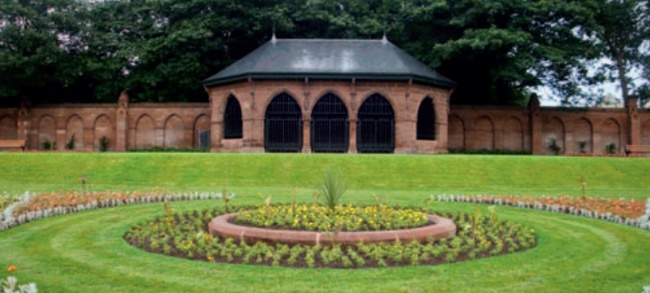
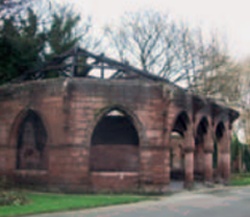
These structures provided shelter along Kemp’s formal terraces and framed the views across the park to the distant landscapes. Constructed in Liverpool’s signature red sandstone, they adopt a simplified gothic style with columns and arches supporting slate roofs. The regeneration proposals included plans for their full restoration in tandem with the provision of new landscape features based on Kemp’s original planting plans.
THE BRIDGES
Kemp’s picturesque landscape included three lake areas crossed by a sandstone bridge and four iron beam composite bridges. These were in varying states of disrepair with the sandstone bridge being shut to the public since extreme vandalism had led to much of the parapet walls being pushed into the lake. The stone was retrieved from the waters and used to provide templates for replacement stone. The bridge was then carefully reconstructed to match its original configuration.
The composite bridges were generally in a better condition but it was necessary to carefully dismantle the structures for restoration to allow for the repair of the corrosion to their iron beams. In due course these were reconstructed with new stonework to match the existing where this was required.
OTHER BUILT ELEMENTS
Other features of the park which were identified in the regeneration plan included the bandstand, boundary railings and walls, the surviving masonry plinth of a long since destroyed boathouse, and a number of smaller Edwardian shelters used in conjunction with the bowling greens and tennis courts. While some of these were considered to be inappropriate in the context of the restored landscape, many were restored and presented in the light of their new setting.
One further major structure presented the greatest challenge in providing a positive benefit to enhance and promote the regenerated landscape, the Gladstone Conservatory.
 |
|
| The restored central pavilion on the formal terrace: new cast iron gates and screens were added to prevent unwanted access when the park is closed. | |
 |
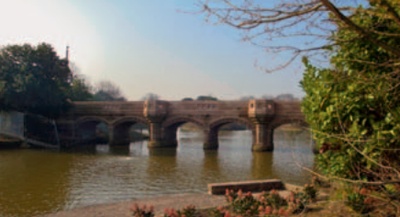 |
| Above left: The restored central pavilion on the formal terrace: new cast iron gates and screens were added to prevent unwanted access when the park is closed. Above right: A view of the restored sandstone bridge following reconstruction of the guardings and refuge detail | |
THE GLADSTONE CONSERVATORY
While this iconic building was not an original feature of the park, its carefully chosen position complements and enhances the westernmost section of Kemp’s formal terraces. The glasshouse was gifted to the park by Alderman Henry Yates Thompson in 1900. Earlier, and presumably for fairness, Thompson also gave Sefton Park in the south of the city an even grander glasshouse, the Palm House. Both are predominantly cast and wrought iron structures by McKenzie and Moncur of Glasgow. The Palm House restoration in 2000 provided a model for the regeneration of the Gladstone Conservatory. Indeed, it was clear that many similar components had been used through both structures although their specific function and form are very different.
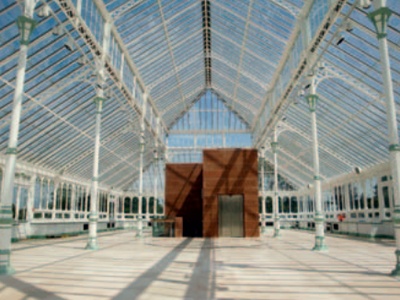
The development of a business plan based on audience development research brought forward proposals for the restoration and reuse of the building as a function and wedding venue with the addition of a permanent café for park users. In essence, the strategy was to carefully dismantle and restore the existing historic iron frame off-site while a contemporary undercroft structure was built to house the ancillary accommodation required to serve the new use. The restored iron frame was then to be re-erected on the new undercroft structure to present the listed building free of any of the modern accretions that would diminish the appreciation of its historic form and volume. The setting of the conservatory and the adjacent bandstand would be subject to a radical reappraisal so that the relationship between the buildings and landscape could be enhanced. In effect, a new precinct was created to lead visitors from the car parking areas through the building and into the landscape. Careful attention to documented evidence of Kemp’s planting plans allowed the landscape architects (Planit EDC) to propose a form and plant types which acknowledged his influence.
Following budget cost approval in November 2005, a detailed survey of the conservatory structure was carried out in December of that year. The aim was to comprehensively analyse the condition of the ironwork and assess the component assemblies that made up the walls and roof. In turn, this would allow the production of a scope of works to provide both a structure for cost control and a specification to guide prospective contractors on materials and workmanship. The survey was carried out over a three-day period in two teams; one assessing the condition of high level elements using a hydraulic platform and one at ground level assessing the lower wall structure.
 |
 |
 |
|
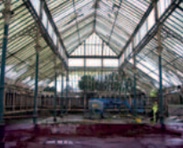
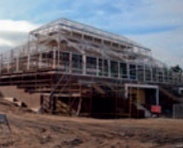
| Main picture: The restored conservatory prior to introduction of loose furniture and tables. The lift housing and stair stand as independent contemporary interventions in the volume of the restored iron framed conservatory. Upper right: Prior to the regeneration the conservatory was a ruinous shell. Lower right: The wrought and cast iron frame was carefully recorded and dismantled for restoration off site in workshop conditions. This allowed the construction of the contemporary basement structure which would provide a café for the park and all ancillary accommodation. The restored frame was then re-erected on its new base. | |
The difficulties of scheduling repairs in such a structure were acknowledged at a very early stage in the process. Having been involved in dismantling three pairs of listed iron promenade shelters in Blackpool, LEP knew that the structure’s true condition would only be revealed once deconstruction and removal of finishes commenced. Through discussions with recognised specialists in this field of work it was resolved that the most appropriate way to manage this would be to break the process down into elements that could be defined and costed (dismantling, re-erection, glazing, painting and so on), while accepting some flexibility within the repair of elements so that the tender figure could be managed as the restoration progressed.
The detailed survey allowed LEP to break down the entire structure into a series of component assemblies. The building is essentially a kit of parts: knowing how the components fit together allows a clear understanding of how best to dismantle and re-assemble it. Based on this detailed knowledge, it was also possible to produce appropriate specifications and costings for the paint and glazing systems and to calculate the contractor’s overheads, scaffolding costs and so on.
This left the restoration of the ironwork as the element of greatest uncertainty. The design team carefully considered methods and proposals for managing this ‘risk’ within a defined contract cost. In effect, the specification dictated the materials and restoration techniques. It was the extent that these would be required that was impossible to accurately forecast with the information available at that stage. The LEP survey had identified a proportion of the structural elements that would require replacement. These were scheduled on a component-by-component basis so that a unit cost for each could be established and an overall cost for ‘new’ identified.
The element of ‘repair’ for each component was also scheduled but it was down to the expertise and experience of the chosen specialist subcontractors to reassess this once deconstruction was under way. This did not remove the risks involved but it did allow the design team to establish and monitor costs as the contract works progressed. This approach placed a great deal of responsibility on the design team to manage the process effectively but it was agreed that this was the best way forward.
 |
|
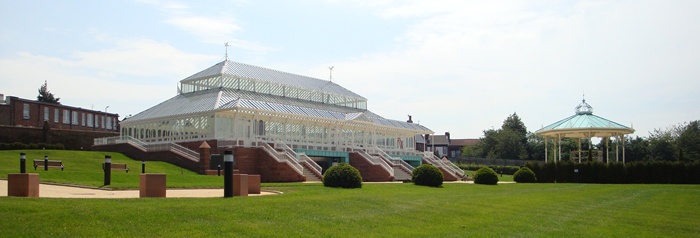
| The restored conservatory and bandstand in the setting of the new landscape precinct |
RESTORATION
The process identified two key areas where materials specification was crucial to success: replacement ironwork and the provision of new glazing. LEP’s investigations confirmed that the structure was a combination of cast iron elements (columns and decorative friezes), wrought iron elements (glazing bars, purlins, and fixing straps) and early steel beams (eaves beams and ridge). In general, the team’s approach dictated the maximum retention of original fabric. Where repairs to elements were required these were to be on a ‘like-for-like’ basis so that wrought iron, for example, would be repaired using wrought iron of a matching quality. However, where replacement of components was necessary this was less straightforward.
Wrought iron is simply no longer manufactured commercially, and only ‘reclaimed’ wrought iron is available. This is difficult to grade and can vary from good quality (ships chains) to poor (reclaimed railings). This clouds the issue of like-for-like provenance. Allied to this, the supply of true wrought iron is variable and few sources reclaim the material in quantity. For this reason it was decided that replacement components should be supplied in a contemporary material. Our research highlighted the compatibility of ‘pure iron’, a modern material with a similar composition, structure and properties to wrought iron. Its use would allow damaged components to be reused as compatible material for like-for-like repairs. All replacement components would be clearly stamped and dated to identify their origin.
The issue of replacement glazing would prove an even more difficult issue to address. In conservation terms the aspirations were to use the most historically accurate replacement glass possible. However, the practical requirements for environmental control and safety would also need to be considered. Given the building’s intended new use, any measures to address overheating in summer and cold in winter could not be ignored. Likewise, the health and safety implications of overhead glazing in a public building needed to be fully acknowledged.
 |
|
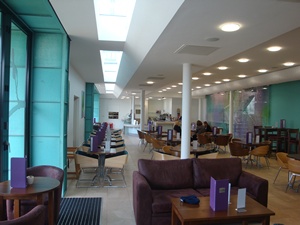
| View of the basement park café which spills out onto the terrace on the north side of the conservatory |
Having used a modern Swiss manufactured glass in a recent conservation project, LEP was aware that it was possible to source slightly textured or rippled glass in large sheets with a nominal increase in the thickness of the glazing system. It was likely that the original glass was approximately 4mm thick. To increase this by any substantial amount would create issues in terms of the rebate depth of the glazing bars and their structural capability.
Through detailed discussions with the manufacturer a system was proposed which used a similar product in a laminated form. Unfortunately, this fell victim to the value engineering exercise that was necessary to keep costs within budget. As a compromise, and with the close involvement of the specialist restoration contractor (Eura Conservation), it was decided to use a modern float glass which is overheated as part of the toughening process, resulting in a slight distortion to its surface finish. The float glass does not match the aesthetic of the more expensive option but its use did address the safety issues and incorporating a solar control safety film on the inside also provided some environmental benefit.
This approach resulted in an overall thickness of 6mm on inclined overhead glazing and 10mm on the low level vertical areas where the use of a more robust material was considered prudent. The structural engineers considered that the existing structure would be more than capable of accepting any increased loading.
The new glass would allow the proposals to keep within the budget constraints and the slight imperfections in its structure would go some way towards delivering the softer look of historic glass. The use of an applied film to address environmental and safety considerations fulfilled the team’s responsibilities to acknowledge the practical issues raised by the building’s new public use.
STANLEY PARK TODAY
The regeneration of Stanley Park means that visitors can enjoy the full beauty of the restored landscape at their leisure and then retire to the conservatory café where modern facilities offer refreshment and comfort. Above this, the restored volume of the conservatory provides a dynamic new venue for a range of functions and uses, from weddings to display and performance. The enhancement of the park’s fabric married to the sensitive incorporation of increased security has provided a safe environment where all can appreciate the quality of the original design. More importantly, the regeneration has restored local pride in, and a sense of ownership of, the park and its structures. The cycle of decline and misuse has been broken and the park is once again the focal point of the community it serves.
THE STANLEY PARK REGENERATION PROJECT Client: Liverpool City Council |