
The Restoration of the 1829 Organ
at St James', Bermondsey, London
Dominic Gwynn
 |
||
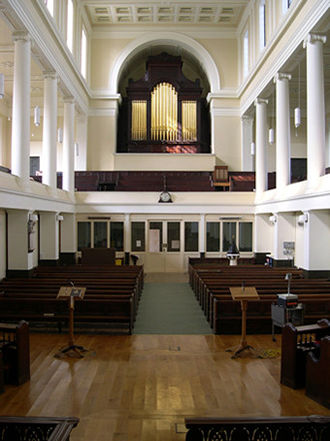
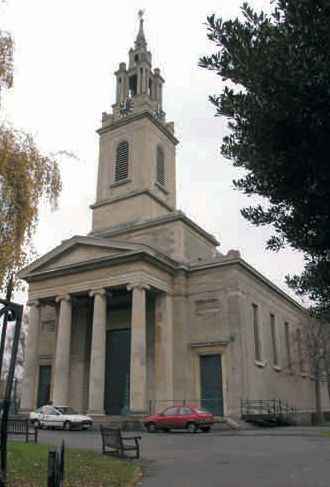
| The magnificent Bishop organ in the west end of St James’, Bermondsey. The exterior view of the church from the west (below). | ||
 |
||
The Church of St James at Bermondsey, which was designed by James Savage, was one of the largest of the new ‘Waterloo’ churches when it opened in 1829, and its organ by James Bishop was one of the largest in the country. While many organs of this period have been modernised either by the Victorians or more recently, this one survived. It remains the most complete example of its kind in Britain, incorporating an early Pedal organ as well as other innovations either unique or most unusual. It is a wonderful survival, providing a fascinating insight into a period of music when church music was becoming more elaborate, classical forms were being expanded for greater expressive content, and the music of JS Bach was being explored for the first time in Britain.
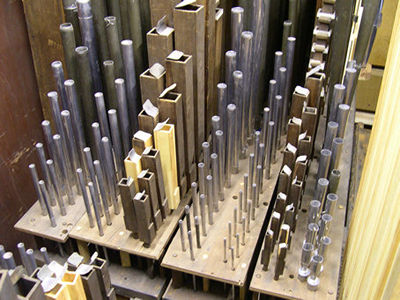
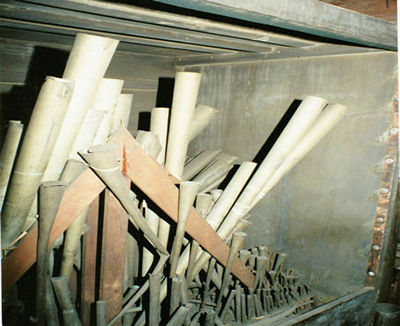
The organ had lain partly dismantled for the last 50 years, but amazingly, most of the original parts survived, at least in part or altered, strewn around the unused spaces at the west end of the galleries of the church. Bishop & Son (as James Bishop’s firm was known by then) had made some alterations in 1877, including turning an organ with a keyboard compass starting at GG in the bass, to one starting at C. In 1975, Bishop & Son restored the Great organ, and in 2002 Goetze and Gwynn restored the whole organ as close as possible to 1829 condition, using all the original 1829 parts that could be found.
The specification and other technical details of the restoration are available on the restorer’s website www.goetzegwynn.co.uk. This article will focus on three recurring issues arising from the organ’s restoration which are relevant to organ restoration in general.
The first issue is that it is always possible to restore rather than replace. It is really a question of money, and the desire to restore, rather than the practicalities of restoring, which determine whether a historic organ is restored or thrown away. The problem for our historic organs is that parts tend to be replaced gradually (as they deteriorate or become out of date), so that it is difficult to tell how much is original. Behind the casework which hides the workings, pipework and mechanism can be altered in a way not immediately apparent to the casual observer or listener. The result, over the years, is that organs which are believed to be historic have lost much of their original character. Many of our attractive old organ cases conceal organs which are a hotch-potch of parts of various dates. They may work as organs, but their fame is spurious.
Goetze and Gwynn find it more exciting to restore an organ in bad condition but unaltered by later builders, than vice versa. At St James’ the organ had indeed been altered, but as little as any example of its date in Britain. It had been altered intentionally, to give what was then a more up to date organ. It had also been altered unintentionally, by pilfering, amateur restoration attempts, and the effects of wear and collapse. The intentional alterations did require some new work, because the original material had been removed, but fortunately the original design was clear, and other surviving Bishop organs provided the details. The console area, for example, including its keys and stops, is partly new, but in original style.
The unintentional alterations provided two challenges. A large number of pipes had been removed (some shortly before the restoration project was due to start). Most of them had been stolen at random, so that matching the new pipes in between the old ones was no great problem. But in other cases, some understanding of Bishop’s original designs for the pipes had to be achieved. That was particularly true of the largest Trumpet pipes and the Cremona (a type of stop which would later come to be known as the Clarinet). Bishop’s reeds in this organ had innovative features which would become the norm in later 19th century organs.
A further challenge was to restore collapsed and damaged pipes which were otherwise unaltered by anything apart from settlement over time. The larger pipes in the Swell had collapsed, and although this looked bad, such effects are superficial. It was clear that once repaired, these pipes would speak as Bishop originally intended. We were particularly fortunate for the largest pipes were so little altered that they even gave us the tuning system for the organ. This proved to be very close to the system which Bishop himself recorded in his records, a system with purer thirds than the usual modern system.
 |
||
 |
||
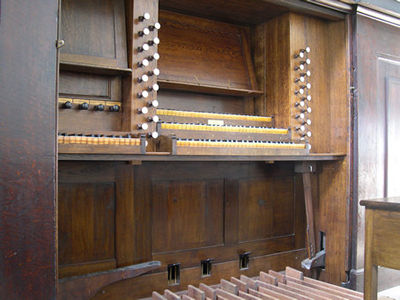
| Parts of the dismantled organ as found, having been stored for the past 50 years (top). The finger keyboard was added for those unfamiliar with the Pedal organ in 1829 (above). The collapsed pipes in the Swell organ (below). | ||
 |
||
The second issue that this restoration illustrates so well is the value of taking each historic organ at face value. Modern life has so many ways of homogenising our experience, that we are increasingly aware of the features which make up the character of historic objects, and value the contribution that they make to our lives for their own sake. We are increasingly suspicious of those ideals which force our experience and taste into a straightjacket. In the case of the organ, one of those periods was the 1960s, when the Bach Revival produced a neo-classical organ style which was claimed by some to be ‘ideal’ for every musical style and function.
Equally wide claims were made for the traditional British organ style, which others claimed was appropriate for all liturgical and musical occasions. In the second half of the 19th century there was a tendency for organs to be built, or to be moved, to an organ chamber next to the chancel in pursuit of the ideal of that time, which was felt by many to be the cathedral service. These universal prescriptions have tended to be applied to organs in similar ways, so that wherever there was sufficient funding, the same tonal and mechanical alterations have been carried out.
It is usually where funding has been lacking that historic organs have tended to remain unaltered. At St James’, we are fortunate that a church which was built in a fashionable area rapidly became unfashionable, thanks to increasing industrialisation in the area. The railway from London Bridge station passes very close to the church. As a result, the alterations carried out to this Bishop organ were the minimum for a parish church organ. It remained more or less intact tonally, mechanically and visually. We are very fortunate that it has survived, and that friends of the church and the organ were on hand to make sure that it was eventually restored, with the help of generous funding from the Heritage Lottery Fund, and other funding bodies, and with considerable effort from members of the congregation. It is probably the oldest organ of this size to be in its original condition, but there are a number of other organs which could be restored in a similar way and to a similar cost. And there are many more which are not so well preserved, but which could be restored to their original condition, either completely or mostly.
The third and final point is that even an organ built at a time of transition can still be useful for modern purposes. There were several features of this organ which were unfamiliar when the organ was made. The most obvious was the Pedal organ, which was so unfamiliar in 1829 that a finger keyboard was added for those unable to play with their feet. If the pedals were required, an assistant was needed to play the bottom line of the finger keyboard, offset on the bass side of the console.
The pedals continue to be the feature most awkward for modern players, not because we are unfamiliar with playing with their feet, but because the pedal keys are in a different position to the usual one, and since players rely a great deal on the keys being in correct alignment, it takes some time to become accustomed to the 1829 position. The same is true of the swell pedal, which is placed to the side of the console rather than being roughly central. It is also only activated when the player’s foot is on the pedal, whereas the modern swell pedal is in equilibrium, and will stay in the position left by the player when he removes his or her foot.
In other respects, this organ is fundamentally the same as a modern classical organ. It has the same kind of stop list, and, generally speaking, the same disposition of stops and keys. For the average parish church service it is as useful and as usable as any modern classical organ would be. In a very resonant church it accompanies hymns as effectively as we would wish, and provides a thrilling vehicle for interpreting solo organ music.