
The Puzzle of St Mary's, Hale
Judith Leigh
 |
|
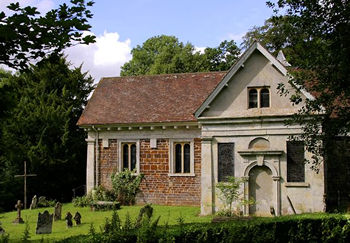
| The bold but simple detailing of the South transept | |
 |
|
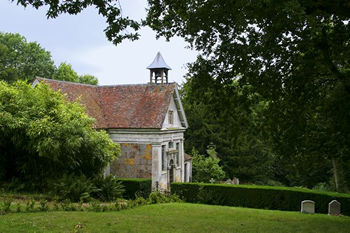
| The North transept with its flourish of volutes on either side of the doorway, features typical of the work of Thomas Archer |
A church has existed on this steeply sloping site probably since pre-Domesday time, but the existing church’s foundations were laid in the 14th century by the neighbouring priory of Breamore. This would have been a simple thatched building; of this little remains except the stone benches surrounding the walls of the nave – the medieval precursor of today’s pews and chairs. But today’s outstanding external features are the splendid Renaissance West front and the Baroque North and South transepts. How did a small village church acquire these remarkable architectural features which take the church into the category of ‘national importance’?
Part of the answer lies in the 18th century owner of the manor house, Hale Park, whose lands adjoin the church. In 1715, the architect Thomas Archer (1668-1743) bought the Hale Park estate from the Penruddock family which had been in residence since 1538. Archer was then approaching the zenith of his career as an architect, and as an astute courtier. Appointed Groom Porter in 1705, in 1715 he became Controller of Customs at Newcastle: both posts brought in good incomes. His architectural credits on the secular side included the North front of Chatsworth House in Derbyshire, the great house at Heythrop in Oxfordshire, garden buildings at Wrest Park in Bedfordshire, Monmouth House and Roehampton House in London. In ecclesiastical architecture, his design and building of St Philip’s, Birmingham (now Birmingham Cathedral) had created a sensation, while in London, St Paul’s, Deptford and St John’s, Smith Square were in the process of being built.
There is no solid evidence as to why Archer bought Hale. He was a Warwickshire man, the grandson of Sir Simon Archer of Umberslade, and he had no direct connection with the area. However, sometime after 1712, Archer designed Hurstbourne Priors in Hampshire for John Wallop (later Earl of Portsmouth) and it is possible that it was then that Archer grew to know the district. So, in 1715, when he started to look for the country estate essential for the 18th century country gentleman, Hale was Archer’s choice. He certainly did not buy it for the existing manor house, which he pulled down and in its place erected a surprisingly restrained Palladian house, very different from his usual Italian Baroque style, but much in keeping with the new fashion beginning to sweep the country. Perhaps the rebuilding of Hale Park was intended to prove that Archer could keep pace with the times, but if so, in the local church, he maintained his passion for the Baroque.
 |
||
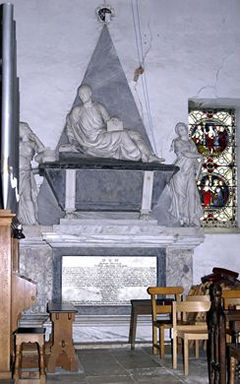
| The magnificent memorial to Thomas Archer which he designed himself was carved by Sir Henry Cheere. |
It is to Archer that St Mary’s owes its North and South transepts. Here are the classic Archer characteristics of mighty pilasters and strongly moulded doorways with heavy keystones and, on the North doorway, a flourish of volutes which frame the semi-circular archway. One unusual factor is that Archer built in an existing local memorial tablet, to members of the Chubb family, in the exterior wall of the South transept. Perhaps Archer had already marked the South transept as the place where his own memorial would stand, and so set the mortuary tone of this section of the church through this subtle inclusion.
However, the West front begins another puzzle. For many years this too was thought to be the work of Archer, and it might so still be argued. But a date of 1683 above the doorway was revealed when a musician’s gallery was taken down inside. This date obviously makes it impossible to be Archer’s work and although the evidence of dates carved over doors is notoriously unreliable, it comes as a relief to be offered the possibility of another hand in the matter. There is something slightly cramped about the arrangement of this front – the blind arch to each side and round window above the door – a little too much ornament in the space. There is a query as to why the doorway is so plain compared to the Baroque flourish of the transept doors, when this is the entrance door to the church. It does not, in short, have the look of Archer about it.
Take Archer out of the equation and one has to think who else might have created such a frontage at such a time. The front does have a striking resemblance to St Paul’s, Covent Garden, built by Inigo Jones in 1630-31. Jones died in 1652, so the date of 1683 rules him out. However, there is a design by Jones for 'Mr Pendruddock’s lodge on an estate in Hampshire' dated 1638. Penruddock was the owner of Hale prior to Archer, so there does seem to be a connection between Jones and Hale. The lodge has either not been identified or was never built but perhaps, in the way of the time, the lodge design was adapted for use at the church. A further intriguing factor is that the church registers state that some type of building work was undertaken in 1631: could this have been the West front? Certainly Jones’ assistant, Isaac de Caus, was hard at work on Wilton House (just 15 miles away) to the designs of Jones at the same time. If this is the answer, the 1683 date might refer to the year the musician’s gallery was erected.
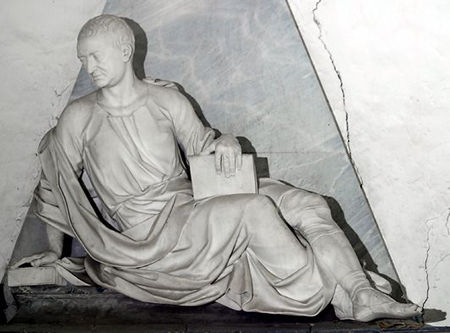 |
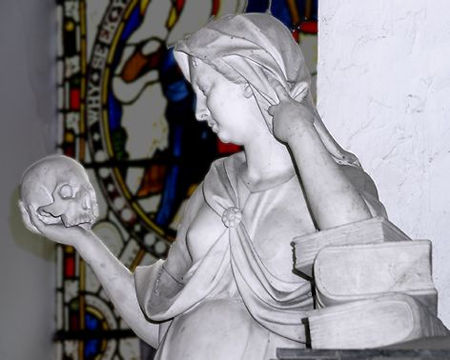
| Details from the Archer Memorial, including Archer's first wife who died within a year of their marriage. She is holding a skull in her hand as she sagely contemplates the fragility of life. |
 |
It is likely that much of the architectural evidence was lost during the extensive 19th century renovation. During this restoration phase, the roof was replaced and a bell cupola of Archer’s design removed. Additional windows and a vestry were added, the original plain ceiling acquired a wooden cover and two extraordinary Wagnerian stained glass windows by Mayer of Munich were added in the chancel.
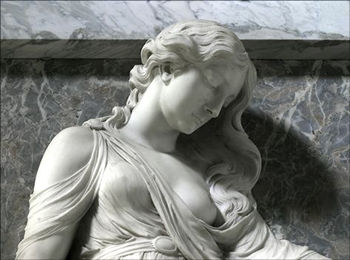
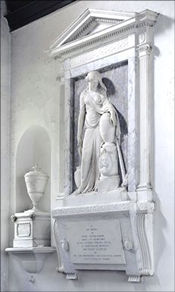
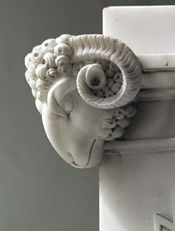
However striking the exterior of the church, an even better surprise awaits in the interior. In the South transept there is an outstanding collection of memorials: the best, inevitably, to Archer. In white and grey marble, Archer as Roman senator reclines upon a sarcophagus, his elbow upon a pile of books. He is flanked by his first and second wives. His first wife, who died tragically of smallpox only a year after their marriage, contemplates a skull held in her hand, while his second wife holds a volume. The monument was designed by Archer and the carving is by Sir Henry Cheere (1703-1781). Below is a wonderful 18th century inscription in Latin, extolling Archer’s virtues (and, delightfully, his looks as a young man). This powerful sculpture would be sufficient to make any church significant, but Hale delights in a further array of outstanding monuments. Archer’s heir, Henry, is commemorated by what Pevsner describes as a ‘thoughtful’ woman by an urn: this extremely graceful composition is the work of Joseph Wilton. The next owner of the estate (Henry Archer had no heir), Joseph May, is remembered by an urn on a base decorated by exquisitely carved ram’s heads. The designer was James Wyatt and the sculptor Sir Richard Westmacott.
The
final puzzle at Hale is: where is the church’s community? The answer is
a mile and a half down the road, where the present attractive village
hugs the edge of the New Forest on one side and a charming green where
ponies roam on the other. One might imagine that, as with so many
communities,
the move away happened at the Dissolution of the Monasteries, when so
many villages lost their raison d’être. In fact Hale’s gradual transition
was caused by the River Avon gradually silting up, effectively removing
its main source of trade and sustenance. From a river-based economy, the
villagers became foresters.
 |
||
| Joseph Wilton’s memorial to Thomas Archer’s son Henry (below, left), draped with a ‘thoughtful’ maiden (above). In the photo on the bottom-left, the urn commemorating the subsequent owner of the estate, Joseph May, can be seen beyond Wilton’s memorial. Stylistic differences between the three memorials illustrate well the different approaches to classical iconography of each generation, from Thomas Archer’s powerful Baroque composition, through the faithful classicism of Palladian architecture preferred by his son, and culminating in the cool, stylised neo-classicism of Adam and (in this case) Wyatt at the end of the 18th century. | ||
 |
|
|
| A detail of one of the exquisitely carved ram's head motifs on Joseph May memorial, designed by James Wyatt and carved by Sir Richard Westmacott. | ||
After 280 years on a sloping site, structural problems for Archer’s work have inevitably been created. The South transept urgently needs to be underpinned to save both the building and the fascinating monuments. The community has, quite literally, a steep task on their hands. It has risen magnificently to the task of gathering money from a small catchment area which faces all the usual rural challenges, and has taken on not only repairs but courageously started work on making the church accessible to all. The Historic Churches Preservation Trust has been pleased to help with the work by awarding the church £3,500 in June 2004 while an additional grant of £1,000 was given from the generosity of the Skaggs Foundation.
Hale church is open at all reasonable hours to visitors. Hale Park house is in private ownership and is not open to the public.
~~~
Recommended Reading
- Marcus Whiffen, Thomas Archer, Art & Technics, London, 1950
- Nikolaus Pevsner, Hampshire, Penguin, 1967
- John Summerson, Architecture in Britain 1530-1830, Penguin, London, 1983
- Margaret Booth-Jones, The Church of St Mary, Hale, Church press, 1971
 |
The
Historic Churches Preservation Trust |
[Editor's note: since the publication of this article, the HCPT has been relaunched as the National Churches Trust. Click here to visit their website.] (HCPT) is a charity founded in 1953. Its main purpose is to help churches in England and Wales that are at least 100 years old and in need of structural repair. Help is primarily provided though grants and loans. There are some 18,000 Anglican parish churches in England and Wales, and very many of other denominations. A lot of them are approaching 1,000 years old; some are even older. Generations of people have given their time, money, skill and strength to constructing these buildings and beautifying them, to the glory of God. Without proper care they decay, and they often need expensive specialist conservation, which dwindling congregations cannot afford. HCPT receives well over 1,000 general enquiries a year, and makes around 350 grants and loans for essential repairs (excluding the restoration of fittings and features) to churches which are in use as places of worship in England and Wales. The average repair bill for a church has risen from £50,000 to £84,000 in recent years and the Trust aims to provide about one quarter of the shortfall, up to around £6,000 after all other sources of funding have been exhausted. Most of its revenue for this purpose comes from donations and legacies. Since 1983 HCPT has also been responsible for running the Incorporated Church Building Society (ICBS), primarily providing interest-free loans and occasional grants to Anglican churches. Originally founded in 1818 to ‘remedy the deficiencies of places set aside for public worship in our towns and cities’, the ICBS is used to assist with the repair of churches (of all ages) and extending their ‘worship area’, although there is still a special ICBS loan fund for assisting with the cost of new Anglican churches. |
|