
Building Stones of the United Kingdom
Francis G Dimes
Stone is a material of variety, nuance and unrivalled durability. Used appropriately and with regard to its nature it can enhance the architectural style of a building and last thousands of years. Geological Consultant, Francis Dimes outlines the geological characteristics of the material and the principles of its selection for use in conservation and restoration work.
 |
|
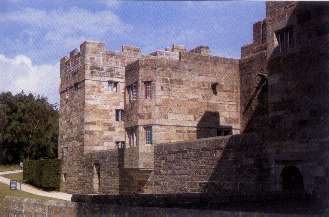
| Granite is the most widely used igneous rock in Britain. It was chosen by Edwin Lutyens for his masterly tour de force of Castle Drogo, Devon, and was quarried nearby. |
Often considered the aristocrat of building materials, stone is arguably the traditional building material of Great Britain. Stonehenge, of a quartzitic sandstone known as sarsen, dates back to about 1800 BC, a lasting testament to its durability. Yet this was a relatively late arrival compared with the magnificent limestone temples of Malta which date back to before 4000 BC, or the stone houses near Jericho, constructed in about 6000 BC.
Any rock, anywhere, has been used for building if only on a restricted local scale. A study of the geological map of Great Britain shows that the country has a great variety of rocks. But not every rock may be used successfully. Thought must be given to its weathering properties and to its nature, which may allow the rock to be worked to a fine surface and detail. It follows that some knowledge of the local geology will be of help in understanding the relationship of a building, the country in which it stands and the stone of which it is built.
Any stone can be placed geologically (and thus scientifically) into one of three groups. Only when the nature of the rocks in these groups is known can the stone be properly used.
Igneous rocks are those which cooled and consolidated from a fluid melt (magma) of rock material. The magma may have cooled quickly to give fine-grained rocks or slowly, to produce coarse-grained crystalline rocks. The nature will depend also on their chemical composition.
Many have been found in Great Britain but only one, granite, has been used on any scale. South-west England and Scotland are the great granite producing areas for building.
Sedimentary rocks were originally deposits of sediment (the eroded material from pre-existing rocks) laid down, mostly, on old sea-floors. When compacted and cemented, sedimentary rocks result. Their composition depends on the nature of the original sediment, but only sandstones (composed of quartz grains) and limestones (chiefly of calcium carbonate) have been used on any scale. In general terms, limestone predominates in southern Britain and sandstone in the north, but some limestones such as Portland stone have been used ubiquitously; and some sandstones, for example York stone are widely used especially for paving.
Metamorphic rocks result from the modification of pre-existing rocks by heat, pressure or both. The one which has been most widely used in Britain is slate. Other indigenous metamorphic rocks have been little used. Slate is found chiefly in Scotland, the Lake District, North Wales and Cornwall.
There are constraints inherent in stone which demand that the material is properly used in accordance with its unique characteristics. Igneous rocks may contain minerals which on exposure to the atmosphere may break down with consequent damage to the stone. Rising salts, also, may cause spalling. Of prime importance with sedimentary rocks is the placing of the bedding plane so that it is at right angles to the thrust imposed upon it. Metamorphic rocks may have deleterious (harmful) minerals present. The greatest restraint in the use of stone is that of the jointing. All rocks are jointed and the size of a block that can be wrought from a quarry is controlled by joints.
Such constraints are minor compared with the benefits: Stone from all these groups, whether used in classical idiom or in contemporary form, will have a durability other materials cannot match, provided it is properly chosen and properly used.
STONE FOR CONSERVATION AND RESTORATION WORK
The first requirement when a stone building is considered for conservation or restoration is to determine the nature of the stone. Many historic buildings will have archival records which should be scanned for references to the source. Where that does not produce any answers a geologist should be consulted to determine the nature of the stone. The next stage, the determination of the 'provenance', the source of the stone, may be much more difficult. Again it is best referred to a geologist with specialist knowledge of the geology of stone for building and decoration.
Once the provenance is established (which may not always be possible), a search of the area for still working quarries then follows. Those quarries in Great Britain known to be producing dimensional stone are listed in The Natural Stone Directory (see the Recommended Reading section below). If the stone is still available, can it be obtained within the time-frame for restoration?; and can it be obtained in suitable sizes? It must also be recognised that stone from a present day quarry, whilst geologically the same, may in fact present a slightly different appearance from stone quarried in the past. Nevertheless, to preserve the integrity of the building, the same geological stone is always to be preferred.
However, it is not always possible to find the stone required. In that event a geologically appropriate stone should be sought, and the re-use of original or reclaimed stone should be considered. Although many masons object to 'second-hand' stone, there appears to be no scientific reasons why the material should not be reused, provided that bedding and other criteria are observed.
The matching of stone from a provenance other than the original is a specialist task. Again, advice should be sought from geologists with experience in this field. It may be necessary at this stage, for thin-sections to be cut for microscopical study, or for X-ray diffraction techniques to be used. Guidance will be given by the specialist.
~~~
Recommended Reading
- Natural Stone Directory, 8th edition, Stone Industries, Ealing Publications Ltd, Maidenhead, 1991
- John Ashurst and Francis G Dimes, Conservation of Building and Decorative Stones, Butterworth-Heinemann, London, 1990
- Alec Clifton-Taylor, The Pattern of English Building, 4th edition, Faber & Faber, London, 1987
- John Penoyre and Jane Penoyre, Houses in the Landscape: A Regional Study of Vernacular Building Styles in England and Wales, Faber & Faber, London, 1978