
Stone Cleaning
Ingval Maxwell
 |
|
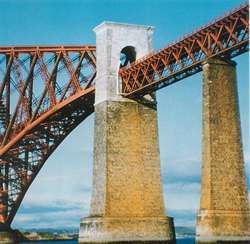
| One of the most difficult problems that can arise as a result of deciding to clean a structure is deciding where to stop. By cleaning the upper part of this bridge only the impression has been created that a totally different stone was used for the treated part. In reality the material has been bleached and discoloured by the chemical used. |
The need to clean a building is commonly perceived as being critical for its well being. Such a physical act is driven by aesthetic considerations often without considering the after-effects or consequences properly. The decision is also frequently made on townscape or streetscape grounds regardless of the physical impact on the actual face of the structure.
Where buildings which are listed or in a conservation area are concerned, Scotland differs from the rest of the country. Here, acknowledging that physical change can occur, stone cleaning has been deemed an 'alteration' since 1992. As a result, all proposals to clean listed buildings now require Listed Building Consent or, in the case of unlisted buildings within a conservation area, planning permission. Such an approach has been determined necessary to ensure that the risk to the fabric is considered and that appropriate damage-limitation measures are adopted.
TYPICAL PROBLEMS
Until relatively recently, cleaning methods generally lacked proper specification and site control. This has resulted in a wide variety of techniques being offered by contractors without due regard to the full consequences of their effect, and usually little or no detailed consideration was shown by manufacturers or suppliers to this need. In attempting to deal with all types of dirt and surface coatings in one treatment, contractors and specifiers catered for worst-case scenarios, and over-treatment was the established norm.
 |
|
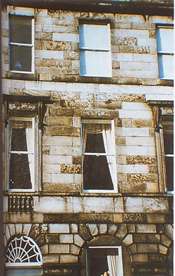
| Understanding the soiling of buildings is critical if cleaning is proposed. Sandstones are particularly difficult to comprehend as soiling can often occur from within the stone, resulting in a variegated appearance at the surface. | |
 |
|
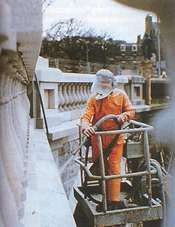
| Where the depth of soiling only extends to a few microns in thickness on the surface, the use of high pressure grit blast cleaning, whether wet or dry, can bite deeply into the historic surface below, destroying the quality of the original banker mason's workmanship. | |
 |
|
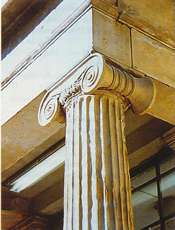
| Early physical cleaning methods, such as the use of rotating discs, were extremely difficult to control. As a result innumerable buildings now display an exceptional degree of surface damage. Viewed at close quarters, the loss of arrisses, irregular shadow effects, disrupted moulding runs and undulating faces typify the consequences. In many cases it is impossible to recreate the quality of the original finish and detail due to the amount of material that has been lost. | |
 |
|
| In much the same way that heavy-handed techniques can remove the surface of stone, considerable quantities of the surface of period brickwork can also be removed. Here, deep scour marks run from brick to brick along the mouldings and there is a general loss of sculpted quality. | |
 |
|
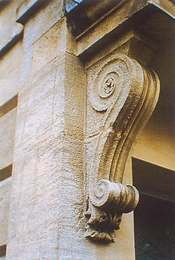
| As a sedimentary rock, limestone which has been cleaned often mirrors the defects created on cleaned sandstone. A general opening up of the natural stratification can produce a blurred and uneven surface, disturbing the once clean lines of fine mouldings. The textured surface is liable to hold a greater degree of water and airborne particles and assists more rapid resoiling. | |
 |
|
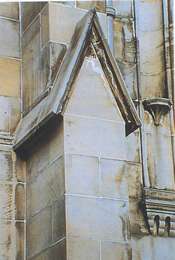
| The wide variations that occur in the mineral content of the different sandstones are often ignored when cleaning is proposed. It frequently comes as a surprise to discover that these factors then manifest themselves after chemical cleaning has been carried out. Not infrequently, this is compounded by efflorescence from the cleaning residue, seen here as wavy white lines under the pediment mouldings. | |
 |
|
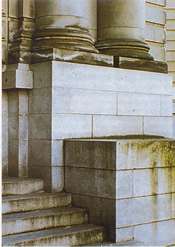
| The use of hydrofluoric acid to clean a sandstone superstructure on top of an inadequately protected granite base can produce some interesting side-effects as feldspars are converted to clays. In effect this makes the granite sufficiently porous to enable biological colonisation. A series of decay contours can be created on the vertical face of the ashlar blocks, and an interaction with the mortar joints and beds can also be found. | |
 |
|
| It has been repeatedly shown that cleaned buildings can attract a
high level of attention from graffiti artists, tempted by the fresh
exposed surface. With the use of highly penetrating aerosol paints,
the applied colours can permeate deeply into the stones structure.
Where attempts have been made to mask the effect by painting over
it, the consequences can be even more complex to remedy. |
In particular, insufficient consideration was given to the wide range of natural materials being dealt with and their relative susceptibility to deteriorate as a result. No building is homogeneous in its construction or detail. Materials such as sandstone, limestone, granite, brick and terracotta are liable to be bound by lime mortar. Some may be used in combination, and other factors such as variations in colour, texture, tooling and form are likely to be met. In many, the composition will vary, and different combinations can lead to the interaction of materials, one with the other. Decay may also be present and different patch repairs, with different substances at different times, may further complicate the issue.
A basic difficulty is deciding where to stop. This can lead to a form of facadism, with only the principal elevation being treated. However this approach has one advantageous side-effect: any change that subsequently reveals itself can be compared against the untreated return faces of the same stones at the extremity of the cleaned area.
The type of soiling also needs to be taken into account. In the cleaning debate, soiling is often pre-supposed only to be an external agent, with particulate deposition and reaction resulting from either wet or dry conditions. Damaging crust-formation can be evident on the surface limestone, but the prospect of benign mineral movement occurring from within the body of sandstone is rarely considered.
Biological surface soiling is equally complex, with bacteria, algae, fungi and lichens each seeking out the appropriate colonisation conditions within which they will flourish. Influencing factors in their growth can include atmospheric and micro-climatic conditions, fluid movement and concentrations, surface roughness and physical changes.
Once the building
has been cleaned, incidents of resoiling, iron mobilisation, efflorescence,
vandalism and graffiti further complicate matters.
THE PRINCIPAL CLEANING METHODS USED
Two fundamental methods of cleaning buildings have habitually been adopted, although a number of specialised techniques have become available in recent years:
Physical methods: these include brushing and rubbing, washing and steaming, wet and dry abrasives, or surface redressing.
Chemical methods: applied as liquids or poultices, these may employ the use of alkaline treatments, acidic treatments or organic solvents, singly or in combination.
Special techniques may promote the use of impregnated sponge, laser technology, ultrasonic equipment, heat lances, gypsum inversion, bacteria, poultices or gels, and surfactants (degreasants or soaps).
Not all treatments are appropriate for all materials, and extreme care needs to be exercised when deciding which system to adopt. Due to the need to minimise the risk of damage, the 'do not clean option' should also be borne in mind.
MEASURES TO BE ADOPTED TO MINIMISE RISK WHERE CLEANING IS ACCEPTABLE IN PRINCIPLE
Determining the actual testing methodology, and the validity of trial area results, can be an elaborate process if it is to be carried out effectively and meaningfully. Topics that should be considered include colour measurements, depth profiling, surface roughness tests, and the use of scanning electron microscopy, determining the petrology (the geological structure of the stone) and pH values, porosity and permeability measurements, before and after test cleaning. Care needs to be exercised when contemplating the consequences of washing chemicals into underlying masonry during rinse-off stages, and the question of how to stop 'wash-in' occurring on porous stone surfaces when 'washing off' chemicals should also be addressed.
Reporting and recording the consequences of tests should lead to a full analysis of results before writing a relevant specification and obtaining statutory consents (if required). Risks may also be reduced by carefully selecting an experienced and suitable contractor; by determining the training and experience of site operatives; by ensuring effective site controls and health and safety precautions; and by the maintenance of adequate site progress records.
PUBLISHED GUIDELINES
To assist
practitioners in this involved area of work, a number of detailed
reports, literature reviews and Technical Advice Notes have recently
been published by Historic Scotland. Based on intensive research,
these publications deal in depth with the cleaning of sandstone
and granite buildings, and the application of biocide to sandstone
facades. Other available material deals with a broader range of
surfaces. At the same time, development work has progressed at
BSI, where the current British Standard (BS 6270) has been under
review.
INDUSTRY REACTION
Industry has responded to this published research material, and developments have occurred with the launch and promotion of a variety of new cleaning methods.
In recognition of the need to use more environmentally friendly and delicate techniques, a number of non-aggressive processes have been released. As the principal areas of concern and risk are at the point of operation, most of the new systems have been designed to make sure that operatives have total control over what is happening. Working with very low water volumes or air pressures, and with a range of nozzles, a variety of new agents are offered. These include spherical nodules of calcium carbonate for use on limestones, and fine particle aluminum silicate for use on sandstones and granites. Calcium carbonate, olivine and calcium silicate abrasives are also available.
Often product-specific
operative training packages are promoted by suppliers, and professionals
are also encouraged to attend the courses to ensure that they fully
understand the correct application of the systems.
SCOTTISH/NATIONAL VOCATIONAL QUALIFICATIONS
A CITB Occupational Working Group is currently focusing on stone cleaning at Level 3 with the intention of producing a Scottish/National Vocational Qualification (S/NVQ) in Facade Maintenance. Although a Level 2 S/NVQ has already been validated, its uptake is poor. The Level 3 S/NVQ is being developed to take into account the need to recognise the operatives' skills in a hands-on capacity, whilst providing some chargehand responsibility for the supervision of others. This initiative is a serious attempt to improve the quality of operators in the field, but it can only work if practitioners demand the use of operatives that are appropriately qualified.
CONCLUSIONS
Stone cleaning
is a complex issue. In the past it has been undertaken without
sufficient consideration being given to the consequences. As a
result, an incalculable amount of permanent damage has been caused
to the country's building stock. How well this point is accepted
greatly depends upon the perceived value of carrying out cleaning
in the first place. For those committed to broader planning and
social benefits, it is possible that no amount of evidence will
shake the belief that cleaning is for the overall benefit of a
building and its surroundings.
Unfortunately,
the health of a building is not determined by an appearance that
might be viewed from a distance, or across the street, but by
what is happening on the actual surface itself. The appropriate
course of action must be driven by establishing what can be accepted
at this level, bearing in mind the long-term effects on the appearance
of the building and its surroundings, not just the short-term
benefits. The adoption of a damage-limitation approach should
also influence the final choice of mechanism or technique.
With a greater awareness of the issues now to hand, there should be no excuse for inarticulate decision-making or specifying. There can be no standard answer offered as to what the most relevant technique might be. All involved must share in the responsibility of getting it right.
|
|
Recommended Reading
Nichola Ashurst, Cleaning Historic Buildings (2 vols), Donhead, Shaftesbury, 1994
Research Commission Investigation: Biological Growths, Biocide Treatment, Soiling and Decay of Sandstone Buildings and Monuments in Scotland (Report and Literature Review, Masonry Conservation Research Group, The Robert Gordon University). Historic Scotland, Edinburgh, 1995
Research Commission Investigation: Cleaning of Granite Buildings (Report and Literature Review, Masonry Conservation Research Group, The Robert Gordon University), Historic Scotland, Edinburgh, 1995
Stone Cleaning: A Guide for Practitioners, Historic Scotland, Edinburgh, 1994
Stone Cleaning in Scotland (5 vols), Historic Scotland, Edinburgh, 1992
Technical Advice Note 9: Stone Cleaning Granite Buildings, Historic Scotland, Edinburgh, 1997
Technical Advice Note 10: Biological Growths on Sandstone Buildings: Control and Treatment, Historic Scotland, Edinburgh, 1997
RGM Webster (ed), Stone Cleaning and the Nature, Soiling and Decay Mechanisms of Stone, (Proceedings of the International Conference, Edinburgh 14-16 April 1992), Donhead, Shaftesbury, 1992