
Stone Cantilevered Stairs
Russell Taylor
 |
|
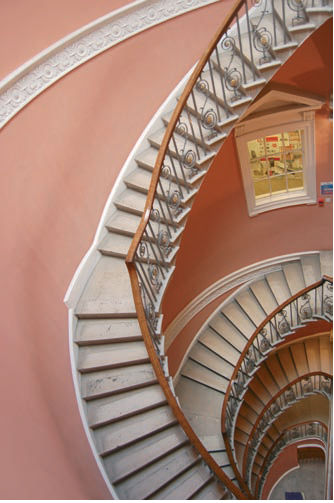
| The Exhibition Staircase at Somerset House (Sir William Chambers, 1775-1795). An 18th century guidebook noted that 'the stair, though winding, is easy and covenient. It has the merit of being contained in a very small space, without prejudice either to its commodiousness or magnificence'. |
Stone cantilevered staircases are not uncommon. Everyone has seen one, usually an elegant, flowing sweep of stairs in an 18th century building, and yet they are still intriguing. Why, you might ask, are there so few 19th century examples in England? And how could a brittle piece of stone project 1,200 or 1,500mm out from a wall without snapping in two? The answer to the latter is that the stone treads are not cantilevers. The term is a misnomer although it remains in common usage.
HISTORY
The first stone cantilevered staircase constructed in England is believed to be Inigo Jones' Tulip Staircase in the Queen's House at Greenwich 1629-35 (below right). It is based on the work of Andrea Palladio who, 60 years earlier, had illustrated various forms of spiral staircases in the first book of his Quattro Libri, which explored the virtues of ancient Roman architecture and inspired generations. In particular he mentioned a classical example which is 'void in the middle' at 'Santa Maria Rotunda' (the Pantheon), Rome. 'Winding staircases', he wrote, 'succeed very well that are void in the middle, because they can have the light from above, and those that are at the top of the stairs see all those that come up or begin to ascend, and are likewise seen by them'. He continued reassuringly; 'I have made a staircase void in the middle, in the monastery de la Carita in Venice, which succeeds admirably'. He thought that stone cantilevered stairs were elegant examples of Roman work, and used them in his designs in continuation of the classical tradition.
Inigo Jones was not generally well served by his craftsmen in the Queen's House, but the craftsmanship of the Tulip Staircase is exceptional. His mason, Nicholas Stone, a craftsmen of great ability and a fine architect is his own right, understood perfectly how to make a cantilevered staircase: not only did he have the visual knowledge that Jones had gained through a study of the works of Palladio, but he also realised how to make it work structurally. Whereas Palladio's cantilevered stairs have treads that merely overlap, in the Tulip Staircase Nicholas Stone formed a 50x38mm rebate along the bottom of the riser - not an obvious or an easy thing to do because the coursing of the stonework is interrupted. This rebate is an important feature of the structural design of a stone cantilevered staircase (see Figure 1). How did Nicholas Stone know of its importance? As far as we know, Stone's use of the rebate was the first in the world, a development crucial for more daring stairs.
 |
|
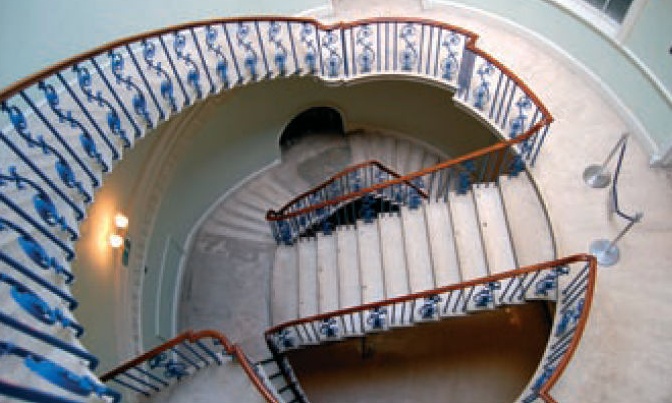
| Above: the Navy Office Stair at Somerset House (Sir William Chambers, 1775-1795). The central flight is supported by an arch beneath. Below right: the Tulip Staircase at the Queen's House in Greenwich (designed by Inigo Jones and executed by Nicholas Stone in the 1630s) |
Ultimately, the riser rebate (which is also known as an 'interlock' or, in Scotland, a 'pencheck') allowed the construction of such great staircases as that of Chatsworth House (1688-91) which projects a stupendous 2.15m out of the wall, compared to the comparatively modest 1.25m of the Tulip Staircase. At Chatsworth the staircase is not a spiral but a series of straight flights connected by quarter landings. With spiral stairs one can, perhaps, imagine all the loads spiralling down the free ends to the ground, but it takes even greater imagination to see how this would work with straight flights and quarter landings.
The subsequent history is easily told. During the 18th century, staircase design became increasingly lighter and more elegant. It also became more daring. It was as if the designers' goal was to have no visible means of support. Until it was arrested by the Victorian Gothic revival, this was the inexorable direction of staircase design. The stairs became a way of implying movement between the static levels of each storey in a classically designed building. The gravity-defying display of William Chambers' Navy Staircase in Somerset House is an inspirational example (below).
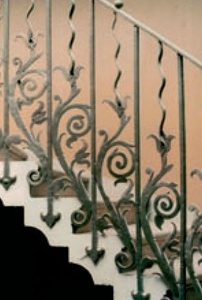
Generally the individual stone treads were rectangular in section in the 17th and early 18th century, then modillion shaped in the mid and late 18th (giving a rippling soffit) and finally triangular in section in the late 18th century and Regency. Balustrades followed a similar route ending with simple wrought iron verticals, as favoured by Sir John Soane, for example.
STRUCTURAL DESIGN
 |
|
An inspection of cantilevered stairs should convince anyone that they are not in fact cantilevering. If they were, the treads would be tailed-in quite a long way, but they are not. The Geometric Staircase in the west front of St Paul's Cathedral is tailed-in 150mm, the staircases at Hampton Court Palace, 225mm, and most early 19th century examples are tailed-in half a brick or 115mm.
This principle is further demonstrated in many London town houses. Often there is a stone cantilevered staircase connecting the main floors and a secondary timber staircase serving the upper floors. Where the stone staircase finishes (usually at second-floor level) the stairwell wall is continued above the level of the top tread as a timber stud wall. Therefore the tailing-in is not used to counteract a cantilever force.
So how does it work? First of all consider plain unrebated treads. At a typical tread in a flight the back edge carries the weight of those above and its front edge is supported by those below. The wall carries the torsion resulting from these two opposing forces (see Figure 1). Clearly the weight increases down the flight. The first (bottom) tread is supported by the floor, so it is the second tread which carries the greatest torsion.
Unrebated treads are usually only found in basement stairs. And it is not difficult to see why: they are often not very wide, they are almost always rectangular in section (and therefore fairly strong in torsion) and sometimes supported by a wall under the free end.
The majority of stairs have riser rebates. Consider a typical tread in Figure 1: any clockwise movement will be resisted by the tread of the lower step and by the soffit of the upper step; any counter-clockwise movement will be resisted by the vertical face of the rebate in the step above and by the back of the step below where it interlocks with the rebate. There are then horizontal forces acting in opposite directions at the top and bottom of the tread. This reduces the torsion in the stone considerably. The stresses are also reduced because the rebate allows the torsion to be carried across the full length of the tread, rather than solely by the restraint from the supporting wall.
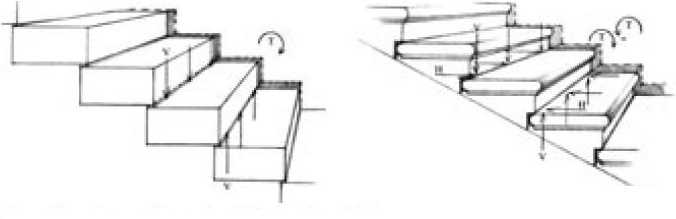 |
| Figure 1: Forces in steps without a rebate (left) and with one (right) |
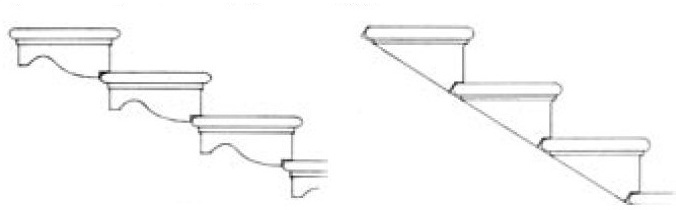 |
| Figure 2: Modillion-shaped treads were fashionable in the mid to late 18th century (left). Simple triangular sections (right) became more common in Regency staircases. |
There are other important advantages of the rebated detail. It allows the treads to act together so that a weakness, or even failure, in one, does not bring about the failure of the whole flight. It also allows the staircase to cope better with any movement that might occur in the supporting wall for some quite independent reason, such as subsidence.
The actual dimensions of the rebate, both horizontally and vertically, do not appear critical, although the smaller they are, the more important the workmanship. Historically, they have been as small as 12mm.
The riser rebate is the key to the design of the most elegant stone cantilevered staircases. Nicholas Stone understood its importance for the Tulip Staircase, and clearly this technique was generally understood and widely used in the period that followed. The exact source of the spark of inspiration or enlightenment which resulted in the riser rebate remains a mystery.
The structure of landings is a little more complicated. As well as being connected to the stair, a landing may span from one side of the stairwell to the other, and in this case its stone slab is clearly not cantilevered. In other cases it may be partially cantilevered where supported across less than half of its circumference or across a corner. But often the slab will be thinner than the treads and therefore inherently less strong. In large and long landings some or all slabs may be potential cantilevers, so they are usually supported on projecting console brackets.
 |
 |
||
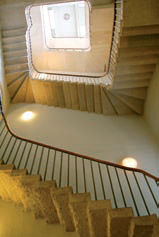
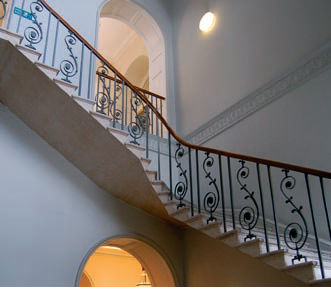
| Above left: Lower flights of the Stamp Office staircase at Somerset House (Sir William Chambers, 1775-1795). The shortness of the flights, the large area of the rectangular treads in section and the comparatively slim width of the stairs meant that it was not necessary to rebate the profile. Torsion is still resisted by the wall. Further up, as the staircase becomes more elaborate, a rebate for the treads becomes necessary to make up for the diminished area of the section. Above right: the Stamp Office Staircase, upper flights. Note that the landing (top left of picture) is slimmer than the overall depth of the tread. | |||
CONSERVATION AND REPAIR
Once a stone cantilevered staircase has been properly constructed, there are generally only three possible causes of failure:
- accidental damage to an individual stone tread or group of treads
- a loss of rigidity either in the wall or between the treads
- weakening by the cutting-in of new nosings.
Accidental damage to an individual stone tread (or a group of treads) may lead to cracking or the loss of a piece of stone beyond the crack. The cause is usually a sudden impact at a concentrated point, such as dropping a piece of heavy furniture onto the stairs. Stone stairs are particularly vulnerable during building work, and a point load from scaffolding should never be applied, even if also supported from underneath. Damaged stairs will not be significantly weakened provided more than a quarter of the tread remains intact at the wall end. Cracks can be stitched together and lost pieces fixed back in place by the insertion of stainless steel dowels and the injection of resin around the dowels and in the cracks.
 |
|
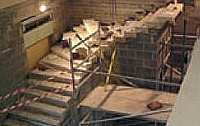
| Cantilevered staircase under construction over temporary blockwork supporting walls. The treads slot into the brick's width cavity in the side wall. (Photo: CWO Ltd) |
A loss of rigidity, either in the wall or in treads may lead to excessive movement between the treads. Stone cantilevered stairs are the exception to the traditional construction rule that everything must be flexible. Here everything must be rigid and the treads must be tightly embedded since if there is excessive movement, particularly where the steps are built into the wall, the torsional forces will not be restrained. In an existing staircase it is probably easiest to ensure that this is achieved by resin injection. Open and cracked joints between treads should be raked out, cleaned and repointed to ensure that every tread is properly interlocking with those above and below.
New nosings are often required to counteract excessive wear in stone treads. One common solution is to cut back the steps to a new line, but in a cantilevered stair this is dangerous and should never be done. This is because the cross-sectional area of each wedge-shaped tread is of structural significance, and cannot be reduced without impairing its performance. Where treads have been cut back in the past, look for cracks in the treads which coincide with the end of a cut-in nosing. These are a sign that the cross sectional area is insufficient to resist the torsion in normal use. If just a few treads are cracked like this, the stairs can be repaired by stainless steel stitching and resin injection. However, if many are cracked the stairs may need to be supported by a raking stringer (in effect an inclined beam following the profile of the staircase from top to bottom), but this should only be considered as the very last resort.
If worn or chipped nosings really do need attention they can be repaired and covered with a carpet or built-up back to the original profile in a resin-based mortar. A rather better solution is to keep the worn nosing and improve safety by applying adhesive non-slip strips. These have the benefit of being non-invasive and completely reversible.
If none of these three structural problems is evident (that is to say, that there are no cracks, no movement and no cut-in nosings) then the staircase is sound. The aim should then be to keep it that way and not allow disfiguring props and stringers to be introduced unnecessarily, or simply because the structural principles are not understood.