
Stone Consolidation
Halts decay and prolongs life
Elizabeth Garrod
 |
||
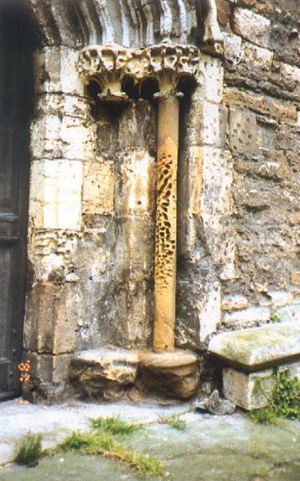
| Testing samples of different consolidants at Howden Abbey, North Yorkshire. The door surround and the pilaster provide a good example of severe stone decay. |
Natural weathering of stone is inevitable, but some types have a structure that makes them more durable than others.
There are three major causes of deterioration in natural stone; pollutants, frost and crystallisation of soluble salts. Water penetration is the main instigator of decay, and structure is the most important factor influencing the ability of stone to resist decay processes.
THE PROBLEM
To illustrate some of the problems a stonework wall may be subjected to throughout its lifetime, imagine the following common scenario:
There is constant wetting and drying of the surface of a limestone wall over the years. Gradually more of the exposed surfaces begin to erode a little. This is natural weathering. A decade of extremely wet weather interspersed with unusually low temperatures heightens the natural weathering. The atmospheric pollutant, sulphur dioxide, combines with the calcium carbonate in the stone and creates a hard gypsum layer covering the surface of the stone. This means that moisture inside the stone cannot escape and salts may crystallise behind this hard layer and eventually cause spalling, which leaves a weak exposed surface, more vulnerable to natural weathering. The owners of the building notice the problem but choose the wrong type of treatment, perhaps a water repellent treatment that does not breathe. It doesn't penetrate any further than the surface and the result is a hard, impervious outer surface like the gypsum. Ultimately the same problem arises as before; spalling occurs and weathering is accelerated.
What, if anything, can be done for this stonework? If it is not possible to shelter or isolate the material from the weather in some way, and continual erosion will lead to the loss of the original, then conservation through consolidation is the answer.
PRINCIPLES
The fundamental principle of conservation is to alleviate the problems affecting a building or monument in a way that doesn't detract from its history and doesn't endanger but promotes its future. This should be done, wherever possible, with the absolute minimum of intervention and in a way that is reversible should a better way come along in the future.
When talking about stone consolidation it is important to be clear on the difference between a consolidant and a preservative. The aim of a preservative is to totally preserve the stone in whatever state of weathering it has reached and stop all future decay; this generally means applying a coating to the surface of the stone which totally protects it from the effects of the atmosphere around it. Consolidation on the other hand should aim to stabilise the friable material whilst still allowing weathering to take place as a result of natural processes and at a natural rate. When considered in this context, consolidation appears to agree with the principles of conservation. However, the application of a chemical to a stone is usually considered a more significant intervention than most. Simple mechanical repairs and alterations such as erecting guttering to protect the stone for example are clearly more readily reversible, and 'traditional' coatings such as lime wash are considered to be sacrificial - that is to say that they provide protection as they decay. Furthermore, stone can cope with getting wet, as long as it can also get dry; it can also cope with minimal loss around the edges: indeed some stones could have been put in certain places purely to be sacrificial. When is it necessary to introduce such a significant intervention and apply a chemical to stabilise the effect of weathering?
A thorough assessment of the damage to the stone and the examination of all possible options, bearing conservation principles in mind, should always precede a decision on whether to simply carry out repairs or whether to use some form of consolidant.
THE IDEAL
The only requirement of a consolidant is to reduce the rate of decay of the stone surface and the most successful treatments are those which least alter the characteristics of treated stone leaving it similar to the underlying sound stone.
The ideal polymer for use in stone consolidation would be one that can reverse the degradation of a stone, returning it as nearly as possible to its original condition. In order to achieve this the treated stone should mimic sound stone in as many characteristics as possible. Some characteristics are, however, more important than others. The most important of these are strength, porosity, permeability, thermal dilation and colour. Of all the polymers, silanes seem to hold out the most promise although they may not be suitable in every situation. The theoretical end-product of polymerisation of the simplest silanes is silica, which is present as a cementing mineral in many sandstones and may mimic the behaviour of a natural cement more closely than many other polymers.
DIFFICULTIES
Traditionally waxes and linseed oil were used as water repellents but they had several flaws:
- there was no possibility of deep penetration by these viscous substances;
- they tended to discolour the surface of the stone;
- the surface picked up dirt very easily;
- after a longer period of exposure there could be a breakthrough of salt efflorescence;
- generally
the water repellency of these substances caused problems. For
modern consolidant treatments these issues still remain but the
most important are depth of penetration and water repellency.
DEPTH OF PENETRATION
There is agreement that treatments confined to the outer surface of stonework are dangerous since they can result in spalling. However, there is no agreement on what would be an appropriate depth of treatment beyond the fact that it is obviously necessary to treat the stone deeply enough to consolidate the full thickness of the decayed zone. It is necessary for the consolidant to penetrate at least 25mm into the stone to reach all areas of friable material.
WATER REPELLENCY
Since water plays such an important role in the decay of stonework, research into consolidants has often focused on their ability to make stone water repellent. However, this may prevent the harmless effects of natural weathering as well as the more damaging ones, causing the appearance of the stone to change.
More seriously, if a consolidant or preservative is water repellent, not only will the ingress of water be lessened but also water already inside the stone will be hampered from making its way to the surface to evaporate. The result of this can be salt crystallisation and eventually spalling. To prevent this, the stone would have to be totally dry throughout the period when the consolidant is being applied (almost an impossibility in our climate) to be certain that no moisture is trapped.
Water repellents are usually marketed as being vapour permeable, suggesting that moisture will be able to escape to the surface of a wall and evaporate. Unfortunately water ingress may continue as vapour at the surface, as water escapes through cracks at mortar joints, as rising damp, or by transfer from surrounding stonework, often entering the structure faster than it can escape. Water repellents can reduce the amount of moisture in stone but they cannot be guaranteed to exclude all moisture.
Although opinion is divided on whether the use of water repellents can reduce stone decay, it is clear that any material that completely blocks surface porosity will lead to accelerated stone decay. Such materials should never be used.
SOLUTIONS
An ambient low humidity, a dry building and a high penetration depth are all very important in the application of a consolidant. So during the decision-making process and before application it is necessary to investigate the needs and condition of the building, monitor its environment and assess the properties of the consolidant.
There has been lots of research into consolidants over the last century to determine colour changes, strength changes, their effect on properties of different stone and even biological growth tests. But as yet, no one has whole-heartedly recommended one product or indeed one type of product as ideal for use in stone conservation.
There are many products on the market, all with different brand names, but their main constituents are similar and can therefore be classified into categories.
SILANE-BASED MATERIALS
Silane-based
materials are generally organosilicon compounds which polymerise inside
the stone. Some water is needed to aid the reaction, but the amount is
critical; a high humidity means the reaction may take place too quickly
and too much water leaves no space for the polymer to form. The end product
of polymerisation is silica, similar to the natural silica deposits which
bind many sandstones. Penetration can be quite deep but this depends greatly
on the product used and the conditions in which it is applied.
By the production of silica there is a definite consolidating effect and many silane-based products seem to increase the strength (flexural, compressive, tensile etc) of damaged stone. Unfortunately, there is some colour change with most types of silanes, although studies show that this usually lessens after about 18 months. Porosity, water absorption and pore size distribution have shown to be affected by the treatment, a little in some cases and a lot in others. This influences resistance to salt crystallisation and freeze/thaw action. Where there is a new area of stabilised decayed material, moisture evaporation has to take place within the stone and this may lead to salt crystallisation at the boundary between treated and non-treated stone.
These are the main silane-based products and their main features:
- tetraalkoxysilanes - have little water repellency;
- alkyl trialkoxysilanes (such as brethane) - less consolidation, but good water repellency;
- polysiloxanes - flexibility and more water repellency;
- silicon hydrides - use presents many health and safety problems;
- halogen bearing silanes - generate damaging acids, so thought to be too dangerous to use in conservation.
ORGANIC-BASED MATERIALS
These products can be applied by themselves or dissolved in an appropriate solvent. They generally have good adhesion to the substrate and are good at taking up dimensional changes in stone (such as thermal expansion and contraction). The disadvantage of using organic-based materials is that they can be vulnerable to heat or ultra-violet (UV) light and generally the penetration depth depends greatly on the ability of the solvent to carry the consolidant into the stone and the percentage of moisture in the stone. Many products have a very low penetration depth.
These are the main organic-based products and their main features:
- acrylic consolidants - there can be some colour changes;
- vinyl consolidants - very unstable in heat and light and tend to pick up dirt;
- epoxies - the treated stone will be prone to yellowing and the appearance of a white powder;
- polyurethanes - can alter many of the properties of the stone it is applied to, including strength, porosity, and brittleness; sometimes having quite a detrimental effect;
- polyesters - have an extremely poor resistance to UV radiation and acid rain; not ideal for stone conservation;
- perfluoropolyethers - good water repellents, their advantage in stone conservation is the fact that they are reversible and stable in UV light, but they have limited cohesive properties
- fluorinated
elastomers - water absorption, vapour permeability and porosity
can be altered by them, but cohesion is good.
INORGANIC TREATMENTS
- Fluorosilicates - cannot be used on limestones since they react badly with calcium carbonate, and they are not very effective on sandstones;
- barium-hydroxide - there is sometimes a colour change, but it can be a very good consolidant if applied correctly and kept wet for an accurate amount of time;
- limewater - an old product that is still in use, it is reversible
and simple to use.
SURFACE COATINGS
Lime treatments and shelter coatings can be applied to a surface to act as a sacrificial layer after repairs and treatment have taken place. They should be breathable and can be colour tinted to match the weathered stone.
Shelter coats are ideal in extreme environments since they provide a sacrificial layer designed to weather and protect the underlying stone, therefore halting decay and prolonging life. It is essential to keep shelter coatings in good repair with regular maintenance.
THE FUTURE
Current research, mainly centred on the properties of each type of consolidant, is largely being done in the laboratory, although these tests often give different results to those performed on actual buildings. Nevertheless, most non-proprietary research concludes that there is no ideal consolidant for use on historic stonework, confirming comments made 80 years ago; either some discoloration of the stone is caused or the altered properties of the stone cause additional problems. There is also little data on the effective lifespan of treatments beyond one or two years.
For new buildings there have been tentative suggestions of dipping building materials into a silane-based product before building. For existing buildings, there are different methods of application to consider. For example, if a water repellent consolidant is applied to each stone individually and not to the mortar in between, a good quality lime mortar could be used sacrificially to help any water escape from the building. Alternatively several carefully chosen stones could become sacrificial by not applying a water repellent to them, so that any water in the structure could make its way to them and escape. These stones may have to be monitored and replaced on a regular basis but it may aid the rest of the building.
There is some new research into dispersed hydrated lime in the recent RILEM publication Historic Mortars: Characteristics and Tests and more extensive tests could certainly be very interesting (Strotmann, 1999).
Whatever treatment is chosen, it is important not to forget the source of damp. Most old stone buildings were built with complicated systems of water removal in place. Over time stone gullies acting as guttering may have eroded away and the system will begin to fail, resulting in stone decay. With the principles of conservation uppermost in mind the best way to consolidate the stonework of a building is to find those places where water is causing decay and make minor repairs to the building to re-institute its own system of water removal. Minor repairs and regular maintenance can in themselves halt decay and prolong life.
Recommended Reading
- TA Bailey and RJ Schaffer, Stone Preservation Experiments, Unpublished BRE Note, 1964
- J Ciabach and JW Lukaszewicz, 'Silicone Emulsion Concentrate VP1311 as a Water Repellent for Natural Stone', MJ Thiel (ed), Proceedings of the International RILEM/UNESCO Congress: Conservation of Stone and Other Materials, Paris, France, 29 June - 1 July 1993, SPON, London, 1993
- JW Littmann et al, 'Development of Polymers for the Consolidation of Natural Stone', MJ Thiel (ed), Proceedings of the International RILEM/UNESCO Congress: Conservation of Stone and Other Materials, Paris, France, 29 June - 1 July 1993, SPON, London, 1993
- CA Price, Arrestment of Degradation - the preservation of natural stone, BRE Report PD142/75, 1975
- R Rossi-Manaresi et al, 'Long-term Effectiveness of Treatments of Sandstone', ICCROM International Colloquium on methods of evaluating products for the conservation of porous building materials in monuments, Rome, Italy, 19-21 June 1995
- R Rossi-Manaresi, 'Effectiveness of Conservation Treatments for the Sandstone Monuments in Bologna', International Symposium on the Conservation of Stone II, Bologna, Italy, 27-30 October 1981
- AS Saleh et al, 'Study and Consolidation of Sandstone: Temple of Karnak, Luxor, Egypt', Studies in Conservation, 37, 1992
- R Snethlage et al, 'The Application of Laboratory Processes and Studies to Real Structures', Technology and European Cultural Heritage: Proceedings of the European Symposium, Bologna, Italy, 13-16 June 1989, Butterworth Heinemann, Oxford, 1989
- E Stadtbauler et al, 'On the Effectiveness of Stone Conservation After 20 Years of Exposure - case study at Clemenswerth Castle', NW Germany, J Riederer (ed), Proceedings of the 8th International Congress on deterioration and conservation of stone, Berlin, Germany, 30 September - 4 October 1996
- R Strotmann, 'Dispersed Hydrated Lime: Development and Production, Techniques and Applications', P Bartos, C Groot and JJ Hughes (eds), International RILEM Workshop on Historic Mortars: Characteristics and Tests, Paisley, Scotland, 12-14 April 1999
- JM Vallet and V Vergès-Belmin, 'Efficacité Résiduelle Après 24 Ans de Vieillissement Naturel de Produits de Protection à Base de "Résines Silicones" Appliqués sur Pierres Calcaires', J Riederer (ed), Proceedings of the 8th International Congress on deterioration and conservation of stone, Berlin, Germany, 30 September - 4 October 1996
- GS Wheeler et al, 'Comparative Strengthening Effect of Several Consolidants on Wallace Sandstone and Indiana Limestone', J Delgado-Rodrigues, F Henriques and F Telmo Jeremias (eds), Proceedings of the 7th International Congress on Deterioration and Conservation of Stone, Lisbon, Portugal, 1992, Laboratorio Nacional de Engenharia Civil, 1992
- KJH Zinsmeister et al, 'Laboratory Evaluation of Consolidation Treatment of Massillon (Ohio) Sandstone', Association for Preservation Technology Bulletin, 20:3, 1988