
Stone Replacement
To do? Or what to do? That is the question.
Malcolm Coulson
 |
|
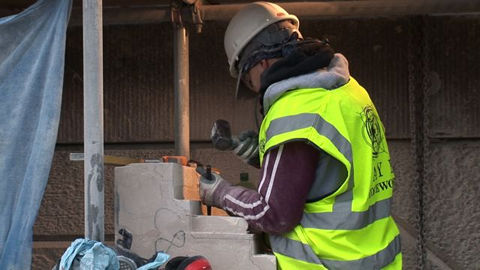
| A stonemason has to be entrusted to make frequent decisions on how much original stone can be safely retained (Photo: Paye Stonework) |
Should deteriorating material be replaced? Why? Who decides? What to replace it with? Are there any alternatives? Questions such as these, sooner or later, are faced by all those who own, work on or are responsible for historic buildings, particularly where historic or original stones are concerned. They are questions that I had to face time and time again in my role as Regional Superintendent of Works for Cadw. Although the buildings for which I was responsible were scheduled ancient monuments (mostly roofless ruins), the principles are easily transferable to most historic buildings. This article is not prescriptive but endeavours to highlight the issues involved and stimulate the thought processes.
Perhaps the first question to be asked is: why are we contemplating stone replacement? Is it for purely aesthetic reasons? If so, we should seriously question our motives. Remember, we are dealing with fabric that is of historic and/or architectural importance, and therefore a vital element of the building's record. With replacement, the patina of age will be lost, leaving a sometimes stark reminder, maybe for years to come, that this is new stone.
Normally the only reason stone should be replaced is because it has failed, compromising the structural integrity of the building. The cause of failure should be investigated as it may be the nature of the replacement. Is it due to the environment? Weather erosion, salt damage, or location, such as sandstone placed below limestone, can be a major factor in stone decay.
 |
||
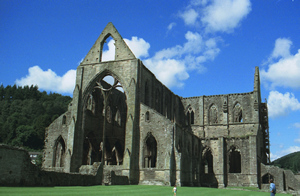
| At Tintern Abbey the unique circumstances favoured a principle of replacing stone which had a life expectancy of less than 75 years |
Bad maintenance or poor repairs in the past may be the culprit; much stone has been lost due to hard, impervious cement pointing. Was the stone of poor quality to begin with, was it 'wrong-bedded' or, more likely, was it rendered over to protect it?
It follows that the environs of the stone may also need to be modified or corrected so that the new stone does not suffer the same fate. This becomes particularly important when the stone has failed structurally due to movement in the building, causing undue, and undesigned for, pressure on it. If this is the case, then specialist advice must be sought, usually by employing a structural engineer who has experience of historic buildings.
It might be argued that replacement is acceptable when the stone is at high level or is otherwise inaccessible without a scaffold, as the expense of reinstalling a scaffold might prohibit further work for many years. The time delay, fifty years plus, could mean that a moulded or carved stone might be in perilous condition before it could be inspected again, and that the 'on-site' record of those mouldings might be lost for all time.
Tintern Abbey was just such a case and here the project team decided on the following strategy:
- that the best preserved components of each window type would be retained and conserved for the future
- that those components whose future life was thought to be less than 75 years would be replaced by stones dressed to the original profile
- that for new work, the most compatible source of commercially available stone would be used
- that none of the missing components of the windows would be restored so that the pattern of fenestration accurately reflects the earliest representations of the abbey church.
 |
||
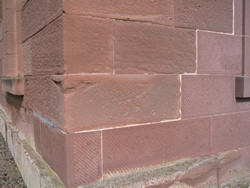
| New replacement stonework at the bottom and right, designed to match the original |
It is worth mentioning that, at Tintern Abbey, previous works had been carried out in the early 20th century using the 'conserve as found' philosophy. This meant that the decay to the dressed stonework was addressed using cement mortar repairs, copper strips and selective piecing of new stonework. However, 75 years hence, the windows were in a perilous condition and in danger of collapse.
At Tintern, a project team made the decisions based on a site philosophy they had developed which produced a range of options. This is the ideal and should be a collaboration between a conservation architect, an archaeologist and the mason who is to carry out the work. It is appreciated that this may not always be possible, especially in the case of the less prestigious buildings, but if decisions are made unilaterally then key factors may be missed.
Of course there are alternatives to replacing stone which can offer ways of retaining the material with minimal intervention. Rubble stonework may have been rendered in the past and, if there is evidence of this, then re-rendering with lime mortar would be an obvious solution to the problem. Rendering may also confer other benefits such as acting as a 'poultice' to draw out salts from the stonework. Limestone can be repaired using a palette of techniques including plastic lime repairs, micro-pinning, and lime shelter coats. The beauty of these methods is that they are largely reversible. They can also be used successfully on sandstones but consideration must be given to the possible effects of salt migration (due to acid rain) into the sandstone. Then there are the more invasive resin-based approaches that may be more acceptable than losing a potentially important piece of history. Consolidants also come into this category and are particularly useful for statuary.
 |
||
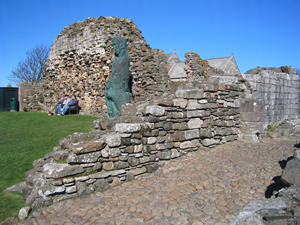
| 'Hungry' pointing used to distinguish old work from new |
If it is decided that stone replacement is the preferred course of action to be taken, there are still a number of issues that must be resolved prior to starting the works.
How much stone is to be replaced? Always aim for minimal intervention. Adequate recording should be undertaken both to preserve a record of the old and to instruct the formation of the new. This can take the form of photographs, drawings (both scale and freehand) and templates (essential when replacing moulded stones) or a combination thereof.
Are there adequately skilled personnel available to undertake the work? Stonemasonry is a highly skilled profession and should only be undertaken by suitably qualified or experienced people. Replacing dressed stonework in-situ is particularly demanding due, for example, to the tolerances involved.
With what should the stone be replaced? There are a number of options, the most obvious being to replace like with like. If the original stone type is up to the job, and not the cause of the problem, then the geology of the existing stone must be determined. This may be easy, as in the case of a Pennant or Bathstone (although even with these attention must be paid to the differences between different quarry locations), or very complicated, requiring the employment of a geologist. Once the stone type is identified then begins the task of finding a suitable match. This is often extremely difficult due to the fact that the original sources of the stone will, most likely, be no longer available and so alternatives have to be sought. Here again the services of a geologist can prove invaluable. The stonemason should be involved in this process to ensure that a usable stone is chosen (and not one which suffers from bed problems, poor quality, or inferior workability, for example). Durability and weathering are also important - will the stone last and how long will it take to 'marry' with the old visually?
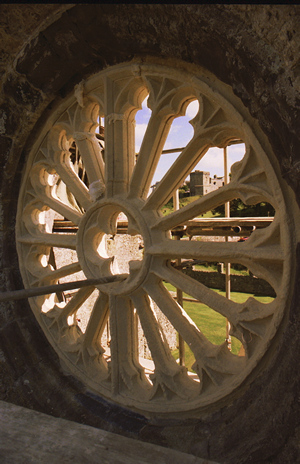 |
||
| A wheel window conserved with a combination of renewal and mortar repairs |
It may be that an exact or 'near enough' match is not obtainable and a compromise of either 'geologically correct' or a visual match will have to be accepted. Such a compromise may be acceptable for another reason: that it delineates the 'old' from the 'new' and so respects the historical record of the building; it may even be decided to use an obviously 'alien' stone for the same reason. This philosophy of 'honest repair' can also involve the use of other material including artificial (cast) stone (although this tends not to weather very sympathetically and can look quite different to surrounding stone in wet weather) and 'tile repairs' (as promoted by the SPAB).
'Honest repair' brings me onto a subject which is peculiar to (though probably not exclusive to) ancient monuments and is not really about stone replacement but about the addition of stone. Stone is not generally added to ancient monuments as they are almost always 'conserved as found'. However, sometimes it becomes necessary to do so in order to preserve structural integrity, or to protect the fabric of the existing masonry. When this is carried out, it is usual to delineate the original from the new.
There have been, and still are, various methods of accomplishing this, including the use of 'alien' stone (as above), 'hungry' or 'inch-back' pointing at the juncture of the two builds, clay tile or slate 'slips' at the juncture, judicious dating of the new and use of masons marks, copper pins at the juncture, use of a contrasting colour or texture mortar in the new build, or drilling holes in the stones of the new build adjacent to the juncture (used in drystone walling). Each one should be decided on a site-by-site basis and should depend on the preferences of the personnel involved in the decision making process. One should be aware of these when engaged on ancient monument work.
One last thought. Consider what is to be done with the original stone after it is removed, assuming it can be taken out intact and is of significant historic or architectural value. Possible options include displaying it in a protected environment on site, putting it in a museum, or burying it on site (and record the location). To conclude, there is no single answer to what can and cannot be replaced. The quality of the conservation work depends on the quality of the decision-making process, and in particular on the stonemason knowing when to stop and consult the rest of the conservation team.