
Exterior Stucco
Ian Constantinides and Lynne Humphries
 |
|
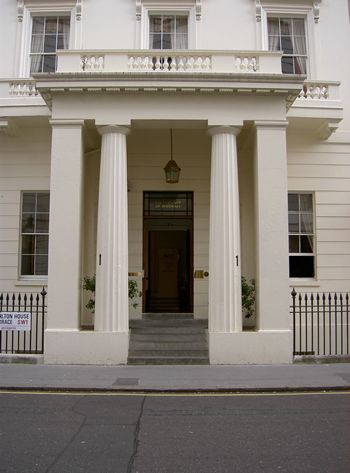
| Nash's exuberant stucco at Carlton House Terrace, London (John Nash, 1827-32) |
The term 'stucco' is of Germanic origin and its use has had many applications since the Middle Ages. These range from a coarse plaster or cement used chiefly for covering rough exterior surface of walls in imitation of stone, to a fine plaster, especially one composed of gypsum and pulverised marble, used for covering walls, ceilings and floors, and for making cornices, mouldings and other decorations. Consequently, the materials used in producing stucco vary considerably. Binders have included fully burnt gypsum; limes, sometimes with pozzolanic additives such as brick powder; cements; and linseed oil (mastic). Aggregates have included marble dust, crushed stone and sand. All have been used in varying mixes and hydraulic strengths with a wide range of colorants and other additives.
In Italy the term has had the widest use historically, generally referring to various soft materials capable of being shaped including mastic- or wax-bound glue for broken statues or lime/egg/brick powder for mosaic.(1) In England, stucco was often defined by the technique used:
Common stucco an exterior render prepared from hydraulic lime, sand and hair
Rough stucco a fine plaster of sand and lime made from chalk or
a very pure limestone which was used internally to imitate stonework
Bastard stucco a superior render prepared from fat lime putty (that
is to say, non-hydraulic) and fine washed sand which was applied to a
good backing coat, scoured and either polished or left floated
Trowelled stucco a fat lime render applied as a normal finishing
coat, scoured, polished and painted.
In this article stucco is used to describe lime-based renders applied as a two- or three-part coating to external facades in the 19th century.
DESIGN AND USE OF STUCCO HISTORICALLY
The
use of stucco or smooth render to simulate finely dressed stonework or
rustication became popular in parts of Britain in the early 19th century.
The material was often applied over brickwork but also sometimes over
rubble stone. Not only was the appearance of finely jointed work or rustication
achievable in stucco, it was also far more affordable than stone in many
parts of the country.
External stucco had been introduced into London in the later 18th century and was increasingly used to satisfy the Regency and early Victorian taste for smooth, evenly coloured house fronts, its cost amounting to about one quarter that of stone. Mid-Victorian fashions, however, as well as the fall in the price of stone, helped to phase out stucco very quickly after 1860. Later in the century, terracotta came into its own as a cheap and durable material for applied decoration and aggrandisement.
 |
|
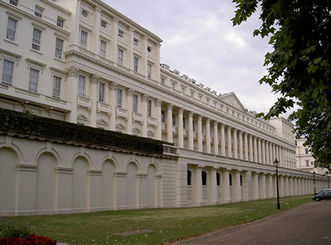
| Carlton House Terrace; detail below right |
In the early Victorian period stucco was used in a variety of developments ranging from the highly prestigious to the less expensive. John Nash used stucco extensively in the early 19th century for his terraces in London, Brighton, Hastings, Southsea and Torquay as well as his Gothic and Italianate villas in Malvern, Leamington and Harrogate. Perhaps the finest example was his development of Regents Park, arguably his greatest work.
As the popularity for the material spread, highly elaborate stucco faced terraces and villas came to dominate the centres of several key towns and seaside resorts in England and Wales. It was generally used to cover the whole façade but not the sides and back. Fine examples of this can be seen on the Holland Park Estate in West London, built by William and Francis Radford between 1860 and 1879.
Although stucco remained popular in London for more conservatively designed houses until the 1870s, by the mid-Victorian period this form of embellishment was losing favour with many builders in London as the principles of Ruskin and Pugin filtered through to them and the Gothic Revival took hold, although it continued to remain popular in other parts of the country, particularly in seaside resorts, probably because stucco provides an excellent defence against salt-laden spray.
Stucco always remained a very regional material as it was rarely used if good stone was readily available, as in Bristol and Bath. Examples of stucco in Scotland are rare.
CONSTRUCTION
 |
Stucco renders are of three basic types: a fat lime and sand mix sometimes with animal hair as reinforcement; a hydraulic mix containing either hydraulic lime and sand, or fat lime with a pozzolanic additive and sand; and various forms of mastic. Correct identification of the material used is essential when carrying out repairs to ensure both historical continuity and structural compatibility, as a different mortar mix may well be incompatible with the original.
LIME-BASED STUCCO
Generally,
a pure or fat lime would have been prepared by slaking quicklime (calcium
oxide) made from a pure limestone or chalk. Dry hydrated lime is sometimes
used today for repair work, although mature fat lime is generally preferred.
A faster set could be achieved by using either a hydraulic lime or by adding a pozzolanic additive such as brick dust to a fat lime. Roman cement, used in stucco from the 1790s, is one form of hydraulic lime which was made from an argillaceous limestone (septarian nodules) and has a distinctive pinky-brown colour. The sand and other aggregates used in a repair should match the existing in particle size, colour and type. For new stucco, washed and graded pit sand complying with the British Standard should be used. This should be hard, sharp, gritty and free from clay and organic impurities.
Hair should be long, strong, and free of dirt and grease, from the horse or ox and blended into coarse stuff in the ratio of 3-5kg per cubic metre of coarse stuff. It should be well teased into the mix, evenly distributed without tufts.
Lime plasters perform best in layers of uniform thickness. They are applied in two or three coats. The mix should be as dry as workably possible as this reduces the shrinkage and cracking on drying and, prior to the application of each coat, the surface should be sprayed down with clean water. This wetting helps to prevent moisture from being sucked out of each stucco application too rapidly, which results in cracking, loss of bond, and generally poor quality stuccowork.
The success of external lime-based stucco is in the tending. The longer it takes to dry out the better it will perform. Each coat of a fat lime stucco should be allowed to dry for between seven and 21 days, depending on the mix, season, weather and temperature, prior to applying subsequent coats. For a hydraulic lime mix the interval between coats can be as little as two or three days. It is most important to protect the work during and after application to prevent either accelerated or prolonged drying. In hot weather or situations where rapid drying is likely, the work should be protected with damp hessian. In addition, work must be completed long before the first frost.
MASTIC
In
the late 18th and early 19th centuries different mastic recipes were patented
by a succession of people trying to produce a high quality but inexpensive
stucco. These included 'Adam's New Invented Patent Stucco' used by the
Adam brothers, Robert and James (in fact based on stucco recipes patented
by David Work in 1763 and Liadet in 1773), Christopher Dehl's mastic (1815),
and Hamelin's Cement (1817).
The various forms of mastic generally consisted of a fine aggregate such as limestone, sands, crushed pottery and glass bound with linseed oil, often with litharge (lead monoxide) to aid drying. Dehl's mastic, for example, which is believed to have been used by Nash at Regent's Park and Carlton House Terrace, London, was made of 'linseed oil boiled with litharge and mixed with [fired] porcelain clay, finely powdered and coloured with ground brick or pottery, turpentine being used as the thinner'.(2) The background was liberally coated with linseed oil before applying the mastic.
Mastic can be recognised by the fact that it repels water. The material did not age well and tends to be very brittle. Where large areas have failed, John Ashurst recommends using a stucco made from hydraulic lime as an alternative to mastic. However, it can generally be said that repair of mastic stuccos is fraught with problems. On the whole the principal of 'like for like' may be followed.
ASHLAR EFFECTS AND FINISHES
The
topcoat of stucco was often given a smooth, trowelled finish, and scored
or lined in imitation of ashlar. This effect could be achieved in three
ways: joint lines could be marked on while the top coat is still green
using a tool called a jointer; the joints may be formed by sunken, slightly
chamfered battens fixed to the second coat and then removed after the
top coat stucco has set firm; or they may be run by a double horsed running
mould. Special care must be taken to match to the existing work in position,
spacing and style.
Generally, traditional renders of any period were painted, with the exception of some early experimental stucco recipes which were slef-coloured, sometimes enhanced with a wash of copperas (iron sulphate) to give the appearance of Bath stone, but often it was left unpainted, particularly where fine aggregates were used. A thin line of white lime putty, graphite, or some other pigment sometimes enhanced the illusion of masonry joints.(3) If using pigments today, it is important to ensure they are compatible with lime
COMMON MISTAKES AND CAUSES OF FAILURE
Arguably
the most common reason for the failure of stucco is neglect. While stucco
is a durable material, regular maintenance is required to prevent excessive
water penetration and a breakdown of the surface. Failure of rainwater
disposal systems, such as from blocked or damaged gutters is one of the
most common causes of failure, which often leads to salt efflorescence,
staining and biological growth. Excessive water penetration is liable
to cause loss of adhesion either between the stucco coats or from the
substrate, causing bulging and, ultimately, collapse. Trapped water may
also freeze and expand causing dramatic failure, or it may move into the
structural fabric of the building, possibly damaging the interior. Increased
wetting and drying cycles contribute towards soluble salt activity as
salts contained in the masonry are carried to the surface. Here they crystallise,
resulting in an unsightly bloom of efflorescence or, worse still, a crumbling
surface caused by 'cryptoflorescence' - the crystallisation of salts within
the pores. Visible damp zones are frequently the first sign of a problem.
Regular checks and maintenance of gutters, hoppers and downpipes are easily
carried out and can prevent extensive failure and loss of original stucco
surfaces.
All too often deterioration is caused by inappropriate repairs. The use of the wrong materials can exacerbate the rate of decay rather than slowing it down or preventing decay. Typical of this sort of problem is the use of hard cementitious materials incompatible with the stucco or lime based render. Cement based renders are more likely to crack than lime renders and consequently to let in the rain, as they move differentially to lime renders. Cracks will also form at the junction between the original and the modern repair.
Raising the ground level at the foot of elevations increases water retention within elevations and encourages rising damp. Prolonged moisture retention encourages biological activity such as moss growth which may cause local disaggregation. Ultimately larger plants may take hold, bringing with them further problems such as root penetration.
Surprisingly, modern synthetic paint systems which form impermeable barriers are still frequently applied over previously limewashed stucco, causing retention of water and associated problems as outlined above.[3] Modern impervious systems trap water behind the surface causing deterioration, which outweighs any possible advantage of imparting water repellence to the face.
REPAIRS
As
with all conservation work, it is most important to record the area to
be conserved prior to commencement as well as during work.
One of the first tasks may be to remove inappropriate materials and methods of repair and replace with the appropriate stucco/render. However, removal should only be carried out if this does not put greater risk on the original fabric. It may also be necessary to cut out defective areas of original that cannot be saved.
When conserving fine or delicate decorative details it may be advantageous to face-up original material around the perimeter of earlier repairs with acid-free tissue prior to removal of crude repairs to prevent any loss of detail.
Cracks greater than 2mm in a lime-based stucco should be carefully cut out to form a slight undercut which will act as a key, and thoroughly flushed out with water to remove dust and loose debris before being filled with fresh mortar based on trial results. Obviously a finer aggregate will be required where the crack is fine or hairline and it is often deemed unnecessary to undercut as the space is easily filled especially if limewash is to be applied.
Hollow areas and voids in a lime-based stucco should be flushed out likewise, although in this case it may be necessary to form a small hole at the base of the void to allow water to escape. Acetone may be used or added to the water to assist drying. A ten per cent solution of Primal WS24 may be injected into the void prior to grouting in order to increase the bond between grout and internal face, before injecting a fine grout based on lime putty or, in the case of a mastic, a similar mix based on analysis results. It is very important to observe the surface of the stucco while grouting to check for escape holes, surface bulging and consequent loss. Vulnerable areas should be supported until the grout has set. Finally the surface of the stucco is reinstated to its original profile, where possible without causing loss.
Salt efflorescence may be dry brushed and removed from all surfaces, as should all algal growth. A suitable biocide should be applied to affected areas only, to remove remaining algae and prevent re-growth.
Friable areas of a lime-based stucco may be consolidated with repeated applications of limewater. To avoid a white bloom it is most important not to let the limewater sit on the surface but to sponge it off with clean water.
Substituting modern materials for the original should always be avoided if at all possible. Wherever a high proportion of original stucco has survived a hundred years or more in the British climate, bear in mind that the original has been proved to work. This historic material, produced by craftsmen long ago, has its own intrinsic value like any antique and, with careful consolidation, suitable repairs and thorough maintenance, it should be possible to ensure that the original stucco work can still be seen by future generations.
Recommended Reading
- John Ashurst, Mortars, Plasters and Renders in Conservation, Ecclesiastical Architects' and Surveyors' Association, 1983
- G Beard, Stucco and Decorative Plastering in Europe, Thames and Hudson, London, 1967
- Anne Grimmer, 'The Preservation and Repair of Historic Stucco', Preservation Briefs, Technical Preservation Services, National Park Service, Washington DC
- Manfred Koller et al, Work in Austria on historic stucco - technique, colouring, preservation, Case Studies in the Conservation of Stone and Wall Paintings, Preprints of the Contributions to the Bologna Congress, 21-26 September 1986
- William Millar, Plastering: Plain and Decorative, (1897), Donhead, Shaftesbury 1998
- Simpson and Brown (Corporate Author), Conservation of Plasterwork: a guide to the principles of conserving and repairing historic plasterwork, Historic Scotland Technical Advice Note 2, Historic Scotland, Edinburgh, 1994
- WD Stagg and RA Masters, Decorative Plasterwork: Its Repair and Restoration, Orion, Eastbourne, 1983
Notes
(1) Manfred Koller et al, 'Work in Austria
on Historic Stucco - technique, colouring, preservation', Case Studies
in the Conservation of Stone and Wall Paintings, NS Bromelle and P Smith (eds), Preprints of the
Contributions to the Bologna Congress, 21-26 September 1986
(2) Norman Davey,
A History of Building Materials, Phoenix House, London,
1961
(3) Anne Grimmer,
'The Preservation and Repair of Historic Stucco', Preservation
Briefs, Technical Preservation Services, National Park Service