
The Townscape Heritage Initiative
Renewing the heart of our historic towns and cities
Judy Cligman
 |
|
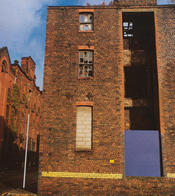
| Derelict warehouses at the corner of Lower Duke Street and Henry Street, Liverpool (Roy Main) |
The Townscape Heritage Initiative (THI) is the Heritage Lottery Fund's grant giving programme for the repair and regeneration of the historic environment in towns and cities throughout the UK. The scheme was born of the HLF's desire to deliver sustainable conservation in historic urban areas by raising the standard of repair where the market has failed to do so, and by bringing new uses and new life back into areas which have lost their traditional economic base.
The THI was launched in 1998 with a £60 million budget for three annual bidding rounds. Some £62 million has already been allocated (by 2001) to more than 80 schemes in the first three rounds. With highest priority given to applications from areas of social and economic deprivation, all demonstrate the key role historic buildings have to play in urban renaissance.
PARTNERSHIP
The THI offers funding for comprehensive and targeted programmes of repair, re-use and enhancement of historic urban areas. The main aim of the scheme is to make possible the continued viable use of the buildings which make up the special architectural character of historic urban areas, giving highest priority to the repair of historic buildings and to bringing derelict and under-used historic buildings back into use.
Grants are made to local partnerships which manage a common fund from which smaller grants are offered to property owners. An important feature of the THI is that it addresses the conservation needs of particular buildings within an overall strategy, rather than as self-contained restoration projects. The THI may only be one element of a much wider economic regeneration scheme. The partnerships are generally led by the local authority, which has the power to deliver the strategy, but they may also include community groups, building preservation trusts, development agencies, civic societies and other such organisations. These partnerships are responsible for putting together an integrated strategy for the social and economic regeneration of the area together with a pool of funding from a variety of sources to fund the strategy.
Applications are assessed in two stages, with 'stage one' applications submitted in May of each year and 'in principle' indications of support from HLF made by September. 'Stage two' submissions include the development of an action plan for the life of the scheme which sets out the proposed programme of work.
Under the THI individual building owners may apply for a grant from the pool of funding and the local authority and other major partners may carry out direct works to buildings in their ownership or to the public realm. We can contribute between £250,000 and £2 million towards each scheme.
The average size of grant is £745,265. In the first two rounds priority was given to schemes in Northern Ireland, Wales and Scotland which demonstrated problems of a severity rarely seen in England, where funding had been much more widely available for conservation areas, albeit on a modest scale, since the Town Schemes of the 1970's. Coastal and market towns featured highly in last year's bidding round.
THE APPLICATION
All the THI schemes should:
- involve a range of works to a number of buildings, structures or spaces within a defined area
- involve the local community
- benefit the wider community as well as those directly concerned with grant aided properties.
TYPES OF WORK FUNDED UNDER THE THI
The THI aims to contribute to the sustainability of local economics and to support the communities that live and work in each area. Projects might include bringing vacant floor space in historic buildings back into use or making an historic area more attractive as a location for businesses or as a tourist destination. We might support the repair and authentic reinstatements of elements lost from the 'public realm' or support the authentic reinstatement of architectural features to historic buildings and their settings.
The THI cannot support schemes which might fall under other FILF grant programmes such as active places of worship or urban parks and town squares; nor can it support schemes in which more than 25 per cent of the common fund is proposed for public realm works such as street paving and lighting, or which include routine maintenance that is the responsibility of the owner.
Two ongoing projects illustrate the kinds of scheme likely to win Heritage Lottery Fund support under the THI scheme, one concerning an industrial area of Liverpool and the other concerning two rural towns in Northern Ireland.
LIVERPOOL ROPE WALKS
In Liverpool the Duke Street/Bold Street Partnership had been in existence for two years before being awarded £1.5 million in the THI's first bidding round. They started work immediately on a four year programme. The partnership board consists of representatives from the public sector (mainly local authority) the private sector, the voluntary sector and four distinct local communities. The THI site is adjacent to a residential area and the project aims to create both new residential and commercial space, the second of these with the intention of creating extra employment for the local communities.
The Duke Street/Bold Street area was the site of many industries during the 18th century due to the proximity of the docks which formed the basis for the swift increase in population and wealth in the 18th and 19th centuries. Rope making in particular was important and many streets, Bold Street among them, owe their straightness and length to having originally been 'rope walks'. Bomb damage and the decline of the maritime industry both contributed to the area's decline.
The THI scheme is focusing on an important area of 18th and 19th century warehousing surviving largely unaltered in a conservation area in the heart of Liverpool. Many of the buildings are listed and show characteristics unique to Liverpool such as combined residences and warehousing. Some original boundary walls still exist along with some railings and street signs. Public support for the scheme is high and economic and social deprivation is much in evidence.
The scheme includes repairing the structure and envelope of the targeted buildings and the repair and reinstatement of authentic historic surfaces. This will bring back into use vacant floor space to encourage the regeneration of the area as a commercial centre. The THI forms the basis of a wider programme within which roughly £20 million will be spent on the area over a four year period and which is intended to achieve the sympathetic re-development of gap sites and public realm works such as paving, street furniture and the planting of trees.
THE THI IN NORTHERN IRELAND
In Northern Ireland the THI has a strong community focus. This is largely because the planning service is centralised and is not the responsibility of the local authorities. In place of the local authority, the schemes are being led by local partnerships of community groups, regeneration bodies and building preservation trusts. The strength of this approach is the high level of community involvement and buy-in. The central planning service has signed up to supporting the THI and to implementing the planning controls needed to maintain the benefits of THI funding.
THE DRAPERS' TOWNS (MONEYMORE AND DRAPERSTOWN)
Supported with a grant of £1.2 million, this THI scheme is providing a comprehensive package to tackle the problems of disrepair and under use in these towns, which originated as plantations of the Drapers' Company. The decline of the rural economy has left both towns with an architectural inheritance that they no longer have the resources to maintain, and they are also suffering from through traffic and a shift of trade. Behind the formal frontages lie charming simple buildings in very poor condition. Several courtyards of early, derelict outbuildings behind the main street frontages are also targeted.
The scheme involves a good mixture of major repairs to key buildings, projects to bring empty buildings back into use, reinstatement of architectural features and proposals to tackle gap sites in each town. Since the award was made, new funding has been coming forward from other sources – one local parish has been inspired to raise £50,000 through Sunday collections towards the repair of the corn store in Draperstown. The Drapers' Company has contributed almost £60,000 to the corn store and to the Manor House in Moneymore. Peace & Reconciliation funding of £175,000 has been confirmed and will go towards supporting various community projects.
SO FAR SO GOOD
The THI programme has been well received, particularly in Northern Ireland, Scotland and Wales (such as the repair of the run-down Lower Dock Street area of Newport in South Wales) where the needs are greatest. An independent evaluation of the programme by a team outside FILF will for the first time track a range of indicators of social and economic well-being in addition to the physical state of the urban fabric, to demonstrate the impact of conservation area funding over a ten year period. THI schemes are seeing genuine community involvement and generation of local pride and interest in the fabric of declining historic urban areas, leading in turn to higher standards of conservation. The Townscape Heritage Initiative highlights the role historic buildings have to play in urban renaissance. We expect the benefits of these schemes to be wide reaching; town centre regeneration will reduce pressure on greenfield sites as well as attracting inward investment, tourism and local employment. We are supporting practical solutions, delivered by supporting local partnerships, which will bring people back into our towns and cities.
Further Information
For further information on the Townscape Heritage Initiative please contact the HLF Information Team on 020 7591 6041 /43 /44/ 45.
Further information can also be found on the HLF website www.hlf.org.uk