
The Conservation of Historic Timber Bell Frames
Peter TJ Rumley
Change is part of life – we cannot avoid it. All we can agree upon or argue about is merely the degree and direction of that change, and its relation to what has gone before. …Accepting the inevitability of change, we can still, however, set out to guide and influence it. Sir Donald Insall CBE, conservation architect, 2008
 |
|
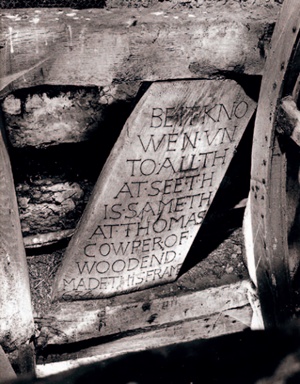
| A fine example of an inscribed timber bell frame dated 1634 by Thomas Cowper at St Botolph, Slapton, Northamptonshire (Photo: Christopher Dalton) |
Although rarely seen by the general public, a church’s historic timber bell frame is a key element of its tangible cultural heritage. As such, bell frames should enjoy a level of protection that ensures the preservation of both their historic fabric and our cultural heritage of bell ringing, for the benefit of present and future generations. Use of the bells and their frames is crucial to their significance and value, and has the added benefit of meeting the social needs and aspirations of those responsible for their repair, maintenance and management: the bell ringers.
Responsibility for the management, maintenance and repair of this precious resource lies with the Central Council for Church Bell Ringers (CCCBR), the diocesan advisory committee bell advisors and the bell ringers themselves, as well as with the parochial church council and the churchwardens. Bell ringers not only summon parishioners for Sunday service throughout the land, they also provide the all-important day-to-day care of our historic church bells and bell frames.
HISTORIC OUTLINE
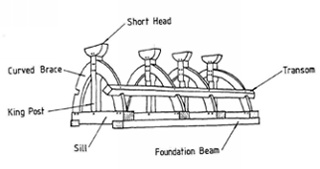
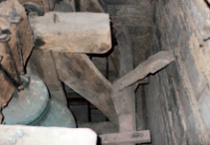
Many early medieval timber bell frames have been lost over the centuries. In Dorset, for example, there is only one surviving medieval timber bell frame (in the Church of St George, Langton Matravers). These early frames were finely crafted and usually consisted of massive oak short-headed king post framed trusses, with regional variations (see diagrams below). These frames allowed the chiming bells to swing back and forth in a short arc but afforded very little control to the bell ringer. The bells usually hung in a line. A fine example of this type of timber bell frame can be found at the Church of St Thomas a Becket, Hill Croome, Worcestershire (illustrated under the section heading 'The Process of Change', below). Such chiming bells marked the medieval daily canonical hours (or appointed prayer times) until bell ringers discovered how to control bells more effectively.
‘Change’ bell ringing (the ringing of tuned bells in a pre-determined sequence) developed during the 17th and 18th centuries and spurred the modification and development of stronger bell frames that could cope with the forces generated by bells being swung full-circle. Although there are many variations, this group of timber frames, described as ‘long-headed’, form a box with top plates, sills, foundation beams and braces to contain the bells. Such frames were designed to hang the bells in different alignments with lighter bells counteracting the heavy ones. Full-circle ringing meant that bells could be held motionless for a second or two at the end of each full 360 degree swing to allow the ringers to generate ‘changes’ by altering the sequence in which bells are rung.
There are a number of frame types. These were first classified by bell historian George Elphick in 1945 and more recently updated by Christopher Pickford FSA.
 |
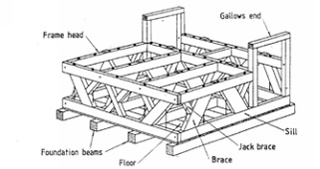 |
| Above left: Medieval shorted-headed king post frame truss and, above right: Long-headed box frame, 18th-19th century (Diagrams: Christopher Pickford) | |
THREATS TO TIMBER BELL FRAMES
The greatest threats to the survival of this resource of fine historic engineering and craftsmanship are neglect, the re-hanging of bells, and augmentation (increasing the number of bells to an existing ring). Many churches, particularly those in rural areas, are at risk of redundancy. There are fewer regular Sunday service bell ringers and even fewer practice nights, when bells and their frames and fittings are usually maintained. Without maintenance, the timber bell frames fall into disrepair, allowing decay to spread and causing the bells to become unusable.
A broken louvre, leaking lead roof or damaged downpipe can easily lead to the frame becoming saturated. Ultimately, the timber bell frame will rot with fungal decay or invite Death watch beetle, which favours damp oak. A structural failure in the tower will put a stop to bell ringing, perhaps indefinitely. Inevitably, the company of ringers will move to another church or just give up their art leaving the bells and historic timber frame to deteriorate.
The re-hanging of bells or augmentation may mean altering an existing historic timber bell frame or, at worst, replacing it with a steel one. The desire to add further bells is driven by an active and enthusiastic band of ringers who want to develop their unique cultural heritage of change ringing and preserve their craft. Often in the past, little consideration has been given to their significance and the impact that alteration will have on the historic timber bell frame.
THE PROCESS OF CHANGE
Whereas alterations to secular listed buildings require an application to the local authority for consent, the principal denominations in England, Scotland and Wales all operate internal systems of control which exempt them from this. Within the Church of England, for example, no alterations, additions, removals or repairs to a church, its fabric, ornaments or furniture may be made without a ‘faculty’. Where bells and their frames are concerned, the DAC must be consulted, via their bell advisors, as must the consultative bodies including the CCCBR and English Heritage. The following national amenity societies would also be notified: the Society for the Protection of Ancient Buildings (SPAB), the Church Buildings Council (CBC), the Ancient Monuments Society and the Council for British Archaeology. With later structures this could involve the Georgian Group, the Victorian Society or the Twentieth Century Society. Once the consultative bodies have been advised, it is the diocesan chancellor who, through the diocesan consistory court, issues the faculty to allow the work to commence. Objections to inappropriate works are heard through the diocesan consistory court, presided over by the diocesan chancellor.
 |
||
| St Thomas a Becket, Hill Croome, Worcs: A simple medieval king-posted frame with steep braces with heavy transoms across the ends of the three parallel pits. The transoms are stepped to allow the bells to swing and give clearance for the clappers. (Photo: Christopher Pickford) | ||
 |
||
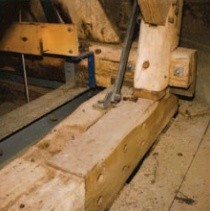
| St Mary, Pakenham, Suffolk: Timber oak plate repaired with new scarf joint with compatible material (Photo: Douglas Kent) |
Applications should be submitted with supporting documentation including plans and, for most denominations, two ‘statements’: the statement of significance and the statement of need, before recommendations for management and change are made.
In order to identify the significance of a bell frame, it is necessary to understand and evaluate its fabric, construction, age, whether it is the work of a single maker and whether the frame bears any important inscriptions. For example, there is a fine example of a signed and dated frame at the Church of St Botolph, Slapton, Northamptonshire (title illustration): a locally made frame for two bells installed in 1634 by Thomas Cowper of Woodend.
It is important to know how and why the frame has changed over time and the relationship with its setting in the tower, including ancillary elements such as clock mechanisms or carillons. It is then necessary to consider, in the words of English Heritage’s Conservation Principles:
- who values the place, and why they do so
- how those values relate to its fabric
- their relative importance
- whether associated objects contribute to them
- the contribution made by the setting and context of the place
- how the place compares with others sharing similar values.
Clearly, the last remaining early medieval timber bell frame in Dorset is of exceptional national historic significance, as are the detached timber bell cages at East Bergholt, Suffolk and Wrabness, Essex. But would a medieval timber frame which has been altered over the centuries with only a fragment of medieval work remaining have the same significance? The question is impossible to answer generically – each case must be judged individually.
Regional differences can also contribute to the significance of a particular bell frame. Historically, timber was relatively rare in areas such as Cornwall, compared to Herefordshire, East Anglia and South East England, the heartlands of timber-framed building. Are timber bell frames more precious in the southwest?
The statement of need is equally important. Mark Regan, the DAC bell advisor for Worcestershire, has highlighted the difference between ‘need’ and ‘want’. Is it actually beneficial to increase the number of bells which may threaten the historic timber fabric of a bell frame, through cutting or removal? Why is the project happening in the first place? Is it better to keep a complete ring of bells cast by one founder in its original timber frame? Does a historic timber bell frame have to be replaced by a steel one because the foundry or bell hanger (possibly driven by commercial considerations) feels happier to do so? A new steel frame is no guarantee the bells will ring more easily, even if the architect, bell foundry or bell hanger gives one.
Such are the threats to historic timber bell frames. But a further, often overlooked threat emerges: that which relates to their conservation and repair. Poor repairs are undesirable and shorten the life of the frame.
ARCHAEOLOGICAL RECORDING
Whatever drives the process of change, whether it is an augmentation, repair or re-hang, it is important to understand the structure of the frame and its historic development. Integral to the statement of significance is an accurate archaeological survey of the bell frame, carried out by a qualified archaeologist who is familiar with historic church buildings. The inspection report should include a measured scale plan of the frame, fittings, foundation beams and braces and should indicate whether or not there is a gallows end. It should also include section drawings indicating the historic development of the frame, the location of the belfry in a cross-section of the tower, the features of previous historic changes to the frame and sketches showing carpenter’s marks, inscriptions, redundant bearings and fittings and any important joint types.
The written report should give a description of the frame as observed from the visual record and drawings. A brief account of the history of the frame and bells covering their evolution and dating should be considered and this may require a visit to the local county archives to check churchwardens’ accounts. Identification of the frame using the Pickford classification should be made, noting any variations. An assessment of the condition, rarity and importance of the frame should be made, as should a photographic record of important features.
CONSERVATION AND REPAIR
 |
||
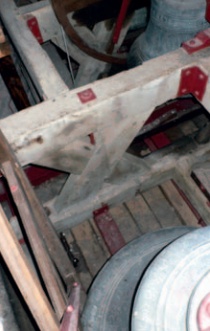
| St John The Baptist, Eldersfield, Worcs: New steel support grillage for the frame, which was lowered in the tower and strengthened with metal tie-bolts and angle-plates (Photo: Christopher Pickford) | ||
 |
||
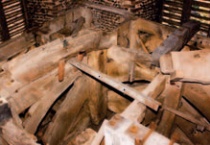
| St John The Baptist, Bressingham, Norfolk: The old timber bell frame has been preserved in situ and is still accessible. The new bells are hung in a steel frame on the floor below. (Photo: Douglas Kent) |
It is the fundamental guiding principle that historic timber bell frames can be repaired rather than replaced using traditional carpentry jointing techniques on a like-for-like basis, as has been the case at St Mary, Pakenham, Suffolk (above right).
Careful metal repairs and changes to design may sometimes be justified, for example where the distribution of the loads has changed due to the repositioning of the bells within the frame over the centuries, making a revised design sensible. It would be wholly inappropriate to use softwood wedges on an oak frame. Decayed mortises and tenons can be cleaned back and repaired with a scarf joint using compatible timber, as can braces, sills and beams. The introduction of resins into decayed timber is not favoured as it is impossible to reverse the procedure, although steel flitch plates may be appropriate.
Over time, timber bell frames do move (as can towers during ringing) given joint shrinkage and it may be necessary to introduce iron tie-rods to strengthen the frame. An example is at the church of St John the Baptist, Eldersfield, Worcestershire (left): a bell frame of 1813 by Charles Jacques of Gloucester, signed with a carved inscription reading ‘CHAS JACQUES BELL HANGER GLOR FEBy 2 1813 / T. SHIPTON T. CLARKE CH WARS’. The bells were re-hung in 2008-9 by AC Berry of Malvern, who provided a new steel support grillage for the frame, which was lowered in the tower and strengthened with metal tie-bolts and angle-plates.
If a timber bell frame has decayed beyond repair and is no longer fit for purpose it should ideally remain in situ with the new frame sited on a floor below the old bell chamber. The Church of St John the Baptist, Bressingham, Norfolk, for example, followed this approach (below left).
An analysis of the forces of the bells when in full swing is important when assessing the nature of the frame. It is vitally important to engage a structural engineer or architect who is familiar with historic bell frames and their repair. Over-specification, such as the insertion of massive concrete ring beams into fragile historic fabric, is to be avoided, as are mammoth iron girders being cemented into towers with engineering bricks, without due care to the impact on the frame and the tower’s fabric and performance. Respect for the existing fabric is essential for a successful repair.
Negotiating the technical challenges and administrative formalities involved in making changes to historic bell frames and the surrounding fabric can be long and demanding, but if all those involved work harmoniously and intelligently, a successful and rewarding outcome can be achieved for all concerned.
A NATIONAL SURVEY
It is a significant drawback that we do not know how many historic bell frames or frame types exist or their condition, although some useful research and inspection work has been carried out, notably in Essex, Norfolk, Lincolnshire, and Nottinghamshire. It is hoped that a joint venture between the SPAB, CCCBR and CBC to survey all categories of bell frames, county by county, will lead to a greater understanding of this fascinating and important cultural historic resource. This knowledge would undoubtedly help us to manage and influence change to secure their survival for future generations.
Recommended Reading
- Council for the Care of Churches, The Conservation and Repair of Bells and Bell Frames: Code of Practice, Church House Publishing, London, 1993
- A Drew-Edwards and D Lodge, Timber Bell Frames, SPAB, London, 1998
- English Heritage, Conservation Principles, Policies and Guidance for the Sustainable Management of the Historic Environment, EH, London, 2008
- C Hewitt, English Historic Carpentry, Phillimore, London, 1980
- D Insall, Living Buildings: Architectural Conservation: Philosophy, Principles and Practice, Images Publishing, Victoria, Australia, 2008
- J Ketteringham, Lincolnshire Bells and Bell Founders, privately published, Lincoln, 2009
- C Pickford, Bell Frames: A Practical Guide to Inspection and Recording, privately published, Bedford, 1992
- W Rodwell, The Archaeology of Churches, Tempus, Stroud, 2005