
Assessing Timber-Framed Structures
Jeff Stott
 |
|
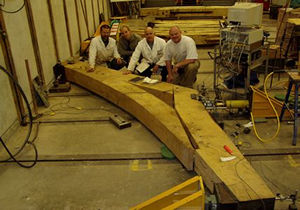
| Strength-testing a proposed roof truss for Pilton barn at the University of Bath | |
 |
|
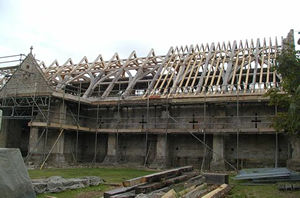
| Completing the roof stucture of the barn |
Conservation is arguably unique in its demands on architects and engineers. There are many complex issues raised when working with historic buildings and structures, well known to be more philosophical and aesthetic than technical. Important carvings, markings, structural elements and structural relationships will need to remain in context within a building to enable us to make sense of its development and to preserve its history. However, these elements may be structurally unsound. Do we sacrifice some to save others? Do we preserve all at all costs? Will the only solution to keeping them detract from them and reduce their impact? Such issues demand an integrated design process between all construction disciplines. There is no room for arrogance or truculence from any professional and certainly no need for any one professional to delude themselves that they know all.
In conservation, and possibly refurbishment or renovation, the thought process needs to be particular – ‘sooner or later, false thinking brings wrong conduct’ – the major difference for engineers being the design based on risk analysis. This is simply illustrated by the perennial problem of modern loading codes applied to historic floors. An understanding of risk and the clear communication of that risk to a design team and client by the engineer are likely to lead to a more universally accepted solution.
The design of new build allows the engineer to have control over the structure and its future performance by allowing him to dictate the loads paths, the spaces, materials and the materials to be used. In existing buildings these are already determined, and the load paths are sometimes not obvious. Through time, structures, especially timber, move and shift, swapping the share of the load from one element to the next. It is also possible that the original builders or designers got it wrong and that the old structure never maintained its original equilibrium, evident from a series of repairs or additions over the life of the building.
It is these particular variables that can catch you out. At the start of any project in conservation, most especially with timber structures, it is imperative that the historical perspective is understood and appreciated. The whole design team should understand the conservation plan, or if one has not been prepared, the significance of the structure and its components, and the aims of the proposed work. Each discipline should work closely with each other including archaeologists, historians, architects, engineers, contractors and conservators, as well as with their clients; this may sound obvious but how many of us truly appreciate each others concerns and can make positive contributions to the inevitable conflicts of interest.
And why ‘especially’ with timber structures? Timber is the most variable of materials when considering the use to which it is put. Unlike masonry, timber is asked to work in tension and compression, to transfer loads from one element to the next through connections at another level of variability. It can decay, be affected by rot and pest and, as it fails in areas, shifting and redistribution of load occurs. It deflects and distorts, it shrinks, it creeps and it behaves differently with variations of moisture contents and under different environmental conditions. Most of the oldest structures we commonly deal with include significant timber-framed elements, from small timber-framed cottages and farm houses to the large, impressive timber-framed roof structures of churches, cathedrals and tithe barns, dating from the 12th century to the modern day.
Thorough research is essential for all significant structures. Historical research should include studying local framing tradition through the survey of similar local structures. This will highlight the typical erection process and associated jointing. The experienced surveyor would approach his research with a frame of reference in the historical development of joints and regional traditions and variations.
A records search is equally important, as this may lead to the discovery of information such as contemporary accounts, drawings, even photographs, hopefully of various dates, which could show the development of the structure, why past repairs were made, previous uses and some of the structural secrets most buildings like to keep. Such research often provides a clearer understanding of the reason for the structure, its historical context, its quality, its erection process, and why changes were made, all of which would help to explain some of the structure’s weaknesses and failures.
The research may be carried out at the same time as the survey, enabling the team to consider all the information with fresh open minds. Their thoughts could then be set against the information provided by the research and their conclusions revisited. Whether this approach is appropriate is a matter of judgment, but it is certain that repair cannot be considered outside the historic context.
Timber-framed structures are often difficult to understand, especially where major elements have been lost, for example as a result of fire, decay, and changes in fashion. It is debatable whether it is necessary to examine in detail every rafter or beam repair, but the discipline secures appropriate thinking through respect for the original structure and construction process, and through the understanding of how the structure works. The survey therefore needs to consider the structure as a whole, and a search for tell-tale elements must be undertaken. Smoke blackening, posts and bressumers set back from the façade, position of braces, removed timbers identified by open mortices (often complicated by the original use of second hand timbers), previous repairs, scars, the dates of joints, brickwork and other associated structures; all of these may yield important clues to the performance of the building.
The discovery and identification of these clues should lead to the ability to construct a model. This may be simply a mental exercise to picture the three dimensional structure, but in the more complex cases, where the interrelationship of different structural elements is not clear, a physical or digital model may be invaluable. A model provides a focal point for discussion and analysis, and the trained eye of the building archaeologist, historian, architect, engineer and carpenter will each pick up differing aspects of the structure, all equally important.
For the engineer the assimilation of all this information is essential, not only to inform the repair, but also to ascertain whether repairs are even required. This is important as repair is often unnecessary and may actually be counterproductive. This is where we return to risk assessment, communication of risk to others, and the management of risk.
One of the problems structural engineers have with timber frames is that there is a reduced level of certainty. There is very little published technical research to help guide an approach to design for reconstruction, repair or conservation and if engineers approach conservation projects from a route founded in their traditional training, they will come into conflict with various disciplines, including insurers and public bodies.
A CASE STUDY: THE RECONSTRUCTION OF PILTON BARN
Cumhill Barn, at Pilton near Glastonbury, is a tithe barn dating back to the 14th century which lost its roof in a fire in the late ‘50s or early ‘60s. It is an excellent illustration of the need to approach a project from the view of risk assessment as opposed to the normal calculation and design, and for genuinely working closely with carpenters and historians. The project required a new oak base cruck roof frame to be reconstructed in green oak on 14th century walls already distorted by the original roof loads and weathering.
It was a conditioning of the funding that the frame had to be researched and reproduced as accurately as possible. This was carried out by Peter McCurdy of McCurdy and Co, timber-frame contractors and historians, along with Jonathan Saunders of Caroe and Partners, architects, whose research was to dictate the form of the new structure.
 |
|
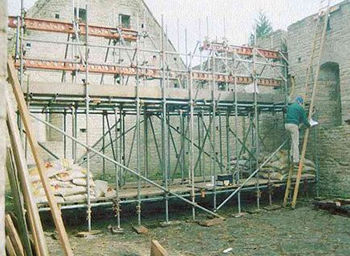
| The lateral restraint of the buttresses at the Pilton barn was tested by loading them vertically and horizontally to a factor of safety of 2.5 using simple load cells, jacks and dial gauges to measure distortion against load. | |
 |
|
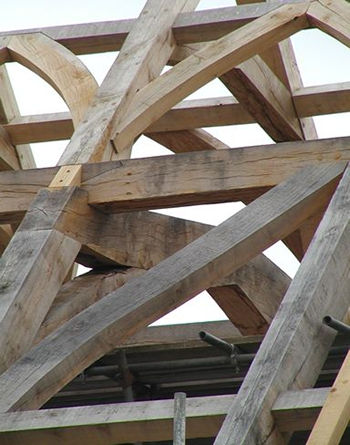
| A detail of the new timber-framed roof structure with its elegant wind braces |
Base cruck structures with an arch brace pose a problem for the engineer as these structures can have an inherent fault – with a risk of failure as defined by our modern standards. The fault lies in the amount of tensile stress placed in the connections of the arch brace. All roofs with a raised tie will try to spread, placing horizontal load into the supporting walls, columns or buttresses. By stiffening this element with an arched brace, the horizontal load to the wall is reduced substantially, with the residual horizontal load contained by the walls and, in this case, their buttresses. If the joint fails, either by damage to pegs, tenons or the walls of the mortice or by deflections, the support walls will be able contain an amount of horizontal load, thereby reducing the stress in the timber joints (in other words load sharing), but the amount can be difficult to determine.
This type of failure had clearly been happening at Pilton. The failure of the roof was evident in the distortions to the walls, and once archived photographs were unearthed it was obvious that a number of repairs had been carried out in the past to stop the roof from spreading. It was clear that sitting down with calculators remote from the site was not the correct approach and that in order to satisfy a traditional cruck frame, a series of tests needed to be employed that would inform risk assessments.
At Pilton, this was achieved by loading the buttresses vertically and horizontally to a factor of safety of 2.5. This was carried out using simple load cells, jacks and dial gauges measure distortion against load. Once a degree of comfort was achieved in the capacity of the walls, the proposed timber joints were also tested. These tests were executed by Thomas Hill at the University of Bath, with five full size crucks loaded to failure.
What was gained from testing was a frame of reference against which risk could be measured. It was found that the arch brace joints appeared to be a good deal stronger than was required, almost by a factor of ten. The tests however were carried out on timber that was relatively green and therefore not affected by shakes or checks. Unfortunately funding could not be secured to continue tests on matured oak sections and joints; although repairs were made to the failed joints, and these were once again tested to failure.
Each timber joint is unique, its strength being dependent on the section, its conversion from the tree, presence of knots and direction of grain, the percentage of heartwood or pith and of course moisture content. Over time, pest and rot can also effect each joint in different ways. All these variations cause some joints to fail and others not; some joints last for 100 years whilst others under the same conditions do not.
This particular case study proved the design of the original cruck frame to be correct. The sizes of timbers and the cutting of particular joints were adequate for the spans and loads. It was the variability in those joints due to decay and degradation that caused weakening in the frame, resulting in additional loading to the walls. As the walls deflected outwards, the joints continued to open and fail, thereby placing more load on the walls and promoting a self-perpetuating cycle of failure.
Armed with this information and some simple quantitative analysis it was possible to agree the joint detailing proposed by the carpenters and inform the team of the element of risk we were anticipating. Contingencies were drawn up to watch the behaviour of the frame over five years from its completion, and agreed repairs were at hand based on a conservation approach.
The results of the tests on the repaired trusses are not complete but showed values at their weakest of around three times the serviceable requirements. The repairs tested consisted of steel banding, steel faceplate fixings, steel through bolts and GRP rods resin fixed. In anticipation of the final report, it appears the weakest was the GRP rod fixing followed by the steel plates, with through bolting and banding providing failure loads of 40T, 22 times the requirement.
The drive for completing these tests was the need to take a pragmatic approach to the design of the new frame using the traditional jointing, knowing that there were risks involved. It would not have been acceptable to fall back on a no risk mind set in protection of insurance cover, pride or reputation as the final build would have been pastiche and uncomfortable for all involved. Instead, to protect all of the above, research was required, testing, talking and communicating risk, to reproduce as closely as was possible, the original Pilton Barn.