
Historic Wallpaper Conservation
Phillipa Mapes
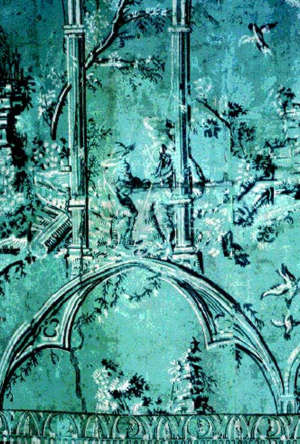 |
|
| Detail of an early 18th century 'Gothick' style wallpaper,
hand- blocked using distemper colours . |
Decorative finishes have as great an impact on the character of an interior as any architectural element or material. Wallpapers in particular are among the most significant, not only because of the visual impact of their design, their colour and their finish but also because of the high proportion of the surface area of the interior which may be affected. Today historic wallpapers are also attracting increasing interest as art and design objects in their own right. However, they are among the most vulnerable elements of a building, subject to changing patterns of taste, accidental damage, and decay, and within the historic interior surviving examples are rare, placing even greater importance on their conservation and understanding.
The conservation of historic wallpapers relies on the skills of the trained paper conservator. As an element of the historic interior, their conservation must necessarily draw on the skills of easel painting, wall painting and textile conservators also, and as an element of the fabric of the building it may also involve close liaison with architects, historic building advisers and other specialists, particularly where deterioration is concerned.
Aside from this multi-disciplinary approach, the conservator must also be able to recognise period designs and styles which not only encourage appreciation, but also help identify contemporary materials and manufacturing techniques. These in turn have a bearing on the choice of conservation treatment.
HISTORICAL BACKGROUNDThe earliest known wallpaper in Britain is thought to date from 1509 and was found covering the beams of the Dining Hall at Christ's College, Cambridge. The wallpaper had been printed by carved wooden block in monochrome on the reverse of single sheet documents. These early papers were usually handmade from reconstituted rags; small sheets were pasted together along an edge to make up a length, and then printed by wood block or stencil (or a combination of the two), using distemper or oil based colours. This type of production became the norm for wallpapers until industrialisation in the 19th century.
Wallpaper at this time provided a less expensive alternative to textile hangings. As such, designs imitated contemporary textile fashions. Flock wallpapers, made by sprinkling chopped wool over a design printed in adhesive, were deliberate reproductions of the damasks and cut velvet wall hangings of the day. Despite their rather ignoble reputation today, flock wallpapers were expensive, prestigious items and like most wallpapers were popular with the wealthy, fashionable classes.
Wallpaper, on either Oriental paper or silk, was also imported from China. These were exquisitely hand-painted to depict stylised gardens of flowers, trees and birds, or scenes of traditional daily life in China. Due to their beauty and fineness of execution, these papers became commonplace in the majority of stately homes in Britain during the 18th and into the 19th centuries and still accounts for their survival today.
By the mid 19th century, wallpaper production joined in the industrial revolution. Increasing demand for paper was met by the use of wood pulp, which was quickly and cheaply processed, but initially resulted in a poor quality, acidic paper. Developments in the papermaking machine allowed continuous lengths of paper to be produced. These in turn could be printed using new mechanised wooden and metal rollers. Concurrent developments in colour production also provided possibilities for new and more varied colours, including some 19th century experiments with arsenic green.
Alongside the rush for mechanisation, some manufacturers were still producing handblocked wallpaper including the doyen of the Arts and Crafts Movement, William Morris, who issued his first wallpaper in 1864. Competition was also strong from the UK's customary rivals, the French, who were producing incredibly elaborate scenic wallpapers for a very appreciative British market. These large 'panoramiques' usually consisted of non-repeating landscapes or vistas which continued around the room and could necessitate cutting over 1,000 blocks in order to print the different elements of the design.
Innovations continued to keep up with, and create demand for new types and designs of wallpapers. By the end of the 19th century, embossed wallpapers such as Lincrusta Walton had become popular, and special, damp-resistant wallpapers were being produced specifically for bathrooms and kitchens with the development of 'sanitaries', which were machine printed in oils and varnished.
Although the industrialisation of the wallpaper industry is often associated with the introduction of poor quality materials and designs, many fine examples were produced and can still be seen today. It should also be noted that increased production provided the opportunity for all but the very poorest levels of society to afford and enjoy wallpaper, and to take pride in the decoration of their homes.
DETERIORATION OF HISTORIC WALLPAPERSTo highlight the principal types of deterioration effecting historic wallpapers in situ, causes can be broadly divided into 'external' and 'inherent' factors.
EXTERNAL FACTORSAs with all works of art on paper, historic wallpapers are susceptible to damage by exposure to light and fluctuations in temperature and relative humidity. Combined with the effects of atmospheric pollutants, these can cause the breakdown of the paint layer and the paper support. Further problems can also occur as a result of the differing responses of the various laminations of the decorative surfaces and its substrate to environmental conditions, and wallpaper conservation should not be regarded as the treatment of the wallpaper alone. The wallpaper, adhesives, linings, canvas, plaster laths and other elements may each respond differently to variations in temperature and moisture for example, and varying dimensional movements are often at the expense of the weakest layer - the wallpaper. Such conditions are magnified within historic buildings where their wallpapers have endured seasonal changes, lighting and heating by candle, oil and coal fires, as well as the installation of central heating systems and a reduction in ventilation.
Historic wallpapers are also prone to damage from structural problems of the building itself. Movement or settlement cracks in walls will strain and tear the wallpaper at the surface, whilst leaks and damp spots can cause staining, encourage mould growth and the physical weakening of the paper, pigments and adhesives. Wallpapers stuck directly to plaster walls, with or without a liner, may also suffer disturbance from crumbling plaster or soluble salts emanating from the wall.
Wallpapers which have been traditionally hung on canvas and stretchers may be protected from the above to some extent. However, it is not uncommon for wooden stretchers to warp and/or the canvas to degrade to a weak, sagging and acidic carrier for the wallpaper. Traditional hanging techniques may also effect the longevity of a wallpaper in their use of impermanent materials, such as iron nails or inferior quality lining papers and adhesives.
Finally, more apparent damage to historic wallpapers comes from general wear and tear, such as human traffic, graffiti, furniture scratches, and holes made for fixtures among other factors. Although this type of damage is more obvious, it is usually less serious due to its localised nature.
INHERENT FACTORSFactors effecting the survival of a wallpaper are often directly attributable to the materials and method of manufacture of both the paper and the media (paint or ink for example) in which the wallpaper design is printed. Deterioration and embrittlement of a paper support dating after the 1850s, for example, could be as a direct result of the poorer quality paper stock used at that time. Alternatively, an 18th century Chinese wallpaper may have become brittle, not because it is of poor quality, but because its thin laminate construction makes it particularly vulnerable to environmental changes.
Similarly, of the wide variety of pigments and media used in historic wallpapers, many cause damage to the support, or are prone to deterioration themselves. Starch and animal glue/gelatin binders not only provide nutrients for insects, but are also prone to desiccation and shrinkage. This results in powdering, flaking and eventual loss of the pigment layer. Often design priorities are in conflict with the requirements of longevity; a matt paint for example, is often deliberately created using granular pigments in very little binder, but results in vulnerable, ill-bound paint layers. The conservator must try to preserve this matt appearance by not saturating the pigments yet at the same time securely reattaching and consolidating the flaking layers.
CONSERVATION TREATMENTSAny treatment of an historic wallpaper has to take into account several related factors; the wallpaper, its hanging system, and the architectural features and environmental conditions of the room itself. Thought must be given to solving the one problem without compromising the historical integrity of the whole room. In general, conservation treatments fall into one of two categories, depending on type and severity: in situ treatments (which are carried out on site); and those which involve the removal and re-hanging of the wallpaper.
In situ treatment is useful where damage is minor and localised, for example, a tear or small detached area. Surface treatments are often carried out in situ, such as the removal of non-ingrained dirt or dust and the consolidation of some types of loose paint media. Deposits and stains can also often be removed by localised aqueous treatments.
As in situ work involves treatment of the surface of the wallpaper only, it is not likely to be appropriate for seriously damaged or delaminated wallpapers. Its principal disadvantages are that it does not allow access to the wallpaper support or the wall for investigation and precludes work to it. In situ treatment is useful however, not only for cleaning and first aid repair, but providing an overall survey of the wallpaper in its original position. This can be documented to aid physical and environmental monitoring, and provide recommendations for future treatments.
REMOVAL AND RE-HANGINGRemoval and re-hanging are the most interventive treatments open to the conservator, and only take place if wall or wallpaper are severely deteriorated. In order minimise disturbance to the historical integrity of the wallpaper, it is removed in as large sections as possible rather than breaking it down into individual lengths.
 |
|
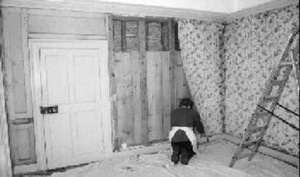
| A badly water-stained mid 19th century machine-made wallpaper before conservation |
When hung on canvas, whole walls of wallpaper can be removed by releasing the canvas from the nails and taking the wallpaper down using the canvas as a carrier support. Other methods involve dry, physical techniques using spatulas and blunt knives to work behind the wallpaper. Alternatively, wet, chemical techniques are used involving a variety of aqueous solutions and sprays, plus the use of superheated steam and/or enzymes to break down the adhesive bond between paper and wall.
Removal then allows treatment of both the front and back of the wallpaper. It also facilitates more effective aqueous cleaning, consolidation and repair techniques and allows for the removal and replacement of degraded and damaging linings. The wall surface itself can also be repaired and prepared with a new but historically accurate lining system on which to re-hang the conserved wallpaper.
The wallpaper conservator is therefore armed with several treatment options with which to conserve historic wallpapers. As wallpapers are viewed as art objects which are part of another historic structure, consideration must be given to the historic structure as a whole. The conservator's main priority is the preservation of the wallpaper, yet acknowledgement of where and how it was hung is also important. Original methods of production and hanging are replicated wherever possible. However, where appropriate, modern conservation-quality materials are used which will protect rather than cause damage to the wallpaper and help preserve it for the future.