
Woodworm
Anobium Punctatum
Tim Hutton
 |
||
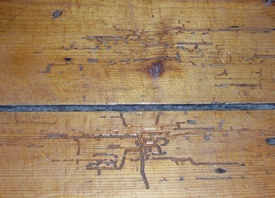
| This floorboard showed no evidence of infection or decay by Anobium punctatum until sanding and polishing revealed extensive tunnelling beneath the surface. Note that the tunnels are approximately 1-2mm wide and generally oriented along the grain. |
Anobium Punctatum, generally known as the common furniture beetle or ‘woodworm’, has been perceived to be the main cause of damage to timber in the UK over the last 100 years. During the last 50 years, insecticidal treatments have been widely marketed and used to ‘treat and preserve’ timbers in buildings thought to be at risk from this organism. The perceived risk of woodworm infection and decay has become so integral to the culture of property management and building repair in the UK that most buildings which are more than 50 years old have been treated at least once, and many have been treated repeatedly on each change of ownership. This became almost automatic as mortgage lenders became convinced of the requirement for ‘guarantees’ that woodworm was not active in a building before issuing loans.
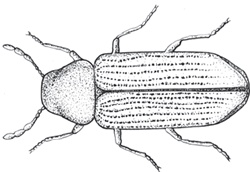
IDENTIFICATION AND LIFE CYCLEAnobium punctatum is one of a large number of beetles that have evolved to exploit the cellulose in timber in temperate climates. It occurs naturally in the wild in the temperate woodlands of northern Europe and may have colonised other similar temperate environments, particularly in New Zealand and the east coast of North America. The adults are small oval brown beetles approximately 4-6mm long. When viewed from above, the head and eyes are invisible beneath the thorax and the wing cases have relatively straight parallel sides rather than an oval or round appearance. When viewed under the microscope, the surface of the wing covers are seen to be covered with fine yellowish hairs and longitudinal rows of pits are visible. The antennae should be visible extending from beneath: these have eleven segments with the last three segments enlarged so that these three together are longer than the combined remaining segments.
 |
||
| Anobium punctatum adult, typically 4-6mm long (Image: BRE, from Recognising Wood Rot and Insect Damage in Buildings, BR453; all other images: Hutton & Rostron Environmental Investigations Ltd) |
The adult beetles emerge from infected timber in the spring, generally between May and August in the northern hemisphere, leaving a small round hole of approximately 1-2mm in diameter on the surface of the wood. The adult beetles mate soon after emergence: first, the female beetle appears to seek out suitable timber to lay her eggs and for the larvae to feed on, and the male then seeks out the female by tracking the pheromones she releases, giving preference to visual cues for standing timber. The adult beetles then die without causing further damage to timber.
The small pearl-like eggs may be seen with the naked eye in clusters of up to 50. These are only laid on dead timber where the bark has been removed and where there are suitable egg laying sites, such as cracks, crevices, exposed end grain or previous emergence holes. Anobium punctatum specialises in infecting the sapwood of temperate softwoods and hardwoods that have been dead for at least five years, but may also infect the heartwood of timbers such as beech, birch, cherry, alder and spruce, or timbers that have been modified by fungal attack. The eggs of Anobium punctatum generally hatch within six to ten days under suitable environmental conditions.
As with many other insects, the majority of the lifecycle of Anobium punctatum is spent as larvae. These are greyish white in colour with a narrow dark band over the mouth parts and grow to about 6mm long. The front part of the body appears relatively thick or hunched and has three pairs of visible legs. The rear section of the body is thinner, with a rounded tail-end. There are transverse bands with two rows of spinules on the first six segments and a single row of spinules on the seventh segment. In the wild, the larvae generally spend a year excavating tunnels usually approximately 1-2mm in diameter and generally parallel to the grain of the timber. These tunnels are backfilled with the residues of the timber consumed, forming a cream-coloured powdery material consisting of lemon-shaped pellets when viewed with a microscope, which may feel gritty to the fingers if relatively fresh. It is in the larval stage that Anobium punctatum causes most of the damage to timber.
Consuming cellulose from timber in this way poses many potential problems for the larvae, not least the fact that growing trees deposit chemicals within their timber to prevent or discourage attack by insects and other organisms. Cellulose is generally indigestible to insects or other animals. Anobium punctatum, like other cellulose-consuming animals, therefore relies on commensal micro-organisms within its gut to help digest the cellulose and produce the proteins and sugars that it requires to grow. The presence and absence of relative proportions of these and other chemicals within the timber appears to be crucial to whether they are able to flourish within particular timbers. This accounts for the apparent preference of Anobium punctatum for sapwood over heartwood, as the former is likely to contain more residual sugars and proteins of use to the growing larvae, while the latter is likely to contain more potentially toxic chemicals deposited by the tree during growth. Similarly, the preference of Anobium punctatum for particular species of timber may be due to this. However, as with other organisms specialising in decaying timber, partial decay and digestion of the chemicals that might otherwise limit infection by fungi may allow Anobium punctatum to infect and consume timbers that would otherwise be relatively indigestible and inhospitable to growth.
 |
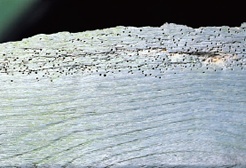 |
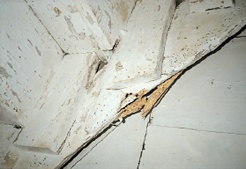
| Timbers supporting staircase within an under-stair cupboard: structurally significant decay has occurred to the sapwood band due to chronic problems with poor ventilation and long-term high relative humidity. | This oak beam shows evidence of extensive decay of original sapwood band by Anobium punctatum and other related wood-boring beetles. |
In the wild, after growing for about a year, the larva of Anobium punctatum forms a cell just below the surface of the wood where it pupates into an adult in approximately two to three weeks. The size of the larva when it pupates and the size of the adult and the resultant emergence hole will vary depending on the size of the larva at that time, and presumably on the relative suitability of the food and environment available. Anobium punctatum appears to have a preference for dead standing timber with the bark removed and only thrives under the conditions produced by the temperate climate of northern Europe. It therefore does not tolerate relative humidity below 60 per cent or timber moisture equivalents below 14 per cent, nor will it tolerate saturated timber and it will not thrive in temperatures much above 30°C.
THE CONDITIONS REQUIRED IN BUILDINGSThe environmental conditions within an occupied building are generally unsuitable for Anobium punctatum to lay its eggs, consume timber and complete its lifecycle. This is because it generally requires a relative humidity above 60 per cent for the eggs to hatch or for pupation to its adult form to occur. The sharply fluctuating and relatively low moisture contents of timber elements in an occupied building and the intermittent high temperatures that occur in many structures also prevent or restrict the growth and development of Anobium punctatum. For this reason, the insect generally requires at least three years to complete its lifecycle, not one, and the conditions required for it to flourish are only found in external structures such as outhouses and agricultural buildings, or in parts of a structure subject to chronic damp problems. However, it should be expected that at least 50 per cent of buildings in the UK have had some prior infection and decay by Anobium punctatum, and it is believed that nearly every house in New Zealand which is more than 15 years old has been subjected to some prior infection or decay. It has also been noted that almost every building in Germany has been infected.
 |
||
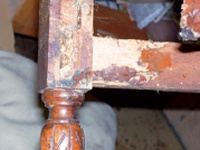
| This antique chair joint was decayed by Anobium punctatum because of the use of poor quality sapwood timber and animal-based glue. |
Timber structures in buildings in the UK likely to have been infected and partially decayed by Anobium punctatum at some time are those which have been subjected to damp conditions persisting for over five years, but not subject to liquid water penetration. Typical causes include condensation and/or high relative humidity, generally as a result of inadequate ventilation and cold-bridge condensation. Poorly ventilated basement and sub-floor structures, particularly the cupboards and voids beneath staircases, and timbers in poorly ventilated roof voids are therefore often found to have been infected at some time. The latter may be a particular problem in the north and west of the UK due to the relatively high moisture levels and reduced summer temperatures in roof structures compared to the south and east. Similarly, it is not unusual to find evidence of past woodworm infection and decay around poorly ventilated and insulated skylights or roof hatches, and in floor structures of bathrooms and kitchens subject to intermittent water penetration and/or high relative humidity levels. Despite the above, infection by Anobium punctatum today is rarely active or structurally significant, and heating and ventilation on occupancy will generally prevent further infection or decay.
Factors preventing infection and decay by Anobium punctatum in buildings are generally the absence of suitable sapwood timber in persistently damp conditions, and the absence of suitable cracks, crevices or holes for deposition of eggs on finished timber surfaces. Historically, the most significant damage by Anobium punctatum was perceived as being the decay of furniture, hence its common name, the furniture beetle. This is probably because in the past furniture was commonly made of cheaper and less durable local timber such as beech. The relatively high proportion of sapwood in country-made or ‘bodged’ timber furniture would also be vulnerable to Anobium punctatum, and the cracks and crevices formed at the joints in furniture also make it vulnerable to infection and failure at these points. It is not unusual to find decay to the bottom of the legs of poorer quality antique furniture due to the relatively high proportion of sapwood on turned elements in these areas, and because legs were often in contact with damp solid floor structures.
 |
||
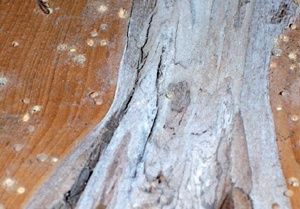
| This timber was infected by active Anobium punctatum and shows the typical holes and deposits of gritty yellow frass, which can be shaken out of old emergence holes by vibration from road traffic or building works long after infection has ceased to be active. |
As a food source, timber is generally deficient in available nitrogen and this is often a major restraint on the growth of organisms relying on timber as a primary food source. It is for this reason that pre-digestion by fungi or bacteria often makes timbers more vulnerable to decay by other organisms and why contamination with highly nitrogenous materials makes timber more vulnerable to decay. However, the glues used for the construction of furniture in the past were often based on animal products such as horn and contained high proportions of proteins and other nitrogenous materials. Their use in the joints of furniture therefore made the glued timber particularly attractive and vulnerable to infection and decay. More valuable furniture was often made with the heartwood of durable timber such as oak or, later, tropical hardwoods. These are generally resistant to infection and decay by the larvae and may represent the majority of antique furniture surviving today.
IDENTIFYING ACTIVITYIn most cases, infection and decay by Anobium punctatum is first suspected due to the discovery of typical small emergence holes in vulnerable timber elements and this is often the only symptom, resulting in unnecessary treatment. Diagnosis of Anobium punctatum infection has even been mistakenly made on the basis of holes made by drawing pins or from other causes. With experience, it is possible to distinguish emergence holes of Anobium punctatum from those of other woodboring beetles and from other causes. However, even when emergence holes are correctly identified, these are by definition the result of past infection and decay, as they are made by the adults emerging and leaving, so may no longer be active. More recent emergence holes can be distinguished by the sharpness of the edges of the holes and the differential colour between the interiors and exteriors of holes, as these may soon become contaminated by dust or the surface application of paints and other materials.
 |
||
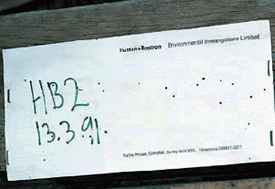
| Paper patch fixed to timber to detect fresh emergence holes: this can be a cost-effective way of monitoring activity by Anobium punctatum and the efficacy of measures to dry the structure. |
Paint finishes or special paper strips may be applied over suspected areas of Anobium punctatum infection to identify new emergence holes as these appear. Activity may also be monitored by trapping emerging adults with electric UV flying insect traps, and by checking cobwebs, particularly around window openings, for caught adults. Similarly, pheromone traps are widely available commercially to allow emerging adult males to be trapped. All of these techniques may be useful for general monitoring of activity and may also help reduce the risk of re-infection. However, it may not be possible to determine where the adults have been emerging from.
The deposition of quantities of fresh gritty frass from the emergence holes may sometimes indicate active infection. However, frass may often be found coming out of emergence holes in previously affected timbers many years after active infection has ceased. This may be due to vibration caused by heavy traffic on adjacent roads or building works elsewhere on the structure. Again, the appearance of freshly deposited frass around emergence holes has often been the justification for extensive remedial treatments in the past, even when the infection by Anobium punctatum has been dead or inactive for many years.
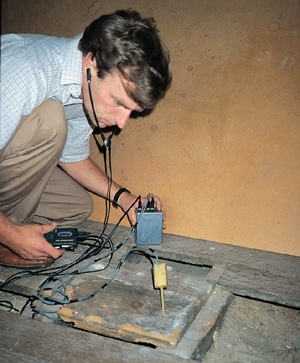
Searching for live Anobium punctatum larvae within timber is generally destructive, and surprisingly few larvae may actually be found. It is possible to use highly sensitive piezoelectric microphones embedded in the timbers to monitor activity, but this is not yet the basis of an effective diagnostic technique for use in the field. Similarly, it is possible to identify recently produced frass using immunological or genetic techniques. Again, this is not yet the basis of a cost-effective field identification technique.
In practical terms, the likelihood of significant Anobium punctatum infection is relatively easy to assess, in that if the deep moisture content of the timber is below 12 per cent, it is too dry for infection and decay to occur, while if the moisture content is between approximately 16 and 30 per cent it is possible, even if infection and decay is not present at the time of investigation. If a deep moisture content of 16-30 per cent is found in the sapwood of vulnerable timber, then an assessment has to be made whether this moisture content is likely to persist for over two years. If this is the case, then appropriate remedial measures should be considered.
In all cases, a risk assessment of the significance of active or past Anobium punctatum infection must be made; for example, there may be a high risk that active Anobium punctatum may be present or may occur, but a low risk of structurally or aesthetically significant damage occurring given the low significance of the vulnerable sapwood component of the affected timber. Alternatively, there may be a very low risk of continuing active Anobium punctatum infection, but a high risk of structurally significant decay having occurred in the past, for example, to joints in vulnerable timber structures or to timber supporting a valuable finish.
In the last 100 years, infection and decay of new furniture by Anobium punctatum has become less common. This is probably due to the increased use of tropical hardwoods and the application of solvent based varnishes and finishes which prevent the deposition of eggs in suitable materials. Active infection and decay is therefore generally confined to older furniture, particularly that which has been stored for at least part of its life in damp, poorly ventilated and unheated conditions. In this context, it should be realised that a localised low level of Anobium punctatum infection may persist in infected timbers for many years after original infection, particularly under conditions which are generally unsuitable for the beetle to complete its life cycle. Adults may therefore eventually emerge from previously infected timber many years after original infection, with little or no risk of further infection or decay. This should not be mistaken for evidence of a sudden outbreak of active infection and decay.
TREATMENTThe management of decay to timber by Anobium punctatum should be considered in two parts. Firstly, it is necessary to consider the extent of decay and its structural significance. This may require the testing of suspect materials so as to determine their adequacy to carry the loads expected. In buildings, drilling and probing are usually cost-effective for this purpose, although it is possible that x-ray or other non-destructive imaging techniques may be necessary when examining particularly valuable or vulnerable furniture or historic items. Ultrasound and other techniques have been tried but the results have generally proved hard to interpret. When the extent and significance of any damage has been determined, it then remains necessary to carry out appropriate repair. In buildings this generally involves replacement or partnering of affected structures. Although resin consolidation has sometimes been proposed, this is rarely cost-effective in buildings, although it may be applicable to valuable historic artefacts or furnishings.
Secondly, consideration should also be given to control of any existing residual active infection by larvae and to minimising the risk of infection and decay in future. This can almost always be done by insuring that the moisture content of timbers is not allowed to remain at over 16 per cent for more than a year. This is usually easy to achieve within the built environment by the application of standard techniques for controlling moisture penetration and providing through-ventilation and drying. In modern occupied and heated buildings, the moisture content of timbers is generally well below 12 per cent, particularly with the use of central heating systems. In the experience of Hutton and Rostron, this is usually all that is required to control infection and decay by Anobium punctatum, although it may sometimes take a year of two for an area of active infection to finally die out and for pupation and emergence of adults to stop. In this context, it should be realised that the actual decay caused by the larvae is relatively slow and it would usually take an infection by Anobium punctatum many years to cause any further structurally significant decay. Drying may be supplemented with measures to control emerging adults such as UV and pheromone traps.
 |
||
| Building pathologist using piezoelectric microphones to detect larvae actively eating through infected floorboards. Like many specialist techniques, this is a useful scientific tool for monitoring activity, but not a cost-effective field technique. |
Other treatment techniques may be considered if it is necessary to control an active infection by Anobium punctatum in the short term, for example to prevent the emergence of adults through a valuable decorative surface, or for management and contractual reasons, such as the sale of a property or a piece of furniture. Unfortunately, experience over the last 50 years has shown that the use of insecticides or chemical remedial timber treatments in buildings has not generally been cost-effective. This is because insecticides retrospectively applied to timbers generally only penetrate a few millimetres below the surface, and may therefore not affect the larvae causing the decay deep within the timber. It is also difficult if not impossible to ensure levels of insecticides that are toxic to the larvae in all parts of the vulnerable structure, particularly given the restraints of health and safety, and the environmental risks inherent in using insecticides or other potentially toxic chemicals. The environmental impact of some of the treatments achieving more effective penetration into timbers such as methyl bromide also preclude their extensive use. The use of insecticides may also represent a potential hazard to those occupying or coming into contact with the treated materials. Although the penetration of toxic levels of insecticides into the superficial layers of timber may be thought to prevent the emergence of adult beetles and restrict the development of new eggs, in practice Anobium punctatum seems to be adept at finding gaps or cracks in treated materials, allowing continued infection and decay, particularly if further water penetration occurs.
In recent years, more localised deep treatment using products such as organoboron timber treatments have been increasingly recommended. These may have the advantage of penetrating deeper into the timber, particularly under damp conditions, and may have a more persistent effect by killing the larvae over a longer period of time, possibly by killing or otherwise affecting the commensal organisms in their gut which allow them to digest cellulose. However, it can be hard to achieve or maintain a toxic level of these chemicals within the treated timbers under field conditions, and adults may continue to emerge after treatment. Because of these limitations, Hutton and Rostron has found chemical remedial timber treatments for Anobium punctatum to be rarely cost-effective.
Fortunately, other more effective techniques for controlling active infection by Anobium punctatum have been developed, generally by those involved with the conservation of museum artefacts. These treatments are generally based on environmental manipulation so as to create an environment that results in the early death of any Anobium punctatum larvae within the material. The most generally useful technique involves raising the temperature of the infected material to above 50°C. This may be easily achieved with furnishings or relatively small objects, but becomes much more difficult with larger more complex structures, such as a building. Special measures have to be taken to ensure that vulnerable materials are not damaged by excessive changes in relative temperature or relative humidity. This may be particularly problematic where vulnerable objects include other materials and finishes of a very different nature, such as oil paints and glues, which may have different responses to temperature and humidity. Raising the temperature will also significantly affect the relative humidity of the environment. The resultant drying may be a contributory factor in the killing of the Anobium punctatum larvae, but differential drying may also cause unacceptable cracking and damage to vulnerable materials. As a result, relative humidity must be carefully monitored and controlled during the heating process. These problems are generally now well understood and reputable firms exist with extensive experience of effectively treating structures and objects using these techniques. Despite this, heat treatment of a structure may be relatively expensive.
The international agreements preventing or restricting the use of methyl bromide or other similar compounds for the fumigation and the control of insect infestations has increased research into the use of inert gases for oxygen deprivation and the killing of insects. Carbon dioxide has been used in this way for many years and, more recently, nitrogen has been used. This is generally achieved by enclosing the objects or structures to be treated in a gas-proof container or enclosure, and pumping in the inert gas until the oxygen content of air has been reduced to below 0.2 per cent. These conditions may then have to be maintained for at least two weeks to ensure the suffocation of the insect larvae. However, it should be noted that damp conditions within the materials may protect the larvae from oxygen deprivation. These techniques may therefore be cost-effective for treating furniture or art objects but are unlikely to be cost-effective for treating buildings.
It is also possible to kill Anobium punctatum larvae by freezing. Obviously Anobium punctatum is able to survive at temperatures below freezing point in the wild and, if given enough time, the larvae are able to adapt to cold conditions. In order to kill them it is therefore necessary to subject objects as quickly as possible to a ‘deep freeze’ temperature lower than -20°C. Repeated cycles of freezing and thawing are also more likely to kill any remaining live larvae within timbers. However, as with heat treatments, it is important to consider the effect of variation in temperature and consequent variations in relative humidity on vulnerable materials.
In conclusion, proper maintenance and management should control Anobium punctatum infection and decay in buildings and furniture in most cases, without recourse to specialist remedial treatments. Unfortunately, a misunderstanding of the cause and effect of Anobium punctatum infection and decay in the past, and the inappropriate use and marketing of potentially environmentally harmful treatments, has resulted in the accumulation of potentially hazardous residues in the built environment. These factors have also resulted in a perception that any evidence of Anobium punctatum activity requires expensive and potentially destructive interventions and has resulted in enormous expenditure on unnecessary treatment – sometimes resulting in damage to original materials – that might have been spent on more cost-effective conservation measures. A better understanding of Anobium punctatum and the recent development of more cost-effective remedial measures renders more traditional treatments not only redundant but unacceptable.
~~~
Recommended Reading- AF Bravery, RW Berry, JK Carey and DE Cooper, Recognising Wood Rot and Insect Damage in Buildings, Building Research Establishment, 2003
- Walter Ebeling, Urban Entomology, University of California Press, Riverside CA, 1978
- Paul Leary, ‘The Eradication of Insect Pests in Buildings’, The Building Conservation Directory, Cathedral Communications, Tisbury, 2002
- David Pinniger, Pest Management in Museums, Archives and Historic Houses, Archetype Publications, London, 2001
- Michael K Rust and Donald A Reierson, ‘Use of Extreme Temperatures in Urban Insect Pest Management’ in Guy J Hallman and David L Denlinger (eds), Lethal Temperatures in Integrated Pest Management, Westview Press, Denver CO, 1997