Working Together
John Glenn
 |
|
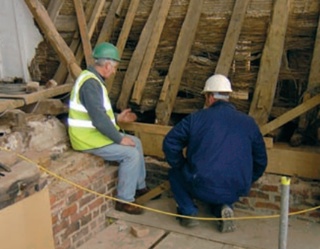
| Terry Hodson and Russell Stokes discuss repair solutions to the 17th century trussed rafters at Alford Manor House. Craftsmen are responsible for making decisions which directly affect historic fabric and so need to be carefully iintegrated into the conservation team. Maintaining an open dialogue between all team members is vital. |
In the mid 19th century, Robert Kerr, a founding member of the Architectural Association, regarded archaeology as the science of rubbish. Such a sweeping condemnation of an entire academic discipline is perhaps more understandable when viewed in the architectural context of the period in which Kerr was writing. It was a time when antiquarian scholarship exercised a disproportionate influence, not only on the design of new buildings, but also on ‘restoration’ work, much of which was heavy-handed and insensitive, and resulted in the wholesale destruction of genuine historic architecture. Today, no one with any claim to sanity would advocate pulling down Peterborough Cathedral in order to build it in a purer form of medieval gothic. Thankfully such radical proposals as this, put forward in the first half of the 19th century by the Cambridge Camden Society, have long been abandoned and a more enlightened approach to the protection and conservation of historic buildings has evolved.
The current, more measured and considered archaeological approach to conservation and restoration has not always found favour with everyone, however. Clive Aslet, the editor of Country Life Magazine, considers that the philosophical pendulum has swung too far the other way. In an article in The Daily Telegraph in January 2005 he argued that some English Heritage inspectors and local authority conservation officers are little more than ‘architectural traffic wardens’ who will resist almost any proposal that alters the existing fabric of historic buildings. Although there may be times when, faced with a particularly banal proposal, even a conservation officer might empathise with traffic wardens, this parody belies the truth. Even the most evangelical of conservationists needs to operate within well established guidelines. Applications for listed building consent and change of use are evaluated using nationally accepted planning criteria such as those set out in PPG 15 and 16. As a result, even though the level of practical and theoretical experience of individual conservation professionals may vary enormously, all of them work within well defined parameters. As government policy guidelines are in the public domain, owners and their agents should also take the trouble to understand them before preparing proposals to alter or restore any historic buildings. Undertaking this preparatory research prepares the ground for productive and informed dialogue with the relevant conservation officers and local authority development control departments. This approach is straightforward and can only be of benefit to both applicants and adjudicators.
 |
|
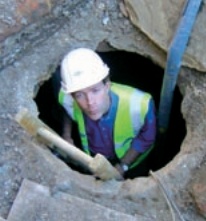
| The buildings archaeologist, Jonathan Clark, emerges from a well at Ayscoughfee Hall, during his investigation to uncover the history of the house. |
Conservation officers and the statutory inspectors (of English Heritage, Cadw or Historic Scotland) are required to have a working knowledge of a wide range of disparate skills. Few officers and inspectors would however claim to be experts in many of the specific areas of conservation specialisation. If an occupational comparison is thought necessary, then surely ‘general medical practitioner’ (or ‘GP’) is more appropriate than ‘traffic warden’. While the role of conservation officers and inspectors is essentially to protect our built historic fabric, they are also in post to advise and assist owners and their agents how to achieve what is best for the buildings that fall within their professional remit. Not only in the area of best restoration and conservation practice but also when necessary as to what is acceptable as regards alteration and sustainable change of use.
The military tenet that ‘time spent in reconnaissance is seldom wasted’ is equally relevant to the preparation of strategies for the conservation and restoration of complex historic fabric. In such cases, just as GPs function in the NHS, English Heritage inspectors and conservation officers actively encourage owners of historic buildings to consult suitably trained professionals before undertaking work on their properties. When appropriate, inspectors and conservation officers are also team players who can, and very often do, work in harmony on projects with owners and their professional agents.
Experienced conservation architects or specialist surveyors are usually the best qualified to act as lead consultants in restoration projects and they are usually high on the list of recommended professionals. Nevertheless, their suitability for this role should not be taken to imply that they are self-sufficient. Just as conservation officers and inspectors are unlikely to have the in-depth knowledge required to deal with all aspects of work on historic buildings, architects and surveyors also need to recognise that it is sometimes necessary to work closely with conservation professionals and craftspeople from other specialisations. Establishing confidence and trust between the varied specialists is therefore crucial to the success of a project. The lead consultant’s role is pivotal, and as such they often have to undertake the lion’s share of the work, but they should also recognise the potential value of every other team member’s contribution to the design process. As conservation professionals, architects and surveyors are, at best, only first amongst equals. This may of course be disputed by some lead consultants who are often prepared to lock horns with conservation officers and inspectors, precipitating a loss of trust and co-operation, and then complain when things don’t necessarily go their way. Fortunately, there are also many professionals who recognise the benefits of working together and that a confrontational approach can only be detrimental to conservation projects and that in the long run this does not serve their client’s best interests.
Once appointed as lead consultant it should be an early priority of the design-team building exercise to initiate a professional dialogue with the relevant local authority conservation officers and if necessary with the pertinent national body (English Heritage, Historic Scotland or Cadw). This contact should aim to establish any listed building or planning consents that are needed before the design work is undertaken. In a perfect world, the extent of any subsequent dialogue should be determined by the nature and complexity of the project being undertaken. With an excessively heavy demand on the time and financial resources at the disposal of many conservation officers, this is sometimes difficult to achieve. The discussions however should always be detailed enough for the consultant to determine as early as possible the specific requirements of the more specialist conservation skills to be included in the design-team. This will help to ensure that the project can be delivered on time, within budget and to the required standards of workmanship.
 |
||
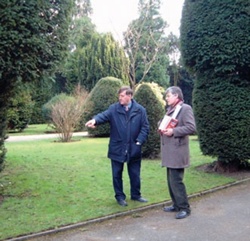
| John Glenn and Peter Goodchild of York University discuss the age of the yews in the grounds of Ayscoughfee Hall, a rare, possibly unique, surviving example of an early 18th century town garden. |
Just as architects and building surveyors need to understand the value of archaeological and other specialist input, archaeologists and conservation officers also need to be aware that the design process is not a purely intellectual or paper-based exercise. For example, a conservation plan for a historic building often contains substantial archaeological input, but it should be above all a pragmatic and usable document. It should recognise that there are many practical considerations which need to be addressed if historic buildings are to be maintained and conserved in a sustainable way. When preparing the document, there is therefore a need to find a consensual balance between the necessarily pragmatic approach of the architect and the more academically based views of some of the other conservation professionals. This can only be achieved by establishing amongst team members and conservation officers an all-inclusive, constructive and open dialogue in which all the participants’ views are considered. This will help to develop mutual respect amongst the various professionals and encourage a more general understanding of the design aims. Early co-operation between the diverse conservation disciplines not only helps to promote good working relationships but in the long term it can also be of great benefit to the building, and this exercise should always be considered an essential part of the project. Care, however, must be taken in the process of choosing the right level and type of specialist expertise. While it is important to exercise budgetary control over fee-scales, and appointments usually need to be made by competitive tender, it is also essential that bids are assessed on a like-for-like basis. Accepting a tender on cost grounds alone is unlikely to result in a team with the expertise required to ensure a successful outcome.
 |
|
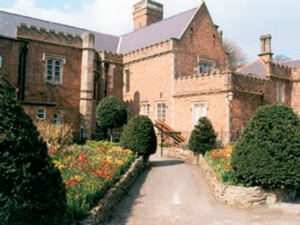
| Ayscoughfee Hall (c1451), Spalding, Lincolnshire |
Structural engineers and quantity surveyors with conservation experience are now generally accepted by lead consultants and clients as an essential part of an architectural design team. There are, however, other specialities that can contribute to the overall project. The lead consultant should be both willing and able to recognise the potential value of input from other professions and to understand the basic principles of the other specialities so that team members are chosen who are right for the project. For example, for more complex historic structures a specialist building archaeologist can prove invaluable if they are brought into the design process at an early stage. This has certainly been the case on three recent Anderson and Glenn conservation projects, namely Ayscoughfee Hall (c1451), Alford Manor (c1611), and Boston Guildhall (c1390). For all of these, detailed analyses of the planning histories of the buildings were prepared by Jonathan Clark of Field Archaeology Specialists Limited (FAS) at the University of York. This work provided a good understanding of the historic fabric, and made a valuable contribution to the overall development of the restoration proposals. All three of these important projects are supported by the Heritage Lottery Fund (HLF), and the success to date of each one demonstrates the value of conservation team-work.
ALFORD MANOR HOUSE – A CASE IN POINT
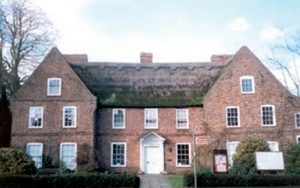
Alford Manor House is in the north of Lincolnshire and has been in the ownership of The Alford and District Civic Trust for over 40 years. It is one of the largest thatched houses in the region and in Pevsner it is said to date from the 16th century. By the year 2000 the owners were growing concerned about its state of repair and in an attempt to obtain HLF funding they commissioned conservation architect Mary Anderson of Anderson and Glenn to produce a costed schedule of works for the building.
The construction of the house is extremely complicated, so a detailed measured survey was carried out to inform the works and to assist in understanding any potential problems. The survey revealed that the minor repairs originally envisaged would not be adequate: the house had serious structural problems which would require substantial intervention to put them right. As part of the project the client also wanted some minor alterations to the fabric of the building. The architect recognised that this went beyond general repairs and that listed building consents would be needed for much of this work. Early on in the design process the architect therefore established a dialogue with East Lindsey District Council’s conservation officer, Fiona Newton. Detailed discussions were soon under way and between them a strategy for dealing with the restoration of the building was agreed which took into account the structural problems.
Initially the design team consisted of the conservation architect, a structural engineer (SE) and a quantity surveyor (QS) who was experienced in costing work on historic buildings. While most architects are happy to use a QS, there are some who produce their own priced estimates for restoration work, and for straightforward projects this is often satisfactory. With complex conservation jobs, such as Alford Manor, it is essential to add an experienced and suitably qualified QS to the team. In order to understand the structural development of the house, it became clear that an archaeological survey of the building was needed to produce a better understanding of its history.
The archaeological assessment of built structures, now more than ever, requires very specific knowledge and experience. Some architects and most conservation officers now realise that this specialisation is likely to extend beyond the scope of the old-fashioned archaeological generalist, who does not always possess the experience or the confidence needed to provide the balanced and specifically informed input that is an essential element of the repair design process. There are now a number of commercial organisations that specialise in building archaeology.
 |
|
| Alford Manor House (c1611), Alford, Lincolnshire |
FAS of York was commissioned to undertake the work at Alford. This proved to be an excellent appointment and the archaeologists were quickly welcomed and integrated into the project team. It was decided that an opening up contract would not only provide a better understanding of the planning history of the house, but it would also expose any potential structural problems. This exploratory work required a methodology that was sensitive to the important historic fabric of the building and practical enough to best inform the archaeological analysis while also revealing the otherwise hidden structural condition. As listed building consent was needed, the architect therefore produced a schedule of works after having discussed the proposed methodology in detail with the conservation officer.
Tasker Builders Ltd, which specialises in restoration projects, was awarded the opening up contract. Subsequently, much of this work was carried out in the presence of the archaeologist, Jonathan Clark, and other members of the design team. On several occasions the conservation officer was also in attendance. This inclusiveness, created an excellent spirit of camaraderie amongst the different professionals and lively discussions were instigated as more and more interesting features of the history of the building were revealed. For example, the archaeologists found that the building was not as old as originally thought, nor did its method of construction conform to previously held theories. Using dendrochronology, a building date of 1611 was firmly established and a much clearer idea of its planned form has emerged. At Alford Manor the excellent team work of the conservation professionals has been of immense benefit to the design process. The team was augmented by project manager John Sutton, thatching archaeologist, John Letts, thatching specialist Keith Quantrill, and the HLF have also required the appointment of a number of other relevant specialists to monitor the work.
Having put forward the case for team work amongst the conservation professionals, it is important to fully involve an even more important constituent required to achieve a successful project – the client. Owners of historic buildings don’t usually need to be concerned too much with every technical detail of the design process, but it is essential that they are involved in all major decisions. Their first priority is to dictate the broad aims of the project and it is important that they are kept fully informed as to any problems that inevitably occur when complex repair jobs are working on site so that their aims remain at the forefront of the decision making process. Understanding and keeping up with any changes that will impinge on the end use of the finished building can only be achieved by involving the client or their agent in the design and construction phases of the project.
Confrontation can easily be avoided if all of the participants understand the basic principles of good building conservation practice and are prepared to co-operate to achieve a successful project. It is simply a matter of team work.