
Green Infrastructure and the
Urban
Historic Environment
The role of parks, gardens and trees in climate adaptation
Jenifer White
 |
||
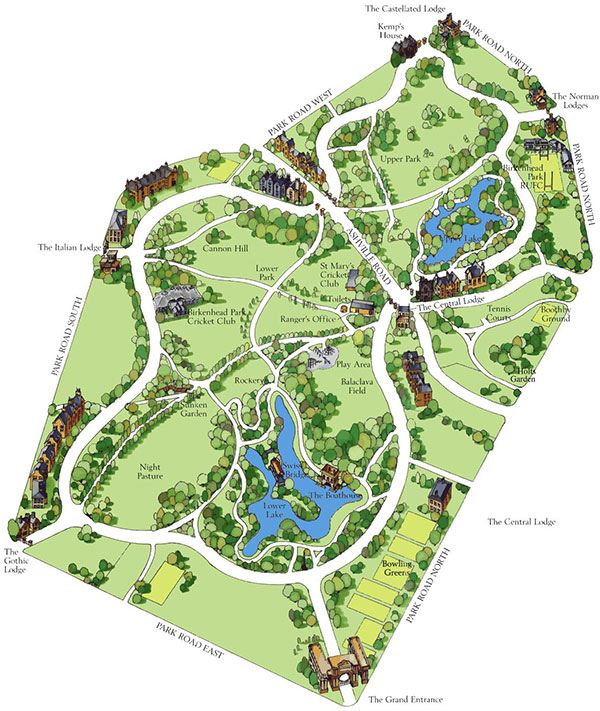
| Plan of Birkenhead Park which was designed by Joseph Paxton and opened in 1847 (Photo: Alexandre Gravis, CC by SA 4.0) |
THE OLDEST municipal public parks have now served their communities for more than 150 years. As the gruesome Covid-19 lockdowns in 2020 demonstrated, they are still essential and very much valued. Designed as places for health and amusement, public parks are still truly relevant in people’s lives. Trees, gardens and parks add to the attractiveness of our towns and cities. The combination of public, commercial and domestic green spaces contributes to the sense of place, its vibrancy and prosperity. However, the origins of these green spaces, their cultural significance, multiple community benefits and on-going upkeep is often overlooked. As climate changes deepen, we all need these green spaces and features to work to help temper increased temperatures and water run-off from heavy downpours, as well as places to relax and exercise. They also have a significant role in the nation’s nature recovery strategy and making space for wildlife. Recently, the wellbeing benefits of parks and green spaces have once again come to the fore in discussions of public health and climate change adaptation.
THE INVENTION OF URBAN PARKS
Our urban green spaces are remarkably diverse in type and size ranging from urban commons and greens to municipal public parks and gardens. This includes botanical gardens, cemeteries, recreation grounds and playing fields, sports grounds and golf courses, town squares, town walks, street trees and verges, visitor attractions, commercial premises, domestic gardens, allotments and detached town gardens, private garden squares and communal grounds. Each is central to the story of how its community developed. Public green spaces such as municipal parks, cemeteries, town walks, avenues and boulevards, and housing landscapes were often part of bigger area improvements, sanitation and education initiatives, and civic developments such as galleries, museums and libraries.
The pioneers of parks worked in the context of urban expansion and recognised the need for green lungs and access to open spaces. The 1848 Public Health Act empowered local boards of health to provide, maintain and improve land for municipal parks. The great British public park was replicated around the world, with Birkenhead Park (opened in 1847) now being put forward for world heritage site status as the inspiration for this global fashion.
The new urban public parks were prestigious developments, attracting top designers. Although Parisian parks were a big influence, designs often followed the principles developed by Humphry Repton (1752–1818) and promoted by John Claudius Loudon (1783–1843) and Joseph Paxton (1803–1865), whose projects included Birkenhead Park and the Crystal Palace Park. The early roll call also includes protegees of Paxton (Edward Kemp, John Gibson, Edward Milner), as well as Joshua Major, Decimus Burton, Robert Marnock, James Pennethorne, Alexander Mackenzie, and Thomas H Mawson. Later, design competitions became important, and local authority in-house experts increasingly took on the new commissions. This tradition continues into the 21st century: the world-status 2012 Queen Elizabeth Olympic Park
at Stratford was the brainchild of LDA Design, with Hargreaves Associates.
 |
|
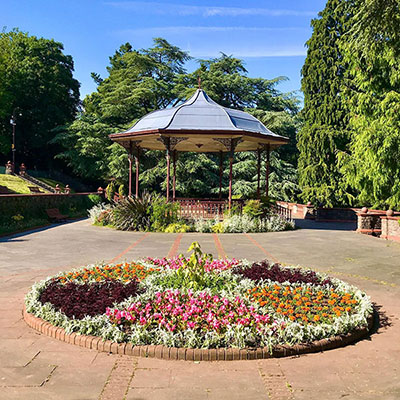
| The bandstand and terracing at CADW-registered Belle Vue Park (1893), designed by Thomas H Mawson as his second public park commission (Photo: Paul Cottrell) |
Park layouts across the decades reflect shifts in design aesthetics from Victorian to arts and crafts and modernism, and these trends are reflected in the registered public parks on Historic England’s National Heritage List. The post-second world war registrations published in 2020 illustrated how the Register of Parks and Gardens of Special Interest had been expanded to embrace more recent typologies such as the Kennedy Memorial at Runnymede (Sir Geoffrey Jellicoe), housing estates like the Brunel Estate in Westminster (Michael Brown), public parks like Campbell Park in Milton Keynes (Tony Southard, Andrew Mahaddie and Neil Higson), Alexandra Road Park in Camden (Janet Jacks) and Harlow Town Park (Frederick Gibberd and Sylvia Crowe).
There are now some 300 public parks registered in England, but this is a fraction of the estimated 27,000 public parks across the UK, and undoubtedly more should be recognised. To be considered for registration, sites should be either good representative or early examples of a particular style or layout, or include listed features; alternatively, the park may be part of a wider group of heritage assets in an area. There is a vast research resource waiting to be tapped in the conservation management plans prepared for National Lottery funded restoration projects since 1995.
As well as landscape design, many park buildings are also of note. Intended to serve the visitors’ needs, distinctive ‘parkitecture’ often includes entrance lodges, boundary gates and railings, cafes and toilets, playgrounds and paddling pools, bandstands, seating shelters, fountains and drinking fountains, and sports pavilions. Larger parks sometimes included conservatories, aviaries and zoos, or lidos. As places for civic pride, many have war memorials and statues of national and local heroes. Buildings and structures may well be listed or included on local heritage lists. Interesting parkitecture is likely to indicate that the historic landscape design is also of importance.
 |
|
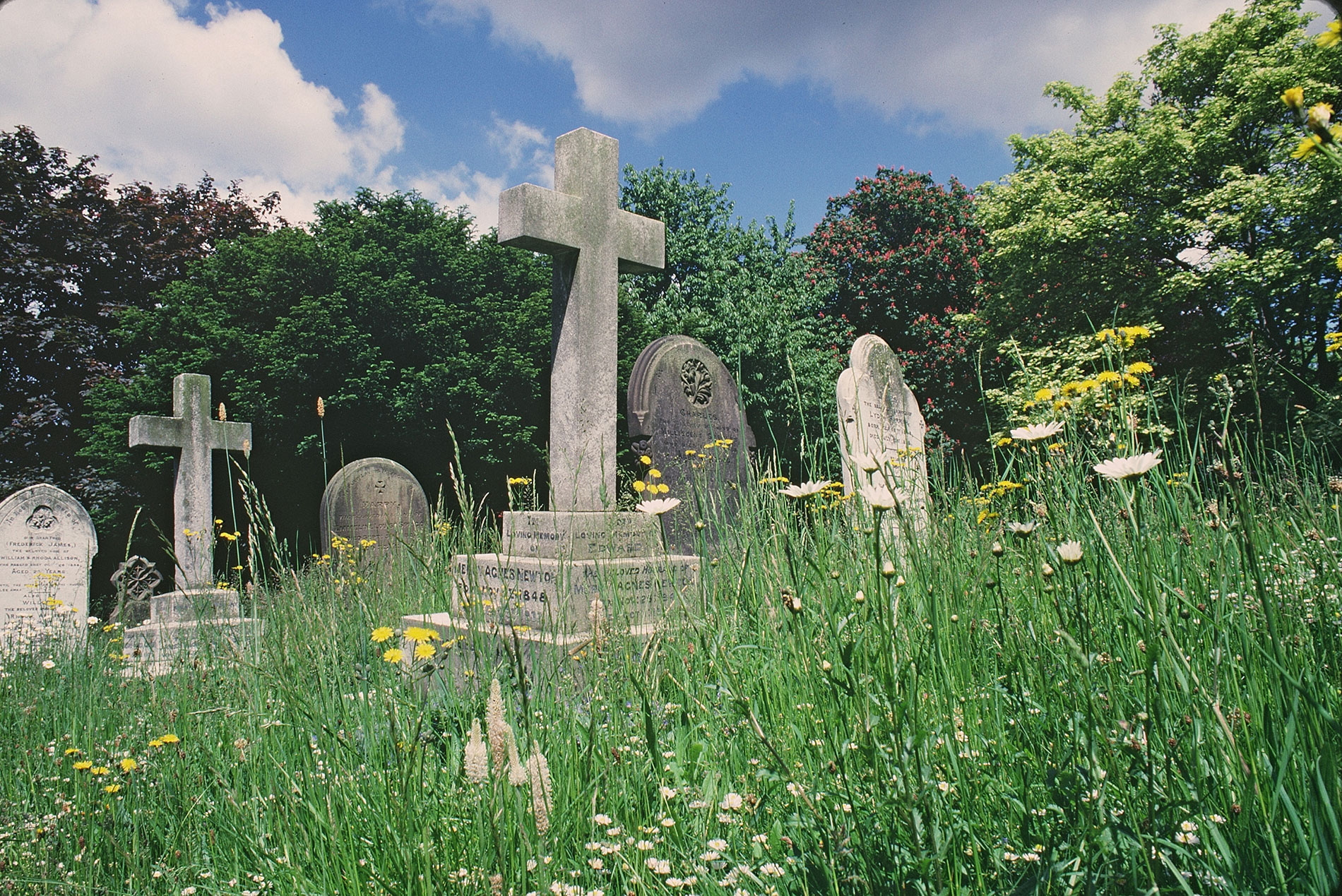
| First established in 1858, Broadway Cemetery, Peterborough was designated a county wildlife site in 1990. (Photo: Peter Wakely, Natural England) | |
GREEN INFRASTRUCTURE
There are parallels in the histories of other green spaces and their designs. In developing the new cemeteries in the mid- to late-19th century, great care was taken with the landscape design and architecture to create not just resting places for the dead but places to visit for quiet relaxation and meditation.
Over 100 historic cemeteries are now included on the NHLE, and like public parks, probably more should be added. Trees and green spaces are often key to the character of conservation areas as well. In Leicester, for example, the central avenue of trees and green spaces making up the New Walk Conservation Area (designated in April 1969) forms a kilometre-long linear park linking the city centre with the 1883 Nelson Mandela Park (formerly known as Victoria Park). Close by the historic Welford Road Cemetery is a local nature reserve. Indeed, if you look at the city council’s web mapping system, you can see how the registered parks and cemeteries, tree preservation orders and conservation areas link together with wildlife sites to create a network of green across the city.
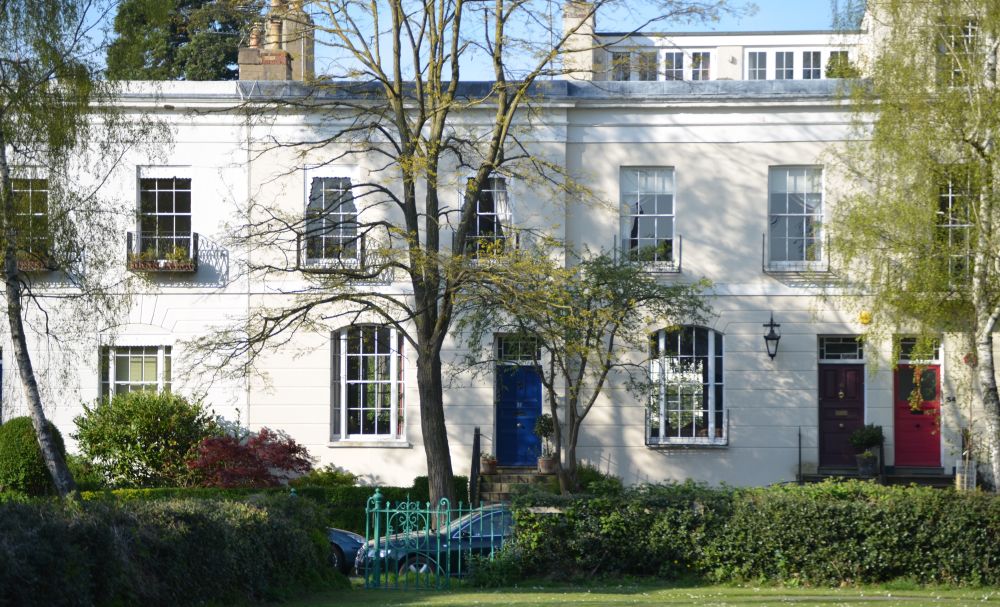
Hedges, street trees and gardens contribute to the character of this conservation area in Cheltenham. (Photo: Jonathan Taylor)
This ‘green infrastructure’ (GI) is defined in the National Planning Policy Framework (NPPF) as ‘a network of multi-functional green and blue spaces and other natural features, urban and rural, which is capable of delivering a wide range of environmental, economic, health and wellbeing benefits for nature, climate, local and wider communities, and prosperity.’ All local planning authorities in England must set out strategic policies for GI and it is woven throughout the government’s planning policies for climate change, for conserving and enhancing the natural environment, for dealing with ground conditions and pollution and for supporting healthy and safe communities. New development is expected to help improve green infrastructure, although too often the emphasis is on creating new features such as rain gardens and greenroofs. "There is certainly a need to address poor provision in many areas, but the largest local GI assets in this network will inevitably be the historic public parks, cemeteries, recreation grounds, urban commons and greens. Together with mature street trees, these are irreplaceable features that need to be protected, conserved and managed to maximise their GI functionality. The statutory Climate Change Committee, and more recently the Parliamentary Environmental Audit Committee, have both stressed the need to protect and expand green spaces to mitigate the urban heat island impacts of climate change. In the United Nations’ whole-system approach to sustainable cooling, reducing urban temperatures through GI is one of three critical steps, along with reducing cooling needs in buildings and greater efficiency in cooling buildings.
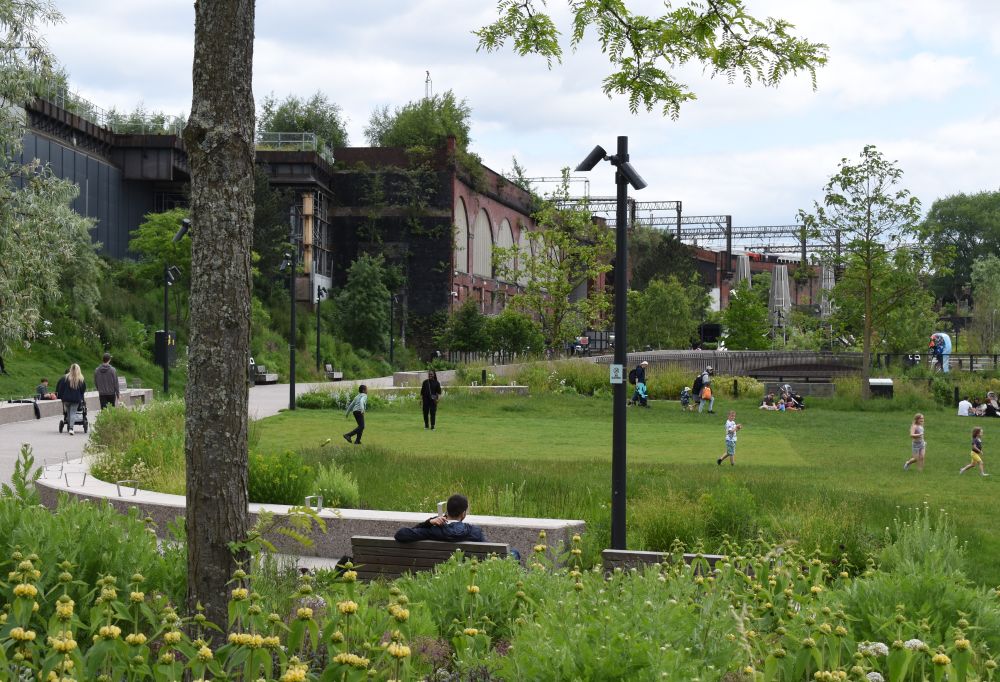
When it opened in 2022, Mayfield Park was the first new public park in Manchester for over 100 years. (Photo: Jonathan Taylor)
In recent times, there has been less scope for creating new large public parks and it was to great excitement that in 2022 Manchester opened its first new public park for over 100 years. Mayfield Park encapsulates 2.6 hectares and cost £1.4 billion. By contrast, the city’s first three public parks, opened in 1847, each covered between 11–12 hectares (more than four times the size of Mayfield). The land for Queen’s Park originally cost £7,200 and there were substantial added costs from a new museum and art gallery, and for landscaping. This was therefore a significant investment but it continues to deliver returns. Queen’s Park remains a crucial part of a green corridor leading out of the city centre along the River Irk.
Unlike maintenance of other public services such as libraries, care of public parks is not a statutory duty for local authorities, so their conservation and upkeep are vulnerable to budget and staffing cuts. Following years of degradation, in 1995 the National Lottery came to the rescue and over the next 25 years more than £950 million was invested in restoring more than 900 public parks and cemeteries across the UK, benefiting some 37 million users. Budgets continue to be under pressure, however, so there is ongoing consideration of alternative funding models.
It is worth noting that alternative models have been tested for over 150 years, and as a provider, the local authority has proved the most robust. The municipal nature of public parks – free to use throughout the year, and all welcome – is very much part of their character.