
Measuring Moisture in Masonry
Matthew Wellesley-Smith
|
| Solid masonry walls absorb and release moisture naturally, and even relatively high levels of moisture may have little effect on the interior fabric and comfort, so measurement should always be combined with a subjective appraisal of the symptoms: is the level of moisture causing harm? |
ISSUES CAUSED by excessive moisture in masonry buildings range from minor blemishes on wall finishes to reduced thermal comfort and occupant health, and ultimately to severe deterioration of wall finishes, facing stone or brick and even building structure. For this reason, it is often assumed that accurate measurement of moisture in masonry is necessary to mitigate these risks. However, measurement in isolation is not a useful exercise.
Simplistic concepts of ‘damp’ and ‘dry’ make little sense when you consider that masonry will always incorporate some water. Even in a wall with no moisture problem, there will be water molecules bound to pore walls, capillary condensation within pores and unbound water moving through the pore system via surface diffusion or liquid movement via capillary pressure.
Any attempt to assess moisture levels in masonry must be framed within the context of the symptoms of damp and their impact, which will depend on how the space is used and the perception of the occupants. For example, high moisture content in the walls of a stone vaulted wine cellar or ground floor hearth might be acceptable if the only consequence is minor salt efflorescence, but where plaster is blowing or paint delaminating it may well be unacceptable even if the moisture content of the stone is in fact lower. In other words, moisture content is not the principal determinant of whether a masonry wall is suffering from ‘damp’.
Good assessments of damp masonry thus combine measurement with subjective appraisal of the symptoms. By contrast, if moisture measurements are allowed to define the problem, flashing red LEDs or a bleeping measurement device can easily lead to reflexive (and possibly unnecessary) remedial work rather than considered, targeted solutions. If a surveyor has good reasons for needing to measure moisture as part of an assessment, the techniques used and the granularity of measurements need tailoring according to the context and the aims of the assessment.
Various methods of measuring moisture content in masonry are available. Moisture content can be measured indirectly by relative measurements giving qualitative or quasi-quantitative results, or directly giving quantitative results of absolute moisture content of a wall sample (not necessarily the wall). Choice of the most appropriate method depends on the purpose of the investigation. If the aim is preventative maintenance, identifying building elements vulnerable to damage and assessing likely sources of moisture, then qualitative and quasi-quantitative measurement may be sufficient. But for defining the scope for remedial work to address an obvious issue such as an overflowing hopper, quantifying the level of moisture in a specific volume of masonry might be required to determine the potential drying time required.
In masonry, quantification requires invasive testing, such as taking drilled samples. The use of different techniques allows these invasive tests to be minimised, the goal in most contexts being to gather sufficient information to determine an appropriate solution, no more. It is therefore sensible to begin with non-invasive techniques, introducing invasive measurements only if they are needed.
Measuring moisture in masonry is an imprecise science even when using invasive methods that provide the absolute moisture content for a particular sample. Whether an elevated result is important depends on when and where the sample was taken, from what material, at what depth and height in the wall and on how it compares with results from samples or measurements taken from elsewhere. It is vital that surveyors have a clear understanding of the strengths and limitations of each technique at their disposal and how the measurements will contribute to their requirements.
In this article, the techniques available to building surveyors are introduced, together with their intrinsic benefits and limitations and suggestions for how they can be employed to provide useful information. A further article to be published later will examine more innovative measurement techniques such as TDR that can be used for monitoring masonry moisture content over time.
Qualitative Techniques
The fundamental technique for investigating damp is always a thorough visual assessment of the condition of the building, both inside and out, which can then be supplemented by qualitative and quantitative investigation if necessary.
The most effective assessment of damp involves a hierarchy of complementary approaches. It begins with the surveyor’s senses and their experience of possible causative defects; in this, measurement plays no more than a supporting role. In many cases, it simply provides additional evidence of a trend or spatial distribution of moisture already obvious to the trained eye, or at least deducible from experience. Surveyors may find that some measurements are only really useful for demonstrating the causes of moisture problems to clients.
Thermography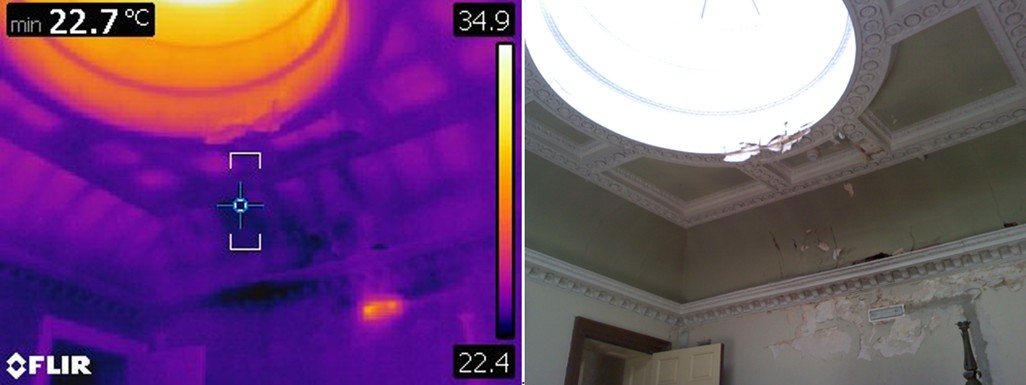 |
| Thermal and visible spectrum images of a cone of damp extending down from a defective parapet gutter |
The surveyor’s eyes can be supplemented with a thermal camera which sees the building surfaces in the infra-red spectrum; in other words, as a pattern of surface temperatures. This can be useful for quickly tracking qualitative moisture profiles: surface temperature differentials may relate to elevated moisture at the surface, or to evaporation.
A word of caution: it can be all too easy to misinterpret images since water is just one of several causes that result in surface temperature anomalies (others include building use – space heating or cooling, orientation, sunlight and other sources of radiant heating, airflow, and the time of day at which the measurements were taken). For masonry, thermography tends to be most effective for assessing leaks (from plumbing and other sources) or acute penetrating water, both of which can cause stark temperature differentials when the building is heated in winter. Although thermography rarely reveals information that could not equally be delivered by touch or by measurement with quasi-quantitative devices, it does allow patterns to be more easily presented to clients.
Damp masonry requires a relatively high change in temperature to warm or cool it relative to dry masonry, so reservoirs of moisture can occasionally be revealed in unheated buildings or on the exterior surfaces of the building envelope. A relatively quick sweep of the walls can suggest areas meriting further investigation and indicate where water uptake is ongoing where a surface temperature differential corresponds with staining or damaged paint. Thermography can also be useful for identifying vulnerable elements of the building, such as embedded pipework or internal downpipe routes, and thus can minimise the chance of misreading the results from relative measurements or the risk of drilling into pipework during sampling.
By exercising extreme caution, and in conjunction with measurement of relative humidity and air temperature (which will set out the environmental context for localised moisture content, especially where salts are present), thermography can sometimes be used quantitatively to assess the contribution of condensation or other excessive surface moisture to damp. This is done by cross-referencing the surface temperatures recorded by the camera against the ambient dewpoint temperature at the time the thermal image was made, or with surface humidity thresholds for mould growth. The camera settings must be carefully tuned to the characteristics of the surface and the environment under investigation, including the emissivity of the surfaces, and accounting for reflected temperature.
Note that if thermal images are made on a single visit, the outcome will present conditions solely at that time. Since surface conditions can vary significantly, for example, during warm fronts or periods of intensive occupancy, contextualisation is vital. This means assessing ventilation and benchmarking readings against quantitative measurements of moisture content, both at the surface and deeper within the wall.
Quasi-Quantitative and Relative Moisture Meters
The quasi-quantitative techniques most widely used by surveyors are relative electrical readings, taken using handheld meters. Broadly, three types are commonly available:
- resistance meters (with pins)
- capacitance meters (with plates or bulb)
- microwave meters (with plates).
All respond to the presence of moisture in different ways and this can be turned to advantage by using two or more techniques on the same area of wall. None directly measure moisture content (MC); instead, the electrical signals they record are converted to arbitrary values. Without specific calibration to the specific materials and homogeneity of the masonry in the wall, they cannot provide absolute measurements. Instead, readings are used to reveal patterns of varying moisture levels across the wall or over time.
The use of electric moisture meters for assessing masonry moisture has become contentious because they are so often used in isolation with little or no understanding of their limitations. If these limitations are accounted for as part of the assessment, electric meters can be helpful for assessing the distribution of moisture. The fundamental errors and uncertainties can be partially addressed by increasing the number of measurement locations; and, to some extent, readings can be benchmarked against the results from invasive sampling to increase information and accuracy.
The principal uncertainty arises from sensitivity to electrolytic solutions: masonry walls inevitably include salts in solution in the pores, which means that readings will often be deceptive. Resistance meters and, to a slightly lesser degree, capacitance meters must be recognised as responding to both the moisture and the salt content of the masonry. Embedded metals such as cramps, fixings or hoop iron will also induce high readings.
On the plus side, electrical meters do not cause significant damage to a wall. Grid measurements may be taken with a fine granularity over a wide area to create a map of moisture that can be helpful for pinpointing the sources of problems. The finer the granularity, the more effective the mapping will be at ironing out measurement anomalies and variations in results due to other characteristics of the masonry, that is, between stone, void or mortar. Furthermore, measurements can be repeated at later dates to monitor how moisture distribution might be changing.
In some cases, the relative measurements can be roughly calibrated either by measuring areas of the same wall that are clearly dry, or more accurately via invasive sampling and gravimetric measurement at a statistically valid number of locations across the full range of the meter’s scale. After a baseline has been established, relative measurements may be all that is necessary to monitor trends.
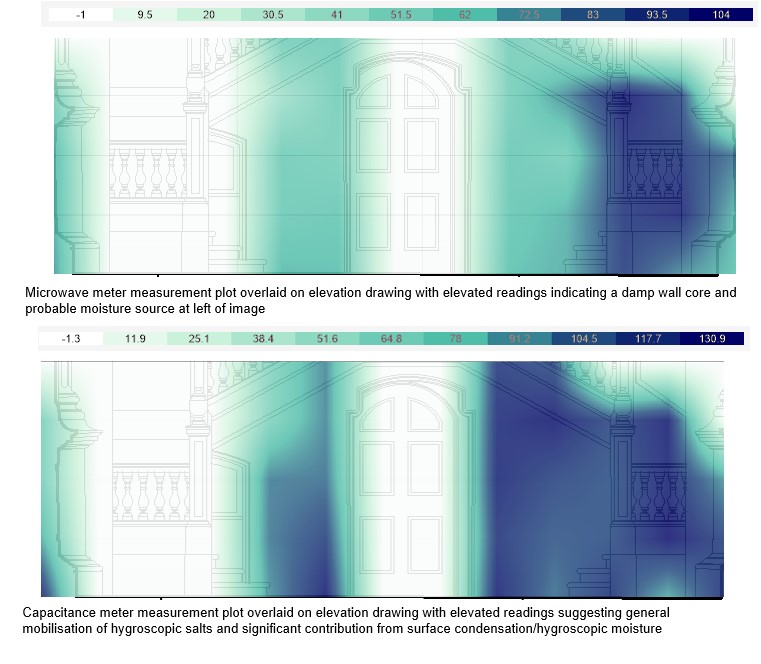
It can also be very useful to combine techniques for an indication of the causes behind a pattern of damage. For example, to assess the contribution of condensation and/or hygroscopic moisture, capacitance measurements (which reveal variations in salt and moisture levels near the surface) can be cross-referenced with microwave measurements (which can show moisture distribution deeper within the wall) taken at the same locations. A sufficiently fine grid of corresponding measurements can provide a three-dimensional picture of the distribution of relative levels of moisture and salts between the wall surface and its core.
|
| Results of non-invasive moisture and salt mapping using relative electric measuring techniques. Top: microwave meter measurement plot overlaid on elevation drawing with elevated readings indicating a damp wall core and probable moisture source at left of image. Bottom: capacitance meter measurement plot with elevated readings suggesting general mobilisation of hygroscopic salts and significant contribution from surface condensation/hygroscopic moisture. |
The electrical resistance of a material decreases when its moisture content increases, so the resistance between the pins of a resistance meter can be used as a proxy for moisture content in some materials. While resistance meters can be calibrated to give accurate measurements of moisture content in wood according to species and temperature, they cannot measure masonry moisture content due to the strong variability in material properties such as density, porosity, and equilibrium moisture content. Of particular importance is the fact that salts in solution significantly increase electrical conductivity, giving elevated readings for contaminated masonry even when it is relatively dry. Another problem is the difficulty of inserting pins into most masonry materials and thus high sensitivity to surface moisture from condensation.
By taking multiple readings, meters can be used to reveal variations in the surface distribution of moisture and salt, but a high reading is meaningless without additional context.
In relation to assessing masonry damp, resistance meters are most useful for:
- preliminary scoping of damp distribution, by measuring the MC of embedded timbers or other timber in close contact with the wall (such as skirting boards);
- monitoring wetting and drying trends via embedded dowels.
Capacitance meters work by inducing an electric field in the material and then measuring impedance (how the material within the field affects the field strength). Impedance is proportional to the dielectric constant, a property of materials which is heavily dependent on MC.
The depth of penetration of the electrical field is limited: a maximum depth of 20mm may be claimed, but it is usually less. In many cases, readings will be of the plaster layer only, not of the underlying masonry, and results will be affected by the interface between plaster and masonry due to the variation in density and potential presence of voids. Small variations in plaster thickness can give misleading measurements. The angle at which the meter is applied to the wall and the roughness of the surface can have a significant impact on results.
Microwave metersMicrowave meters measure the same electrical properties as capacitance but via higher wave frequencies which increases depth penetration and reduces the influence of salts on measurements. Originally developed for assessing concrete, they are most accurate for homogenous materials of a substantial thickness which have a flat surface.
Handheld microwave meters assess the attenuation of an electrical field projected in from the surface to a depth of between 10 to 300mm. Relative values are recorded as a weighted average of the measurement field, with the masonry nearest the plate accorded the greatest impact on the reading. Each type of microwave probe has a minimum wall thickness below which the energy being reflected at the opposite surface will distort the results. Like capacitance, microwave measurement can also give misleading results for masonry with a rough surface. Voids in a wall will strongly affect results (slightly blown plaster will give artificially high readings), as will walls with layered materials with differing MCs, such as brick and mortar. The impact of density also means that microwave readings cannot be compared across different materials.
Quantitative Measurement
Determining absolute moisture content involves measuring the quantity of water in a sample, and therefore requires invasive sampling of the masonry. The number of samples needed and their locations depend on the aim of the investigation. Preliminary qualitative and quasi-quantitative assessment can be used to guide the strategy. Where the intention is to help pinpoint an elusive moisture source, samples are often taken at different heights above floor level and at regular intervals across a wall. They can also be taken from various depths in the walls to provide a profile of moisture content through the wall, which is helpful for determining the contribution of condensation to a damp problem. Repeat sampling can be employed to monitor a trend in drying/wetting over time.
It is important to remain aware that sampling gives snapshots of moisture content in the wall at the time of sampling, not a complete picture. This is especially relevant following an acute event like flooding or a temporarily blocked hopper: the moisture content is likely to vary substantially within a relatively small area, according to the routes the water took into and through the structure (via minor cracks, interfaces and voids) and to the properties of the material associated with initial water absorption, such as the proportion of large pores. These factors can vary significantly across the masonry, not only between blocks and mortar, but from stone to stone and brick to brick resulting in localised areas of saturated masonry in the midst of relatively drier areas. Drying times defined on the basis of the worst case measurement from such a wall is likely to be an overestimate; for this reason alone, it is advantageous to combine measurement techniques.
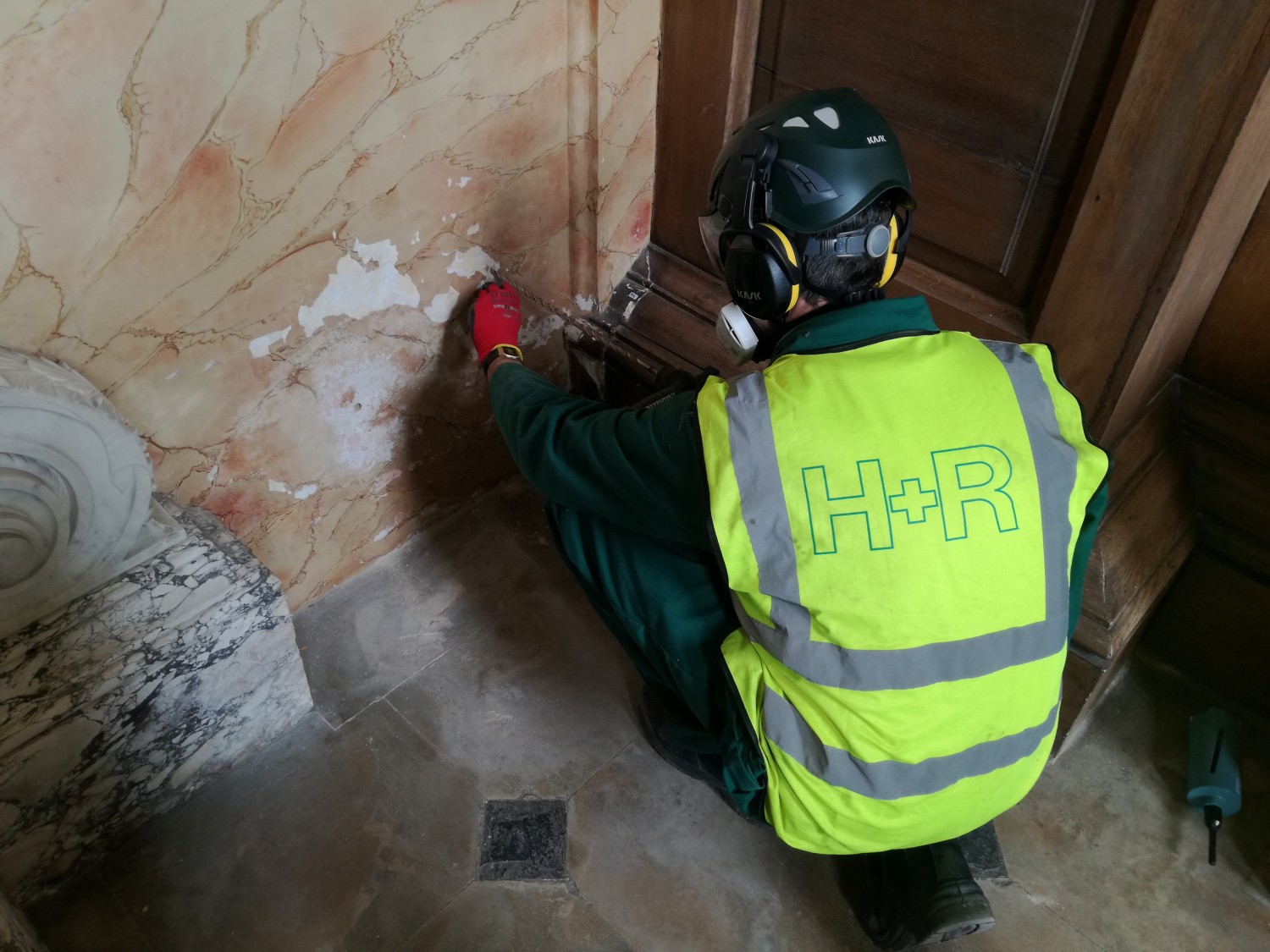
Drilled samplesThe least destructive means of sampling is by drilling into the internal surface using a 9 to 13mm masonry bit, and capturing the drilling dust in a sealed container which can then be transferred to the laboratory for analysis. At least two drill bits should be used to avoid overheating (and the consequent evaporation of water in the sample) and also to prevent cross-contamination of samples between wetter and drier areas (residues of damp dust will adhere to the bit). Sampling should be at a consistent depth across all locations to enable valid cross-comparison. Samples should be as representative as possible of the material at the chosen depth band. However, the effect of the very property being assessed can skew the results: drier masonry is generally easier to drill and is more readily expelled from drill holes (as dust) than wetter material (granular, through paste to slurry) so where taking a sample from a substantial wall thickness the extracted material can include a disproportionate quantity of the drier material.
To minimise damage, samples are usually taken from the mortar if visible. However, this may exaggerate overall moisture levels in stone walls as the mortar will have a greater moisture content than the stone and accounts for a smaller volume of the wall. Decisions regarding drying strategy should take this into account. Where possible, some additional samples from the masonry units should be taken to give a broader understanding of the wall as a whole.
The quantity of material collected must be optimised: a minimum of two grams is needed for a sample to be representative of a sufficient volume of masonry while excessively large samples will extend equilibration time when assessing hygroscopic moisture content.
Sampling can provide benchmarks for quasi-qualitative/relative measurements if corresponding measurements of the masonry are recorded with electrical meters at sampling locations, for example, recording capacitance and microwave measurements at locations where surface and deep samples are subsequently extracted. This can serve as project specific calibration for the electric meters, enabling monitoring of drying or wetting trends of the wall by relative measurements thereafter, provided the sampling covers a suitable range of moisture contents from dry to wet.
Assessment by gravimetry
|
| A surveyor undertaking gravimetric sampling |
In the laboratory, the MC of the samples is commonly quantified gravimetrically using the oven drying method. The initial mass of the sample is determined by weighing on a balance with a resolution of at least 0.1mg before the sample is then dried to a constant weight (when the difference between consecutive measurements taken at four-hour intervals is less than 0.5%) in an oven and re-weighed. Oven temperature is generally set at 103±2°C for expediency, but for materials with chemically bound moisture (such as gypsum and cement) temperature should be reduced to 60°C to avoid over-estimating the moisture content.
The gravimetric MC is expressed as a percentage ratio of the mass of water lost during drying. It can be calculated in two ways, giving broadly similar results:
- as a ‘dry weight basis’ – the mass of water divided by the mass of the dry sample (preferred by international standards)
- as a ‘wet weight basis’ – the mass of water divided by the initial weight of the sample (recommended in BRE Digest 245 and the most common method in the UK).
The two ways of expressing moisture content give broadly similar results and are convertible but not equivalent: MC calculated on the dry basis will always be slightly higher than on the wet basis, so it is important to state which method was used when reporting.
Expressing moisture content by weight does not permit direct comparison between materials with different densities. To enable cross-comparison between materials, volumetric MC should be calculated, which requires the bulk densities of the various components of the wall to be known. Very rough estimates are possible on the basis of material type: typical bulk densities include mortar 1500–1900kg/m³ (with lime mortar at c 1700kg/m³), stone at 1900–2500kg/m³, and plaster at 900kg/m³. The different capacities for moisture retention between masonry materials also prevent direct comparison, for example, MC at saturation (open porosity fully filled with water) can vary between 4% and 25% between different brick types.
BRE Digest 245 recommends an additional stage of investigation for which dried samples are conditioned at a relative humidity of 75% RH until they reach constant weight, which gives a hygroscopic MC when re-weighed. (75% RH represents an extreme value for occupied buildings but is simple to achieve with a saturated solution of table salt.) This step was intended as a means of estimating salt contamination of the masonry (and thus as a way of evaluating the contribution of groundwater to damp), but it can provide other useful information. Excessively high hygroscopic MC (greater than 2%) suggests high salt contamination and an associated risk of damage from salt crystallisation cycles. For samples with a lower hygroscopic MC, the measure can be used as an indication of the combined moisture storage characteristics of the material. By comparing it with the sample’s total moisture content, it is possible to put a figure on the proportion of moisture which is readily mobile within the pore structure, and therefore associated with water damage to internal finishes. The technique thereby allows MC by weight to be broadly characterised into non-material specific bands of dry, wet and saturated on the basis of the available moisture not bound into the material.
Assessment by calcium carbide testingCalcium carbide testing is a quicker alternative to gravimetric sampling for which the analysis (total moisture content only) is possible on site, but a sample size of around 8g is necessary. Specialised equipment measures the pressure within a sealed vessel of acetylene gas given off as calcium carbide reacts with water in drill dust or a pulverised sample. This is directly convertible to moisture content with the use of tables. Despite this being a relative measurement, the results are known to be very accurate. Carbide meters do tend to underestimate the MC of cementitious materials (since they do not fully account for hygroscopic MC in fine pore structures), but the method avoids the overestimation likely for cement if oven temperatures are too high.
To conclude, while it might be argued that quantitative measurement techniques are generally under-used when assessing damp in masonry; in most cases intuition and experience will be enough to demonstrate the nature of any remedial work required. However, there are times when a more detailed understanding is necessary, requiring a combination of different measurement techniques to be employed.
Recommended Reading
- BRE, 2007. Digest 245: Rising damp in walls. Diagnosis and treatment.
- BRE, 2002. Assessing moisture in building materials (Good Repair Guide 33 Parts 1–3). BRE.
- BSI, 2017. BS EN 16682:2017 – Conservation of cultural heritage. Methods of measurement of moisture content, or water content, in materials constituting immovable cultural heritage.
- BSI, 2012. BS EN 16085:2012 – Conservation of Cultural property. Methodology for sampling from materials of cultural property. General rules.
- Dill, M, 2000. A review of testing for moisture in building elements (errata 2000) (No. C538). CIRIA.
- Orr, S for Historic Scotland, 2021. Moisture measurement in the historic environment – Historic Environment Scotland Technical Paper 35.
- Pender, R, 2016. ‘Water in permeable building materials’, Building Conservation Directory. Cathedral Communications.
- Phillipson, M, Baker, P, Davies, M, Ye, Z, Galbraith, G, McNaughtan, A, McLean, R, 2007. ‘Moisture measurement in building materials: an overview of current methods and new approaches’. Building Services Engineering Research and Technology 28,4 (2007) pp. 303–316.
- Wilhelm, K., Viles, H., Burke, Ò., 2016. ‘The Influence of Salt on Handheld Electrical Moisture Meters: Can They Be Used to Detect Salt Problems in Porous Stone?’ International Journal of Architectural Heritage 10, 735–748.
- Viles, H, Zhang, H & Orr, S. for Historic England, 2022. A Comparative Evaluation of Methods to Monitor Moisture in Historic Porous Masonry Materials – Historic England Research Report Series no. 2/2022.