Basic HTML Version


t h e b u i l d i n g c o n s e r v a t i o n d i r e c t o r y 2 0 1 2
1 1 9
3.3
3.3 Structure & Fabric :
metal, wood & Glass
Wrought Iron and
SteelWindows
Eleni Makri
H
istoric iron
window frames were
produced in wrought iron, cast iron
or mild steel. This article concentrates
on wrought iron and mild steel windows and
their conservation.
Wrought iron is the purest form of iron
used in construction, containing between
one and four per cent impurities and less
than one per cent carbon. It is fibrous and
malleable and can be welded. Mild steel is an
iron-carbon alloy containing up to about two
per cent carbon and has qualities similar to
wrought iron.
Left unprotected, iron corrodes back to its
original state (iron oxide). Wrought iron is the
most resistant to this process and mild steel
the most susceptible.
Wrought iron is either charcoal iron or
its successor after 1784, puddled iron. Large
scale production in the UK came to an end in
1973 with the closure of Thomas Walmsley’s
Atlas Forge in Bolton, Lancashire. Shortly
afterwards the forge was rebuilt at Blists Hill
Open Air Museum in Ironbridge where it
resumed production for a few days a year.
Mild steel was a new iron-carbon alloy
first produced in 1855 by Henry Bessemer
in his Bessemer converter in an effort to
reduce the production cost of wrought iron.
Continuous advances in its production led to it
replacing wrought iron and the establishment
of the modern steel industry.
Historical development
Wrought iron fenestration evolved from
medieval window construction and
from ecclesiastical stained-glass window
construction in particular.
The 12-light Armada window of Sutton
House, Hackney, London, dating from the
early 16th century is a rare complete survival
of early domestic fenestration. Typically for an
early domestic window, all 12 lights are fixed.
The wrought iron opening casement
appeared in the late 16th to early 17th century,
initially as a single element which was less
than the full height of the opening and set in
predominantly fixed fenestration. In the next
century both the number and size of opening
casements increased and they now occupied
the full height of the opening.
Changes in construction methods and
materials (from timber-frame to masonry,
brick or stone) saw the introduction in
the early 17th century of the classical
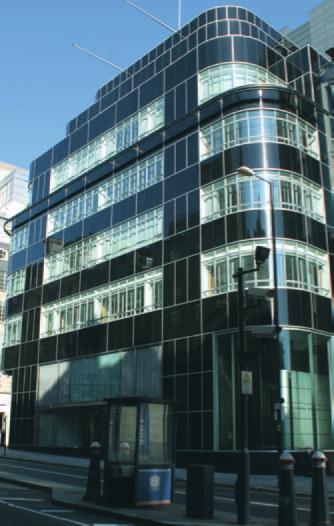
The Daily Express Building in Fleet Street, London (Ellis and Clarke, 1932), now occupied by Goldman Sachs International
(Photo: Carole King)