Basic HTML Version


1 2 0
t h e b u i l d i n g c o n s e r v a t i o n d i r e c t o r y 2 0 1 2
3.3
four-light cross-window. An example
with wrought iron fenestration is a 1707
cross-window with three fixed lights and
an opening wrought iron casement at a
farmhouse in Pilning, Gloucestershire.
The late 17th century former manor
house in Freckenham, Suffolk, retains
original wrought iron casement windows
with rectangular leaded lights. Some of the
leaded lights contain crown glass, which
became available in the late 17th century.
While the counter-balanced timber sash
window gradually became the fashionable
standard for the houses of the wealthy
following its use at Chatsworth in 1676,
the wrought iron casement remained in
use throughout the 18th century. In the
19th century wrought iron casements were
sometimes used in attics and service rooms.
In the late 19th and early 20th century, the
wrought iron window became popular again
through the Gothic Revival and in the work
of Arts and Crafts architects such as Edwin
Lutyens. However, in the 1850s wrought iron
production was considered expensive and
labour intensive and this gave rise to the
production of metal windows (both sashes
and casements) in cast iron.
By the late 19th century the development
of the Bessemer process had enabled the
production of sections from hot-rolled steel
which were considerably cheaper than those
made from wrought iron. At first, steel
windows sought to replicate earlier wrought
iron fenestration, as is evident from the
early mild steel casements of Henry Hope
& Sons Ltd and WF Crittall in the Brooking
Collection at Cranleigh in Surrey. Among
these, the 1891 casement by Hope is a new
metal casement window in its own right. The
1909–10 example is encased in a thick timber
frame and comprises a fixed light and an
opening light very much in the tradition of the
historic cross-casement.
Following the introduction of standard
window sections, often referred to as the
‘universal suite’, in 1918–20 by the newly
formed Steel Windows Association (1918–23),
the use of steel windows flourished. They
were suitable for a range of architectural
applications in the inter-war years and
beyond, both in Britain and internationally.
By 1954, Crittall was the biggest of the
three main suppliers of steel windows,
accounting for 40 per cent of production.
The other two were Henry Hope & Sons and
Williams & Williams, who jointly accounted
for 25 per cent of production. This may
explain why Crittall became synonymous
with 20th century steel windows.
In revivalist examples of the inter-war
period, such as at The Fox public house
at Bix, Oxfordshire, universal suite steel
sections were combined with timber frames
and leaded glazing to produce strip and
oriel neo-Tudor windows for a neo-Tudor
architectural idiom. The fenestration of
The Railway Tavern in Crouch End, London
was constructed in a similar fashion. The
possibilities for revivalist expression can
be seen in the ground floor fenestration
of Elizabeth House in Highgate, London
(Richardson and Gill, 1930), and in particular
in the Crittall French doors and combined
fixed side lights, which all contribute to
the building’s neo-Georgian idiom.
Significantly, this is also the window of
the Art Deco movement and its varied and
widespread use can be seen in examples such
as the Arnos Grove (1932–34) and Turnpike
Lane (1932) Underground stations (both
by Charles Holden), the Hoover Building
(Wallace Gilbert and Partners, 1935) and
many public swimming pools. These buildings
demonstrate yet another trend associated with
steel windows – the development of a new
colour range for the 1930s.
The potential for architectural expression
provided by the steel window is also seen
in structures which used more advanced
building technologies such as the Boots
D10 Factory in Nottingham (Sir E Owen
Williams, 1931) and the Daily Express offices
in London (Ellis and Clarke, 1932). Both of
these buildings are clad concrete frames in
which the envelope of the building, including
the fenestration, is a lightweight system
independent of the structural frame.
The steel window also became standard
in the domestic buildings of the inter-war
period, which otherwise continued to be
built in the existing tradition of terraces,
semi-detached houses and mansion
flats. Notably, it was also Frank Lloyd
Wright’s window of choice at Fallingwater
in the United States (1935–39), with the
frames painted in Cherokee red.
WROUGHT IRON WINDOW CONSERVATION
The conservation of the wrought iron window
may involve repairs to the sub-frame on which
the casement hangs (if it is metal), repairs to
the casement frame including the window
furniture, or repairs to the leaded glazing.
When repairs are being considered, an
informed decision should first be taken on
whether surviving glazing (lead cames and
glass quarries) can be adequately protected
during the works or whether it should be
removed until repairs are complete. If repairs
are required to the casement, for example, it
is unlikely that removal of the glazing can be
avoided, whereas for repairs to the sub-frame
alone, the casement can be removed and safely
stored to be re-hung later. Any work involving
leaded glazing, including its protection, is
highly specialised and requires the right skills
to avoid loss or damage.
If repairs are necessary, the surface of the
wrought iron sections should be cleaned back
to healthy metal, primed, repaired and finally
painted in the following sequence of works:
Degreasing
Oil or grease should be
completely removed from the metal surface
using scraping tools, washing with warm
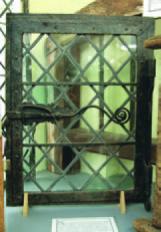
Inward opening casement, mid 17th century
(Brooking Collection)
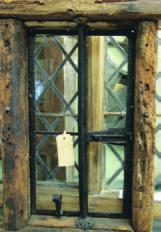
17th-century wrought iron casement window with oak
frame from vernacular farm building near Winchester,
Hampshire (Brooking Collection)
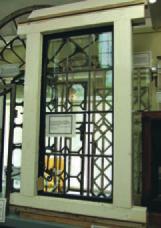
Early factory-made window constructed from wrought
iron sections and incorporating rubber draught-proofing
(Brooking Collection)