Basic HTML Version


1 3 8
t h e b u i l d i n g c o n s e r v a t i o n d i r e c t o r y 2 0 1 2
3.4
Conserving Bats
and Buildings
a natural synergy
Kelly Gunnell
L
ong associated
in popular culture
with horror and the supernatural, bats
are in desperate need of a PR make-
over. Contrary to popular opinion, bats are
not mice with wings. They are, in fact, more
closely related to humans than to rodents.
These socially complex mammals usually have
just one young per year and look after their
offspring fastidiously, often forming crèches
that allow the mothers to go out to forage
while other females look after the pups.
Bats have long life-spans for their size.
The record is 40 years for a ringed Brandt’s
bat. They do not make nests and they do not
cause structural damage to buildings. Bats
are not blind, they can see reasonably well
but have evolved echolocation to help them
with the difficult task of hunting tiny insects
in the dark. Bats are an important part of
the UK’s biodiversity, the 17 species of bat
account for nearly one third of our national
mammal species (globally there are over
1,000 bat species). All bats in the UK eat
insects – a single pipistrelle bat can eat up to
3,000 midges in a single night. Bats are thus
an important part of the ecosystem and their
presence is an indication of a healthy and
biodiverse landscape.
One stereotype does hold true, however:
bats do like to roost in old buildings. In fact,
bats and people have been sharing dwellings
for thousands of years, making these unique
creatures part of our cultural heritage as well
as part of our natural heritage. Consequently,
when conserving old buildings, there is a legal
and moral imperative to preserve bat roosts.
Why do bats roost in buildings?
About half of the bat species in the world use
holes in trees for roosting. The other half use
either caves or cavities. However, as ‘natural’
roosting sites have become scarce due to
development and changing land-use, bats
have adapted to use buildings, like barn owls
or swifts, and are a building-reliant species.
Buildings offer a range of possible roosting
opportunities that mimic those found in the
natural environment and are often cleaner,
safer and warmer spaces than natural roosting
sites. Crevice-like or tree cavity type spaces
include those found in both modern and
traditional houses such as behind fascia and
barge boarding, spaces beneath roof tiles, wall
coatings, hollow mortice joints, rain gutters
and chimneys. Cave-like spaces include
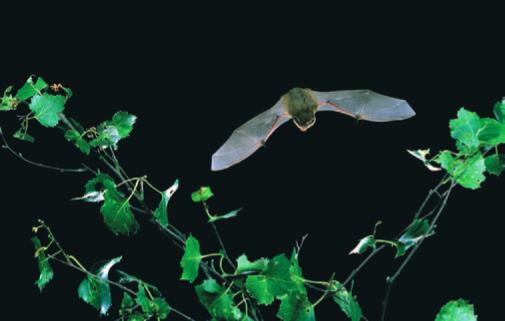
A pipistrelle bat in flight (Photo: Hugh Clark)