Basic HTML Version


1 4 0
t h e b u i l d i n g c o n s e r v a t i o n d i r e c t o r y 2 0 1 2
3.4
surveys aim to confirm the species present,
the type of roost and identify any access
points and commuting routes. Once this
information has been collected, an assessment
is made as to whether the planned works
will impact the bats. If necessary, measures
will then be suggested to reduce the impact
to an acceptable level. In some instances
where the impact is considered significant, an
application for a European Protected Species
(EPS) licence will be needed. The EPS licence
will outline conditions to mitigate for the
unavoidable impacts. This does not stop the
work from going ahead, but tries to ensure
that any work doesn’t negatively impact the
bats and is within the law.
The licensing process can take up to
six weeks so it is always recommended
that an ecologist is contacted as early
on in the process as possible. This
allows for any alterations to the scope
and timing of works to be incorporated
into schedules and prevents delays.
Steps to take if bats are discovered
When undertaking building or development
work where bats may be present, the following
steps should be taken:
• contract an ecological consultant for
guidance throughout the project
• undertake a bat survey at the
appropriate time of year
• if bats are present, compile a mitigation/
compensation plan or method statement
for everyone involved including
architects and building contractors
• incorporate the bat survey report and
mitigation plan/method statement
into the planning application
• apply for planning permission
• if necessary, apply for an EPS licence
(the planning permission will be needed
as part of the licence application)
• if a licence is granted, carry out works
with an ecologist’s supervision
• carry out a compliance check to ensure that
mitigation is being properly implemented
• monitor the site after the completion
of the mitigation to gauge the
response of the bat population.
Bat roost mitigation
The main aim of bat roost mitigation is to
allow for the conservation status of bats to
be maintained or enhanced during and after
the development. Bat roost mitigation comes
in many forms. In most cases, mitigating for
bats during building works involves changing
the construction schedule to avoid sensitive
breeding seasons and changing the scope of
the work to maintain the bat entrances. Bat
access points are created or maintained by
making gaps either using existing materials
or specially designed bat access tiles or bricks
that allow bats to re-enter the roost once the
work is finished.
More complicated forms of mitigation
involve replacing roosts within the building
or creating purpose-built roosts such as bat
houses or bat barns. Maintaining roosts in
situ is always the preferred option. However,
in some cases purpose-built bat houses may
be considered, as long as the risks of non-
adoption by bats are minimised through
careful design and site selection. In all
cases, bat mitigation should aim to mimic
or optimise the original roosting conditions,
particularly thermal properties and access to
favourable landscape features.
Below are some design principles for
ex situ roost conservation:
• situate the replacement roost as close
as possible to the roost to be lost
• match the replacement roost closely
in terms of size, height and aspect
• situate the replacement roost close to
existing flight-lines and have an entrance
close to appropriate habitat to maximise
chances of the bats finding and adopting it
• design the new roost to provide a suitable
thermal regime for the target bat species
• provide a variety of roosting
opportunities and thermal regimes
• make the building resistant to vandalism
• arrange for the long-term integrity and
security of the replacement roost.
Roost website
The frustration for homeowners and ecologists
alike is that even the best thought-out and
designed roost mitigation may not succeed.
Bats can be fickle and our understanding of
them is incomplete. Each species has its own
unique preferences for temperature, roost
size, access points and proximity to suitable
landscape features and vegetation. These
requirements can also change regionally and
seasonally. Determining all these criteria
and putting them together for a successful
mitigation strategy is immensely challenging.
Combine this with a lack of systematic follow-
up and monitoring and you can see why the
realm of bat roost mitigation has remained
more of an art than a science. The licensing
procedure has made it difficult for builders,
ecological consultants, architects and
homeowners to keep track of the mitigation
measures used in the past and whether they
were successful.
To address this, the Bat Conservation
Trust has developed a new web resource
called Roost which enables users to upload
information about roosts, mitigation strategies
and explore case studies. Users can browse
case studies using a number of criteria, make
comments and access information on general
design principles and resources for bat roost
mitigation. The aim is that Roost will become
a knowledge hub for anyone undertaking or
involved in bat roost mitigation. In the long
term, the collected information could provide
a wealth of insight into what it takes to make a
successful and attractive replacement roost.
It is hoped that by sharing information
about effective mitigation, we can find new
ways to enable bats to live happily alongside us
for centuries to come.
Roost was launched in September 2011
(http://roost.bats.org.uk).
Recommended Reading
Bats and Buildings: Bats and the Built
Environment Series Volume 1, Bat
Conservation Trust, 2010
Bat Mitigation Guidelines, Natural England, 2004
Bats in Traditional Buildings, English
Heritage, National Trust and Natural
England, 2009
C Williams, Biodiversity for Low and Zero
Carbon Buildings: A Technical Guide for
New Build, RIBA Publishing, London, 2010
Kelly Gunnell
is the built environment
officer for the Bat Conservation Trust. The
Built Environment Project aims to raise
awareness and facilitate solutions for
bat conservation in the construction and
building sector.
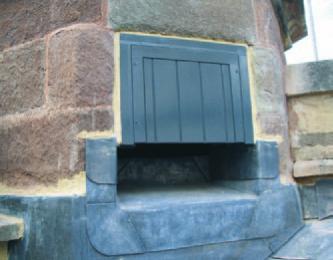
New bat access in one of the turrets of Clarkencombe Lodge, Bristol (see Case study 2, page 139)
(Photo: CTT Sustainable Architect)