Basic HTML Version


t h e b u i l d i n g c o n s e r v a t i o n d i r e c t o r y 2 0 1 2
1 6 7
4.2 Services & Treatment :
Heating & Lighting Services
4.2
exploring all the appropriate energy-efficiency
measures, examining the renewable energy
options, and implementing water-saving
and waste-reduction measures. Many simple
improvements, such as draught-proofing,
can be made but evidence shows that for
solid-walled dwellings to achieve significant
CO₂ savings, the thermal performance of the
external walls must be improved.
Where traditional and historic buildings
are concerned, careful consideration is needed
if performance is to be improved without
compromising their heritage value, damaging
historic fabric or undermining the wellbeing
of occupants by changing the way buildings
breathe and respond to their internal and
external environments.
Wall insulation
Traditional solid-wall construction is
probably the most difficult and often the
least cost-effective building element to
insulate. For listed buildings, any form of
wall insulation is likely to require listed
building consent and for the majority
of buildings external insulation will
usually require planning permission.
External insulation can be particularly
difficult to incorporate into existing buildings
as costly ancillary adaptations such as
changes to the eaves and verges of roofs are
often required. The potential benefits from
installing internal or external insulation
should be considered carefully, along with the
planning constraints, the potential impact on
the fabric of remedial works and the impact on
internal conditions.
Internal insulation
is usually applied
directly to the inner face of the external wall,
followed by a finish such as plaster. It is often
necessary to relocate plumbing and electrical
services and to adjust skirting boards, door
architraves and fitted furniture. Cornices will
also need to be modified which may result in
the loss of original plasterwork.
Whatever insulation material is used, the
improved wall will normally need to achieve
a U-value of no more than 0.30 W/m²K,
although a lower standard may be acceptable
depending on the building. (U-value is a
measure of heat transfer through a building
element, so the lower the value the better.)
Thicker internal insulation systems
may significantly alter the sizes of rooms,
corridors, etc.
External insulation
systems usually
comprise an insulation layer fixed to the
existing wall and a protective render or
cladding installed on top to protect the
insulation from the weather and mechanical
damage. The increased depth of an external
render or insulation system will require
adaptation of roof and wall junctions, window
and door openings and rainwater goods.
Decorative details such as string courses
and quoins may also be affected, and natural
materials such as stone or brick will be hidden,
effecting a significant change in character.
As most suitable external insulation
systems will also need to be protected from
rain and mechanical damage, they should
normally be considered as a two-component
system where all layers must work together.
Materials are available which can be used as
a single coat, such as insulating lime renders
which contain expanded vermiculite, but these
tend to give significantly lower insulating
values. They can, however, sometimes be
applied in circumstances where other types
of external insulation would be unacceptably
detrimental to the character of a historic
building. Again, whatever insulation material
is used, the improved wall will need to achieve
a U-value of no more than 0.30 W/m²K.
Predicting the risks and
potential benefits
It is necessary to understand from the outset
how the proposed changes are likely to alter
the behaviour of the building. The biggest
area for concern is moisture, both in the wall
and in the building as a whole. The addition
of insulation material to a wall is likely to
alter the way moisture moves through it. For
example, if non-breathable materials are added
to an older porous wall, its ability to breathe
and regulate moisture is compromised.
Dampness, and even structural damage could
result. Even if the walls are dry when the
work is carried out, there may be evidence of
past problems and a risk of them recurring.
The main sources of external dampness will
include run-off from gutters and downpipes,
defects in the fabric such as roof flashings, and
penetrating damp from driving rain. Rising
damp may also be a problem, but only at the
base of the wall. Internally, condensation is
the mostly likely problem.
It is also necessary to consider the
state of repair of the walls as dampness is
often associated with salt crystallisation or
efflorescence. Together, these processes can
accelerate the deterioration of stone or brick
surfaces, internally or externally.
The moisture content of a wall depends
on the prevailing weather conditions, time
of year and exposure of the site. If the wall is
damp or in a poor condition, these problems
need to be overcome before installing wall
insulation. If there are any doubts about
the condition of the existing walls, they
should be professionally surveyed before any
improvement works are considered.
Before any work is undertaken, it is also
important to estimate the potential savings
in terms of energy use, CO₂ emissions and
reduced heating bills. The most common
method of predicting the benefits is to model
the performance of the building before and
after improvements. The usual model is a
SAP or RDSAP (Reduced Data Standard
Assessment Procedure; further information
on these procedures is available at www.bre.
co.uk).
SAP uses a series of input values for the
thermal conductivity of the different building
elements, a series of accepted values and a set
of equations that represent the environmental
physics of the building. Accepted values are
provided as part of the assessment method
and these are used when specific performance
information on the product or system is not
available. However, when specific performance
information is available for walls, floors,
roofs and other elements, it should be used in
preference to data from the tables.
Moisture
Moisture movement and its measurement in
walls has been studied for many years. Various
measurement methods have been developed
and tested but the most reliable seems to be
to collect a small sample by drilling a hole
and then weighing, drying and re-weighing
the sample. This is a good way to determine
the moisture content, but to start mapping
moisture and to measure change over time
requires too many drill holes to be practical.
However, advances in computing have
allowed the development of complex models in
1 and 2 D, which can be validated by a limited
programme of on-site intrusive measurements.
The most frequently used model seems to be
WUFI (Wärme und Feuchte Instationär or
Transient Heat and Moisture), developed by
IBP in Germany. This model is validated using
data derived from outdoor and laboratory tests.
It allows realistic calculation of the transient
hygrothermal behaviour of multi-layer building
components exposed to natural climate
conditions by modelling the coupled heat and
moisture transfer in building components.
There are a number of projects applying
WUFI modelling to traditionally constructed
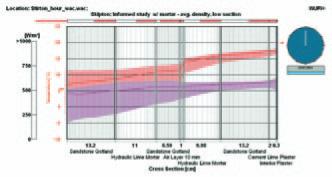
Figure 2 An example of a more complex model showing predicted temperature (red) and dew point (purple) changes through
a sandstone rubble infill wall (Image: Dan Browne/SPAB Project)