Basic HTML Version


1 7 6
t h e b u i l d i n g c o n s e r v a t i o n d i r e c t o r y 2 0 1 2
5
Shellac
Anthony Beech
M
any resins,
oils and waxes have
been used over the centuries to
provide a glossy finish to fine timbers.
One of the most important is shellac, a resin
produced from a secretion of the lac beetle
(Laccifer lacca), which feeds on tree sap. The
insect’s name is derived from the word Lakh,
the Sanskrit word for the number 100,000,
and relates to the number of insects found
on infested trees. The tree branches become
covered in the secreted material which, in
its raw form, is called sticklac. It is harvested
extensively in India and, to a lesser extent, in
China, Burma and Thailand.
During the process of harvesting,
branches are cut from the tree then crushed
and washed to remove wood fibres and other
contaminants, transforming the sticklac
into a usable material called seedlac. Further
refinement is achieved by heating the seedlac
to its melting point and filtering it through
a cloth onto a cool surface to form discs of
buttonlac, which will be familiar to traditional
polishers as a key ingredient of shellac.
The seedlac or buttonlac can then be
dissolved in alcohol. This dissolved form
of shellac is sold as French polish under
trade names such as ‘special pale polish’
or ‘button polish’ depending on the exact
preparation. The natural product contains
a small quantity of wax produced by the lac
beetle which is sometimes removed during
production to create ‘de-waxed’ shellac.
The weight of shellac dissolved is described
as ‘the cut’. This term refers to the ratio of
shellac to alcohol in the preparation, so
one pound of shellac dissolved in a gallon
of alcohol is called a ‘one-pound cut’. Most
commercial preparations are a three-pound
cut, which can then be further diluted as
required or used neat for ‘bodying up’.
Other off-the-shelf shellac preparations
may have added ingredients to adapt the
properties of the shellac, such as melamine
to produce ‘heat-resistant’ polish. These
modified shellacs have their place alongside
modern cellulose and acrylic lacquers for
finishing new cabinet work and furniture but
are not generally suitable for period furniture
or period architectural features because they
are likely to be less reversible and less stable.
The exact nature of the shellac product
varies depending on the species of tree
which the lac beetle feeds on. This results
in different colours and properties which
were historically exploited to achieve
different finishes ranging from deep brown
to orange and amber tones. Use of the
more opaque shellacs can be problematic as
building a ‘grain-filled’ finish can require the
application of so much shellac that the wood
surface is partially obscured, resulting in an
unsatisfactory, muddy finish. The finish can
also become patchy during the ‘cutting back’
process (see ‘Application’ below).
Other issues arose historically with
the grain-fillers used to prepare the wood
for polishing. These were popular in the
late 19th and early 20th centuries as a way
of speeding up the polishing process. They
were often prepared using chalk and other
materials which were coloured to match the
wood surface. As a result, the finish on much
Edwardian furniture displays white flecks
in the grain where the grain-filler has been
bleached by ultraviolet light.
Historic use
Shellac has been used for wood finishing
since at least the 13th century but it has had
many other uses. Its most common early
use was for fixing dye and it has been used
in the food, pharmaceutical and cosmetic
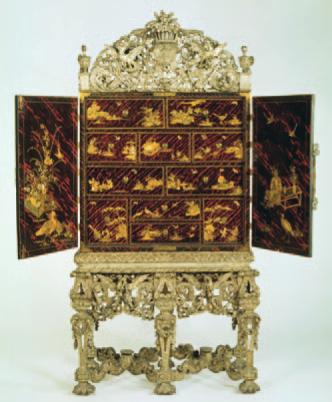
English Japanned cabinet, 1690-1700: Japanning allowed European cabinet-makers to imitate oriental lacquer finishes.
Shellac-based recipes for Japanning were published in 1688 in John Stalker and George Parker’s
A Treatise of Japanning and
Varnishing
. (Photo: Victoria and Albert Museum, London)