Basic HTML Version




t h e b u i l d i n g c o n s e r v a t i o n d i r e c t o r y 2 0 1 2
1 7 7
5
Interiors
industries. Its thermoplastic properties also
leant themselves to the production of cast
material before the advent of modern plastic
alternatives, including early gramophone
records.
Early uses in cabinet-making include the
creation of ‘Japanned’ finishes. References
to the use of shellac appear in Stalker
and Parker’s A Treatise of Japanning and
Varnishing published in 1688. This included
recipes for the preparation of shellac-based
varnishes and drawings of suitable oriental
designs. The process of Japanning was an
attempt by European craftsmen to replicate
the appearance of Japanese and Chinese
lacquerware, which was highly fashionable
and was imported by wealthy collectors
alongside oriental porcelain. Some confusion
exists regarding the differences between
oriental lacquer and shellac-based finishes.
Oriental lacquer differs from shellac in its use
of raw ‘urushi’ lacquer direct from the tree. It
can only be used in its country of origin as it
is difficult to store and cannot be transported
in its raw form.
Around the time of Stalker and Parker’s
treatise, shellac was also being used to
formulate varnishes which were applied by
brush and created a finish for cabinet-work
but which did not produce the completely flat
and grain-filled surface typical of the later
technique of French polishing. Many other
varnish types were also then available. These
were based on drying oils such as linseed
oil, copal, sandarac and mastic, which were
extracted directly from trees and plants.
Towards the end of the 18th century the
technique of applying shellac using friction
to achieve a grain-filled, bright, flat surface
developed. This was well-suited to veneered
surfaces which were often decorated with
marquetry and inlay. Satinwood was one of
the most fashionable veneers and responded
particularly well to the bright finish of shellac,
which enhanced the ‘satin’ patterns in the
grain. This bright finish continued to grow
in popularity into the Regency period when
highly polished rosewood took over as the
veneer of choice for fashionable furniture.
The eclectic nature of Victorian furniture
later in the 19th century and the ease of trade
with other parts of the world meant that
mahogany, walnut and oak were all used by
cabinet-makers. The majority of this work
received a shellac finish of some sort, ranging
from opened grained oak to highly polished
mahogany and walnut. Some of the best
shellac finishes were produced at this time
and many of them were sufficiently stable that
they can be found in good order today.
Unfortunately, the Victorian period also
saw a great deal of 17th and 18th-century
furniture inappropriately given a shellac
finish, often removing or covering earlier
oil and wax finishes. Many late 19th-century
interiors also boast excellent examples of
French polished surfaces, staircases, panelling
and display cabinets. These will often have
original finishes which can be revived or
uncovered from beneath later layers of opaque
varnish or shellac.
Application
The familiar term ‘French polish’ refers not
to the product itself, as is often thought,
but to the technique of applying shellac
in thin layers. The shellac is applied
with a polishing ‘fad’ or rubber made by
compressing polishers’ wadding or cotton-
wool into a covering of fine, lint-free cotton.
The wadding is then saturated with liquid
shellac and the sides are wound to tighten
the cover, forming a firm pad which can be
held between the thumb and forefingers.
After building up a base-layer the surface
is then worked in circular or figure-of-eight
movements to push the soft shellac into the
grain, then in straight lines to pull the surface
flat and remove any circular ‘whip’ marks.
The surface is then allowed to dry before
it is lightly ‘cut back’ with fine sand paper.
Traditionally, pumice was sometimes used to
assist the flattening process and fill the grain.
This is less common in modern polishing
workshops as it can compromise the quality
and stability of the shellac film. After cutting
back to remove any ridges, the application
process is repeated until the desired level of
finish is achieved. Many traditional polishers
used linseed oil to lubricate the fad so that
more polish could be applied before the
stickiness began to cause the fad to drag and
damage the surface. This can be problematic,
however, because if all the oil is not removed
in the spiriting off or waxing back stages, it
can spoil the finish by bleeding through or
creating matt patches.
Once the desired full-grained surface has
been achieved, the spiriting off or pulling over
process begins. More alcohol is introduced
into the mix to flatten and polish the surface
of the shellac film to a bright finish with no
lines or whips. This bright finish can then be
‘burnished’ with a liquid abrasive compound
to produce a bright finish or matted back with
wax and fine wire wool to achieve a softer,
mellow finish which is well suited to late 18th-
century furniture.
Restoring and conserving
shellac-based finishes
Traditional shellac-based finishes remain
semi-soluble in alcohol many years after
application and can therefore be removed
or reworked with alcohol. In many cases
finishes with superficial damage can be
reworked without the need to clean back and
re-polish. If the shellac film is not heavily
degraded it is preferable to repair the surface
rather than re-polish. Minor damage and
signs of wear can be carefully re-saturated
with a weak shellac solution and a fine brush.
This will often be sufficient to return the
damaged area to its base colour, making
the damage less visible. This approach
is most effective on period pieces where
evidence of use is recognised as part of the
object’s history and should be retained.
White ‘bloom’ or haze on shellac caused
by water or heat damage can sometimes be
‘burnished’ out with a mild abrasive solution
if it is limited to the surface of the shellac, or
re-saturated with a weak shellac solution. The
bloom is caused by tiny cracks in the surface
and polishing with abrasive can bring back
a good reflective finish. However, caution
French polished display case at the Sedgwick Museum of Earth Sciences, Cambridge
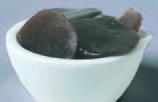
Discs of
buttonlac
, a key ingredient of shellac
(Photo:
www.cornelissen.com
)
Rio rosewood table from the collection at Burghley House with original French polished
finish (Reproduced by the kind permission of Burghley House Preservation Trust)