Basic HTML Version


1 9 0
t h e b u i l d i n g c o n s e r v a t i o n d i r e c t o r y 2 0 1 2
6
After the Games
Olympic architectural
heritage
John Gold and Margaret Gold
T
here is
a deep and abiding connection
between the Olympics and their host
cities. It started in the early 1890s when
the nascent International Olympic Committee
(IOC) decided that the modern Olympics
would not follow the ancient pattern of having
a permanent base, but would be an ambulatory
event that was effectively franchised to the
cities to which it was awarded. These ‘Olympic
cities’, which in principle could be anywhere
in the world, would supply the necessary
sports venues and infrastructure in return for
the right to stage the world’s most venerable
games.
For the first few Olympiads, organisers
made use of existing facilities or constructed
temporary structures to house participants
and stage the sports competitions. The
Olympics, however, quickly grew. The
participation of many more nations brought
far larger numbers of athletes and officials,
who were housed in sizeable ‘villages’.
The addition of new events from sports as
varied as cycling, gymnastics, shooting and
equestrianism led to a festival of increased
complexity and diversity that needed purpose-
built facilities.
Given the glare of publicity that the
Games attract, the organisers and their
architects understandably tend to treat the
occasion as an opportunity to create iconic
structures designed to impress visitors and
the world’s media – a strategy most recently
illustrated at Beijing 2008 by buildings such
as the ‘Water Cube’ Aquatics Centre, designed
by a Chinese-Australian consortium and
the ‘Bird’s Nest’ National Stadium, built by
Herzog and de Meuron to a creative concept
by Ai Weiwei. Frequently seen as lasting
advertisements for technical prowess and
creative design, such structures are permanent
features of the cityscape and often become
heritage sites of considerable significance. Yet
because the Olympics imposes demands that
are quite different from most other sporting
events, it is inevitable that host cities struggle
to find alternative uses for such venues after
the Games leave town.
Stadia
Nowhere is this truer than for the main
stadium. The IOC stipulates that there should
be an open-air arena with around an 80,000
seat capacity that stages the opening and
closing ceremonies and, in almost all cases,
is also used for the athletics competitions.
As the scene of many of the most memorable
moments as well as being a prime focus for
showpiece architecture, the Olympic stadium
is emblematic of the Games.
There are few other occasions when
these vast arenas are needed, however, and
their shape and layout are poorly suited to
the few mass spectator sports that might
conceivably capitalise on their size. Football
teams, for instance, complain about the lack of
atmosphere, with the presence of the running
track and the typically gentle rake of the seats
of an athletics stadium making the action on
the field feel distant for their spectators.
Without viable anchor tenants, their
formidable maintenance costs cannot be
borne without subsidy or by revenue from
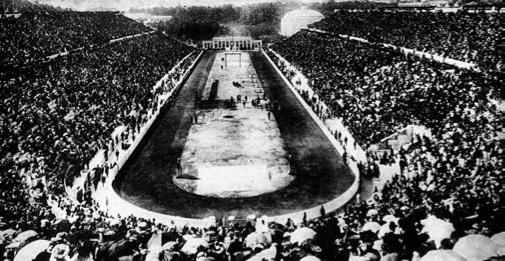
The Panathenian Stadium, Athens during the 1896 Olympics