Basic HTML Version


t h e b u i l d i n g c o n s e r v a t i o n d i r e c t o r y 2 0 1 2
1 9 1
6
Useful Information
tourist visits and occasional concerts, often
leading to them becoming labelled the
‘limping white elephants’ of the Olympic
movement (Mangan, 2010). The experiences
of three host cities – each with a distinct story
to tell – point to the problems and challenges
encountered with Olympic stadia and their
legacy (Table 1).
Athens
The city of Athens has hosted two Summer
Games, more than a century apart. For
the first, in 1896, the organisers used the
recently-excavated Panathenian stadium (or
Panathinaiko) to house the athletics events
and stage the major ceremonies. This had
the advantages of making valuable links
with the Games’ heritage and of successfully
accommodating crowds of more than 50,000 at
a modest cost – mainly incurred in renovating
the seating and adding a modern running track.
Yet even then it was outmoded; its
traditional elongated horseshoe shape with
accentuated curves at each end hindered
athletic performance and limited the nature
of subsequent sporting uses. Such uses of the
stadium, therefore, were largely retained for
reasons of symbolic connection – most notably,
hosting the archery competition and finish
of the marathon races for the 2004 Summer
City
Year Stadium details
Post-games use
Athens
1896 Panathenian Stadium built 4th century BC
renovated 144AD
excavated 1869/70
renovated for first ‘modern’ Olympic Games in1896
music
theatre
celebrations and festivals
heritage site
archery and marathon events at 2004 Olympics
2004 Spyros Louis Stadium built in 1982 for European Athletics
Championships
renovated and roof added 2002-04
athletics
cultural events
football (Panathinakos FC/AEK Athens)
Berlin
1936 built in 1913 for 1916 Olympics
rebuilt for 1936 Olympics
listed in 1966
renovated for 1974 World Cup
reconfigured and roofed for 2006 World Cup
mixed-use stadium
athletics
football (Hertha BSC)
London
1908 White City Stadium built for 1908 Olympics as part of
Franco-British White City Exhibition site at Shepherd’s Bush
mixed-use stadium
athletics
football
entertainment
greyhound racing (core use 1926–1984)
demolished 1985
1948 Empire Stadium built for 1923 British Empire Exhibition and
later renamed Wembley Stadium
national football stadium
athletics
cultural and sporting events
demolished 2003
2012 Olympic Stadium completed 2011 for 2012 Olympics
planned reconfiguration for dual use (football/ athletics)
TABLE 1
Details of Selected Olympic Stadia
Games. Nevertheless, it has become a valued
feature of modern Athens. Standing with its
open end facing on to Vasileos Konstantinou
Avenue, one of the city’s main thoroughfares,
its gleaming marble seating and memorial
tablets to Olympic victors serve as a daily visual
reminder of the ancient and contemporary
significance of the Games for Greek society.
Rather less positive conclusions, however,
might be reached about the Olympic stadium at
Maroussi, a suburban district 9km north-east
of the city centre, which was renovated for the
2004 Games. It originated as the Spyros Louis
Stadium, a 75,000-seater venue built for the
1982 European Athletics Championships.
Wanting an ‘architectural landmark of
international recognition’, the organisers
approached the Spanish architect Santiago
Calatrava in March 2001 to submit a
redesign for the stadium. The key element of
the project involved installing double-tied
tubular steel arches, rising to a height of
72m, which support a 25,000m² laminated
glass roof. Although functionally designed
to protect spectators from the heat by
reflecting up to 90 per cent of the fierce
sunlight, the additions also served to
supply a high-tech image for the stadium.
The 2004 Games, however, were notorious
for a lack of forethought about their legacy. For
strategic reasons linked to Greece’s desire to
be able to stage an Olympics at any time, the
stadium will retain the capacity to host major
athletics competitions. Nevertheless, other
uses are sought to defray the costs. All three
of Athens’ major football teams (Olympiacos,
Panathinaikos and AEK Athens) have played
there at different times. Panathinaikos and
AEK Athens continue to do so, but neither
is entirely satisfied with using a stadium
designed for athletics, with the former
seeking to build its own ground and the latter
complaining about poor gates.
Between football fixtures, the stadium is
used for around 15–20 rock concerts per year
and receives a trickle of visitors, although
there are no visitor facilities or tours. The
stadium might represent iconic architecture
designed to portray the new Greece but it sits
unseen in an Olympic park, far removed from
the major circulation patterns of the city, that
is deserted at most times of day.
Berlin
Heritage issues of a more awkward form
arise in relation to Berlin’s Olympic stadium,
which has never quite escaped its association
with ‘Hitler’s Games’ (Hart-Davies, 1986).
Located in a peripheral area to the west of the
city, the 1936 stadium grew from a predecessor
constructed in 1913 for the never-staged 1916
Olympiad. Werner March’s re-design of the
1913 stadium, originally designed by his father
Otto, provided for a 110,000-seater stadium
with a steel- and stone-clad structure that,
in deference to Nazi ideology, was given
a neo-classical facade with stone pillars
and colonnades. Memorialised in Leni
Riefenstahl’s film Olympia and immediately
familiar from television documentaries about
Nazi Germany, the Olympic stadium lay at the
heart of the Reichssportfeld – once the world’s
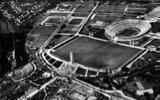
largest sports complex (below).
The Olympic Stadium, Maroussi, Athens, 2009
Aerial view of the Reichssportfeld, Berlin, 1936, with
Olympic Stadium top right