Basic HTML Version


1 9 2
t h e b u i l d i n g c o n s e r v a t i o n d i r e c t o r y 2 0 1 2
6
It became a focus of attention throughout
Germany in the period leading up to and
including the 1936 Games for a regime that
appreciated and mobilised the opportunity for
powerful spectacle. After the Games, the city
and state gained the infrastructural legacy of a
sports complex and parade ground that could
be used for military purposes and for future
National Socialist celebrations.
Little damaged by the war, use of the
stadium after 1945 was controlled by the
occupying forces. A short phase of opening
the grounds ended when the British Army
requisitioned the Reichssportfeld. It then
remained closed to the public until transferred
to the city council (Magistrat) of Greater
Berlin in June 1949. After languishing for some
years, it was adopted as the home ground for
Hertha Berlin Football Club and was listed for
preservation as a historic structure in 1966.
While externally little changed, the
stadium was renovated internally by the
addition of spectator covering for the 1974
World Cup, with a partial roof designed by
Friedrich Wilhelm Krahe. Complaints from
international sports bodies and others about
the stadium’s dilapidated facilities and ailing
structural condition led to a debate that
included the possibility of demolition.
Its saviour was again a sporting mega-
event. In 1998, Germany’s gained the
nomination for the 2006 World Cup, with the
Olympic Stadium in Berlin accepted as its key
venue. After appraisals and an architectural
competition, the Hamburg-based architectural
practice gmp (Architekten von Gerkan, Marg
und Partner) won the contract to renovate the
stadium at a cost of €242 million (Meyer, 2010).
Only perhaps at this stage could the long-term
future of the Olympiastadion be guaranteed.
London
The first of London’s three Olympic stadia
was less fortunate in this regard. The main
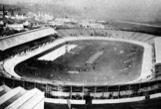
venue for the 1908 Games was the White City,
the first purpose-built Olympic stadium and
also the largest sports venue of its day. Its
enormous concrete bowl, designed by George
Wimpey, enclosed athletics and cycle tracks, a
100m swimming pool, platforms for wrestling
and gymnastics and even archery (above left).
Called the White City after the gleaming
white stucco rendering applied to the Franco-
British Exhibition buildings (to which the
Olympics were attached), its foundation stone
was laid on 2 August 1907 and the stadium
was inaugurated on the opening day of the
adjoining exhibition (14 May 1908). It held
93,000 spectators, with 63,000 seated.
Although the Games themselves were
regarded as successful, they left the less
desirable physical legacy of a huge and largely
unwanted stadium. Retained after 1908 despite
an initial decision to demolish it, the White
City was scarcely used for two decades before
passing to the Greyhound Racing Association
in 1926. It was then renovated, with its capacity
reduced from 93,000 to 80,000, the cycle track
removed and a greyhound track installed
over the existing running track. In 1932, the
reconfiguration of a running track to a new
440-yard circuit allowed the stadium’s use for
national and international athletics events.
On occasions, the White City did stage
large-scale sporting festivals, such as the
1934 British Empire Games and the 1935
International Games for the Deaf, and
provided a base for British athletics from
1933 onwards. However, when the athletics
events moved to their new home at Crystal
Palace in 1971, the stadium deteriorated. It
continued to host greyhound racing until 1984
but became an increasingly forlorn structure
that few mourned once it was demolished in
1985 to make way for offices for the British
Broadcasting Corporation and housing.
Little needs to be said about the city’s
second Olympic stadium at Wembley, which
was rarely regarded in the public mind as an
Olympic Stadium. Held against a background
of extreme austerity, the 1948 Games saw
the organisers make full use of whatever
was available. With custom-built stadia out
of the question, they designated the Empire
Stadium at Wembley, originally built for the
1924 British Empire Exhibition, as the Olympic
stadium even though it had not staged an
athletics competition for more than 20 years.
Once the 1948 Games were over, the
stadium returned to its use as a greyhound
racing venue (1927–1998), but more
importantly as the national football stadium
staging major domestic and international
matches, as well as providing ideal facilities
for pioneering outdoor arena rock concerts
in the 1970s. It was demolished in 2002–3
and replaced by a purpose-built football
stadium designed by Foster and Partners
and HOK Sport. The lengthy delay before
it could open in March 2007 was due
more to indecision about its purpose than
constructional problems, with attempts
to combine athletics and football in a
single stadium eventually scrapped in
favour of a dedicated football stadium.
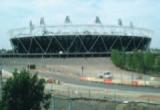
For the 2012 Olympic Games, London
promised a utilitarian purpose-built athletics
stadium which after the Games would become
a multi-purpose venue that included athletics
at its core (above right). Designed by Populous
(formerly HOK Sport), the 2012 stadium
addressed the ‘white elephant’ problem by
combining a core structure that could find
permanent usage with a temporary steel-
and-concrete top tier for 55,000 spectators
that would be removed after the Games. This
would downsize the stadium to 25,000 seats,
with the top tier, as originally hoped, possibly
reused in a stadium elsewhere.
The visual impact of the stadium was to
be provided by a fabric wrap which would
be draped around the stadium. This fell
victim to spending cuts at the end of 2010,
but was reinstated after it seemed likely
that the cost could be borne by sponsorship.
Understandably, the success of this approach
to stadium design rests on finding an anchor
tenant that would allow the stadium to be used
profitably while still permitting occasional
athletics meetings. At the time of writing,
however, the decision to retain the stadium
in public hands as a mixed-use venue without
having first found such a tenant means that,
despite all endeavours, yet another main
Olympic stadium seems destined to join its
immediate predecessors as a white elephant.
Conclusion
The stadia discussed here show in microcosm
the challenges faced by all Olympic cities as
they reconcile the demands of the Olympic
movement, the desire to house the Games
in a memorable fashion and the provision of
a viable post-Games future for the facilities
delivered. London has tried to pre-empt
these future problems for its Olympic sites by
engaging in the most comprehensive exercise
in legacy planning yet attempted. However, the
vagaries of post-Games market conditions will
impact on these plans in ways that could well
call into question the architectural heritage
that will result from these Games.
Recommended Reading
D Hart Davis, Hitler’s Games: The 1936
Olympics, Century, London, 1986
JA Mangan, ‘Prologue: guarantees of global
goodwill: post-Olympic legacies – too many
limping white elephants’, International
Journal of the History of Sport, 25, 2010
MMeyer,‘Berlin 1936’, in JR Gold and MM
Gold (eds), Olympic Cities: City Agendas,
Planning, and the World’s Games, 1896–
2016, 2nd edition, Routledge, London, 2011
John Gold
is a professor of urban historical
geography in the School of Social Sciences
and Law at Oxford Brookes University.
Margaret Gold
is a senior lecturer in
arts and heritage management at London
Metropolitan University and an associate of
the university’s Cities Institute. They have
published extensively on the urban impact
of the Olympic Games and are the editors of
Olympic Cities: City Agendas, Planning, and
the World’s Games, 1896–2016
(2010). Their
most recent work is a four-volume set on
The Making of Olympic Cities
for Routledge’s
Major Works series (forthcoming).
The White City Stadium, West London, 1908
The Olympic Stadium, London, June 2011