Basic HTML Version


1 9 8
t h e b u i l d i n g c o n s e r v a t i o n d i r e c t o r y 2 0 1 2
6
PRACTICE MAKES PERFECT
A new approach to skills training
Jonathan Taylor
A
pproximately one
in five buildings
in the UK predates 1914. Most of these
buildings are traditionally constructed
with solid walls built with lime-based mortars.
As these structures are vulnerable to being
damaged by modern repair techniques, it
is vital for their survival that the workforce
employed to repair them has the skills
and expertise required. However, most
construction colleges and training centres
focus on the construction skills required for
new buildings. The specialist skills required
for stonemasonry and traditional brickwork
are taught in only a handful of colleges, and
many skills required for historic building
work are unavailable through either the
NVQ system or the new Qualifications
and Credit Framework, which are geared
to meet the needs of industry and large
employment groups such as house builders.
The traditional method of teaching
practical skills is through apprenticeships,
an approach that lends itself well to
teaching repair skills. It is difficult to teach
a student in a classroom to ‘read’ the fabric
of an old structure and, no matter how
good the course, there is no substitute
for on-site training. Appropriate repair
techniques also vary widely from case to case
according to condition and construction,
something that is best learned in the field.
The UK construction industry largely
abandoned the apprenticeship training system
in the 1970s and ’80s. Some of the larger
specialist conservation firms have continued to
take on apprentices, who have either completed
their college training or who are still in college
but on a day-release programme. However,
the numbers attaining the standards required
by this route are limited, and the additional
cost of carrying apprentices can make the best
companies less competitive, particularly if the
competitive tendering process focuses on price
rather than on quality and value.
Much has been written recently about
the decline in traditional craft skills, and
research by the National Heritage Training
Group (NHTG)1 has given some insight
into the scale of the problem in finding
skilled craftspeople for the repair of historic
buildings. It is clear that new initiatives
are required if we are to continue to
maintain our traditional building stock.
The Tyntesfield Orangery
A scheme piloted by the National Trust at
Tyntesfield near Bristol is one of the most
exciting training developments in recent
years. Ten trainee stonemasons from
City of Bath College are engaged in the
1
The NHTG has published a series of reports analysing demand, supply and training provision in traditional
building craft skills for England, Scotland, Wales and Ireland: see www.nhtg.org.uk/nhtginitiatives.
conservation and repair of a fine Victorian
orangery as part of their architectural stone
conservation NVQ in Heritage Skills level 3.
The orangery had been derelict for at least 20
years, with all the classic masonry problems
associated with weathering and rusting
metal cramps. Working alongside stone
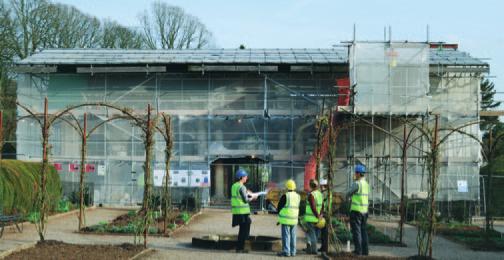
The National Trust’s restoration of the orangery at Tyntesfield is providing a unique training ground for students and members of the public
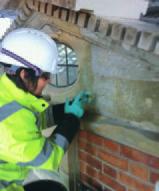
Jackie Blackman, a student from City of Bath College
preparing to insert a stainless steel rod to fix gable masonry
at the Tyntesfield orangery for her NVQ level 3
(Photo: Nigel Bryant)