Basic HTML Version


t h e b u i l d i n g c o n s e r v a t i o n d i r e c t o r y 2 0 1 2
3 3
1
Professional services
Flooding
Risk and remediation
Ruth Nicholls
F
reak storms,
often associated
with Atlantic hurricanes, and the
risk of flooding have been a threat
to communities in the British Isles for
centuries. However, climate change
predictions suggest that changes in global
temperatures will alter weather patterns,
causing sea levels to rise and an increased
frequency and intensity of extreme weather.
The UK will be prone to prolonged and
higher rainfall that will increase the
likelihood of flooding. Historic buildings
in areas so far unaffected by flooding may
be poorly prepared to face this threat.
The last ten years have seen a number
of floods in the UK that have caused serious
damage and disruption. Many historic
buildings have been affected. In 2004
Hurricane Alex caused storms over Cornwall
with a flash flood in Boscastle where the
river Jordan rose by 2m in one hour and tore
through the village centre.
In 2007 towns and villages all down the
Severn valley were flooded when the river
burst its banks and in 2009 in Cumbria the
rivers, streams and becks became raging
torrents sweeping away bridges and causing
widespread damage in many communities. In
2007 Gloucester was hit by both the rise in
the Severn and its tributaries and by localised
surface water and foul sewer flooding.
Images in the media of the Mythe Water
Treatment Works at Tewkesbury and the
electrical substation outside Gloucester
surrounded by water were a reminder that
many services and buildings are located
on flood plains. The loss of water supply to
the community and the narrowly averted
catastrophic flooding of the substation made
the threat of climate change seem more
immediate and more serious.
In response to recent floods, English
Heritage (EH) has prepared guidance for
the custodians of historic buildings entitled
‘Flooding and Historic Buildings’ (EH, 2010).
This article draws on EH guidance and on
experience gained at the flood-damaged
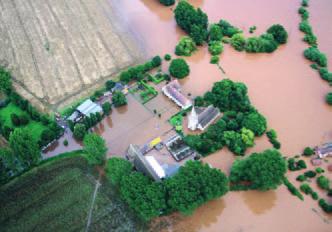
Church of St Andrew and St Bartholomew,
Ashleworth, Gloucestershire, where
the author is the church architect.
The lessons learned at Ashleworth are
relevant to other historic churches and
to all old buildings at risk of flooding.
Water and flood damage
The Environment Agency (EA) describes the
risk of flooding as the chance that a location
will flood in any one year and has developed
comprehensive maps that illustrate the areas
at risk. The EA defines the types of flooding
as: river flooding, coastal flooding, surface
water flooding, sewer flooding, groundwater
flooding and reservoir flooding.
Water damage can be classified into three
categories:
• clean water from internal water pipes
• grey water from internal wastes
such as washing machines
• black water, which contains contaminants.
Contaminants vary depending on the
surrounding environment and catchment
areas. As the flood water recedes, mud,
slurry, salts, raw sewage and other chemicals
and matter are left behind. The effects on a
building’s fabric depend on its construction
and the duration of exposure and saturation.
Water damage can be divided into
primary and secondary damage:
Primary damage
includes damage to
the structure, expansion or shrinkage and
staining. It will largely depend upon the
severity and velocity of the flood waters,
how long the materials remain saturated
and their absorbency. Contaminants can
also cause damage: the salts in seawater
are corrosive to some metals and some
absorbent materials cannot be cleaned if
they are stained by oils. Cleaning and drying
out processes can also be damaging.
Secondary damage
is caused by
moisture travelling to other areas than
those originally affected. Water vapour
rising through a building can cause mould
growth. Hygroscopic materials, which absorb
moisture, will support mould growth because
they maintain a high relative humidity at their
surface. This can also occur on less absorbent
materials if they provide a cool enough
surface to elevate the humidity sufficiently.
Introducing heat to dry the fabric of the
building can make the situation worse if the
vapour this produces cannot be removed.
Cleaning and drying
Many historic buildings are fairly
flood-resilient and most construction
materials can withstand the occasional
brief saturation. However, perhaps the
The Church of St Andrew and St Bartholomew, Ashleworth, Gloucester and adjacent buildings in July 2007: the line of trees at
top right marks the western bank of the River Severn (Photo: R Keene)