Basic HTML Version



4 4
t h e b u i l d i n g c o n s e r v a t i o n d i r e c t o r y 2 0 1 2
1
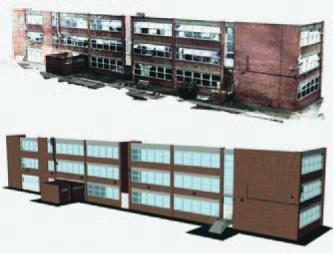
Figure 4 Point cloud (above) and surface model (below) of
an existing school facade
3D point cloud data is usually available
to the purchaser if requested. However, the
amount of data is large, sometimes running
into terabytes, so an external hard drive is
normally used to transfer it.
A scalable image and
a 3D photograph
There is nothing quite like having
photographs to record and look back on a site
visit, or explain the project. If photographs
were scalable, we would be able to confirm
dimensions and take levels that perhaps are
not covered on our 2D drawings, however
well specified.
The program TruView™ is a very powerful
tool that does just that. Truview takes the
scan data and effectively produces an image
Figure 5 Point cloud (right) and surface model (left) of the hull of the Tudor warship Mary Rose
of the building on an office PC. This can
be rotated, enlarged and interrogated for
dimensions and levels. It is a very useful
application that provides good visualisation.
Small architectural details can be enlarged
for closer inspection. Structural defects
such as cracks down to perhaps 1-2mm can
be viewed, and sagging in beams and the
bulge in walls can be read, even though the
professional may be unable to see them on
site.
The point cloud is the not the only site
data that can be recorded while on site.
A 360
o
colour photographic image is often
specified in conjunction with the scan. These
photographs are not currently scalable, but
by combining the digital photo with the
scan image so that both are registered by the
computer program, the photo itself appears
to be scalable. Scanning techniques are being
developed to record the colour directly using
the spinning laser, before registration.
Costs
The cost of on-site laser scanning is now
essentially hidden in the survey itself,
so there is no cost premium. The whole
process of 2D drawing production is no
more expensive than by traditional total
station techniques, assuming that normal
drafting tolerances are specified.
The production of drawn output
from the collected point cloud data will
normally represent about 60-70 per cent
of the cost of the overall survey, but
this may rise to 90 per cent for detailed
stonework, showing just how important
it is to define the survey parameters.
Some consultants are tempted to produce
the drawn output themselves from the point
cloud. This can achieve good results but
may prove more expensive. Direct use of the
cloud by the consultant is more normally
associated with surface and solid modelling.
Photographic colour imaging currently
requires different equipment to be mounted
to the tripod and so roughly doubles the time
spent at each site set-up. It also adds to the
registration process and will add 10-25 per
cent to the overall cost of a survey.
3D modelling can be economical for
basically rectilinear and recent fabric. The
simple facade in Figure 4 was scanned and
modelled, out-of-plumb and complete with
bulges, for £1,350, ready for incorporation
into the BIM model.
Drafting into 3D
The use of Building Information Modelling
or Management (BIM) has been declared as
a government objective in the procurement
of design. Although capable of much greater
sophistication, reduced to a minimum, BIM