Basic HTML Version


t h e b u i l d i n g c o n s e r v a t i o n d i r e c t o r y 2 0 1 2
5 9
2
Building CoNtractors
Geometric designs such as zigzags or
wavy lines became an integral part of the
shopfront design.
Faience and terrazzo also rose in
popularity. These modest, unassuming
ceramic materials provided a smooth
finish and clean lines. Some retailers, like
Montague Burton particularly favoured
faience. His tailoring empire used white
faience for its purpose-built inter-war
shops designed by their Leeds architect,
Harry Wilson. The gleaming white ceramic
combined with Art Deco detailing to give
a truly modern look for their shops. Chain
stores like Burton’s made an important
contribution to the promotion of these
new materials and styles and were often
at the cutting edge of shop design.
Problems
The great architectural success of these
shopfronts was also perhaps their weakness.
They were so modern and striking that their
fashion was short-lived and by the time
World War II had ended, the desire for this
type of shop was waning. The 1950s saw a
continuation of some of the themes born in
the 1930s, but with less vigour and enthusiasm
for the radical designs. Many shopfronts were
replaced, making way for the designs which
prevailed in the post-war decades including
the rising use of aluminium.
Those which have survived face a
number of issues. First, 1930s shops tend
to be extremely sensitive to inappropriate
alterations. Their minimalist style means
that the overall architectural composition is
surprisingly easily destroyed. Alterations to
signage, entrances and windows can seriously
detract from the designer’s original intention.
In contrast, Victorian shopfronts are often
more robust and seem able to withstand a
greater degree of intervention while retaining
their integrity. For purpose-built shops such
as those erected by Burton’s, although the
upper facades generally remain largely intact,
the ground floor shops rarely survive, losing
the overall design effect of the building.
Secondly, a lack of understanding of the
rarity or significance of these shopfronts
means that they are extremely vulnerable.
Although there is a greater appreciation of
them now and statutory measures offer some
protection, many outstanding examples
have already been lost. In cities like Glasgow,
where the streets were once brimming
with Art Deco shopfronts and gleaming
Vitrolite, finding good surviving examples
is a challenge. Effort needs to be focused on
ensuring that any shopfronts which remain
are suitably protected and conserved.
Undertaking conservation, however, can
be a problem. Some of the materials, once
mass produced and readily available, are no
longer manufactured. Vitrolite has not been
produced since the 1960s and although there
are some limited salvage options it remains a
very rare material. This is a significant issue
when dealing with a product which is subject
to breakages and cracking, particularly at
stall-riser level and around entrances where
impacts can easily damage the glass.
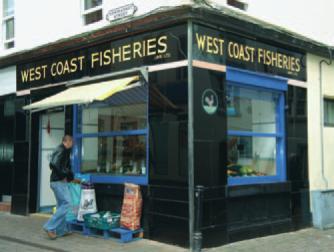
West Coast Fisheries, Ayr: 1936 black Vitrolite shopfront. Some damage is evident but overall the Vitrolite is in fair condition.
The fascia signs are particularly good examples of their type (Photo: Historic Scotland)
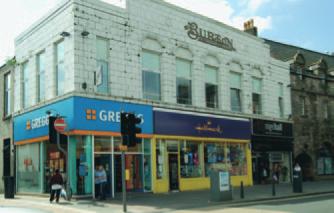
Former Burton’s store, Dumbarton: The ground floor shops have been altered and although the upper facade of white faience
remains intact, the overall effect is lost (Photo: Historic Scotland)
Substitutes are rarely successful as they
lack the depth of colour and distinctive
finish which is characterised by Vitrolite.
Shop owners have tended to resort to a
mixture of unsatisfactory repair options
including painted plywood, painted
Perspex or glass and even polished slate.
Damaged panels can allow water ingress,
which may affect the stability of panels.
Options may include moving surviving
panels to more visible locations and using a
substitute material where the panels are less
obtrusive. However, care needs to be taken in
the removal of the panels to ensure further
damage does not occur and that panels are
made watertight when reinstated.
Other materials like faience and
terrazzo are also subject to cracking and
damage but they can, at least, be repaired
more easily than Vitrolite. Similarly,
matches are possible where marble
cladding has become damaged or lost.
Future conservation and repair
It is ironic that some of the more recent
shopfronts cause the greatest conservation
challenges. While repairs to Georgian
joinery or Victorian cast iron shopfronts are
relatively straightforward, the conservation
of inter-war shops presents a much greater
problem. The lack of expertise in dealing
with them, together with the limited
availability of certain materials means that
shops frequently go unrepaired or are poorly
repaired with inappropriate materials.
Recognising the significance and rarity
of these shopfronts is a vital starting point in
ensuring that their place in the architectural
time-line of shops is secured. Statutory
protection also has a vital role to play.