Basic HTML Version


7 8
t h e b u i l d i n g c o n s e r v a t i o n d i r e c t o r y 2 0 1 2
3.1
later development made more allowance for
thermal expansion of the bays, made it easier
to form junctions and proved particularly
preferable on shallow sloped pitches where
footfall could damage standing seams.
Experimentation in methods of laying
copper continued through the 1950s and
1960s, making use of the longer strips of
copper then available for greater economy.
The Broderick System was patented in 1953
and incorporated bay-width cleats held in
place by dummy welts. Developments in
Switzerland at the same time led to the Long
Strip System, which was introduced in the
UK in 1957 and is now used for most modern
copper sheet roofing. This method uses long
trays of copper sheet, 520mm wide and up to
8.5m long. It uses fewer clips and cross welts
than the traditional method and the long
standing seams are often machine-formed.
Common defects
Copper roofing can be affected by mechanical
damage, corrosion and deterioration of the
supporting structure. If the roof was laid
in such a way that it cannot respond to the
prevailing environmental conditions, then
defects can arise through stresses applied to
the sheets. Wind-lift can lead to drumming
of the sheets. The copper hardens at the
points of most stress and eventually tell-tale
‘star’ cracks form at the intersection of the
lines along which the sheet has flexed. This is
a particular problem at Chichester Cathedral
where wider bays allow greater deflection
of the sheets. Where thermal movement is
restricted, fractures can occur. Accidental
damage can produce punctures through the
sheet or deformation of the seams, which
prevent them from performing correctly.
Acid corrosion of the copper sheet either
by acidic run-off or concentrated flue gasses
will lead to thinning of the sheet. The acid
solution removes the protective patination
and oxide layers accelerating corrosion of
the metal. Excessive thinning can lead to
perforations developing in the metal.
Deterioration of the structure or
underlay to the roofing can be caused by
condensation if ventilation of the under-
structure is inadequate. Deterioration may
be due to earlier failure of the roofing as
described above. In either case it is likely
to lead to further mechanical failure. In
this way defects in the under-structure
or roof covering can lead to progressive
failure of the roof if they are not dealt
with when they become apparent. The use
of roofing felt and wood-wool underlay,
introduced in the 1960s, has led to the
premature failure of some roof coverings.
Staining is a common defect of copper
roofs. It does not reduce the weathering
capabilities of copper, but can significantly
affect the visual appearance of the roof.
Run-off from other metals, particularly
those subject to oxidation, leaves metal oxide
deposits in the patination layer, changing its
colour. Run-off from steel or iron surfaces
creates brown staining and run-off from lead
surfaces creates grey staining. The only way
to remove this discoloration is to dissolve
the patination layer and then re-patinate
it. The process for removing the oxide layer
using a 5–10% solution of sulphuric acid is
described in Ashurst and Ashurst’s Practical
Building Conservation, Volume 4: Metals (see
Recommended Reading). The solution must
be handled and applied very carefully as even
diluted run-off can badly stain adjacent wood
or stonework.
Repair methods
Recommended repair methods for
copper roofs are described by Ashurst
and Ashurst and in the Defence Estates’
publication Roofs: Metal Sheet and
Asphalt (see Recommended Reading).
In most roof coverings the sheets are held
together through the use of welted joints. It
is possible to re-open these joints and replace
the defective sheets. Where necessary, the
sheets can be replaced with sizes that are
better suited to the mechanical forces which
the roof covering is subject to.
Difficulties can arise from this method
of repair because of the properties of copper.
Hammering copper will harden the metal.
Hardened copper sheets may fracture
while the joints are being opened up or
re-formed. Copper can be softened again
with the application of heat, a process called
annealing. Small areas of damage can be
patched using soldering, brazing or welding,
but all of these require the application of
heat in some form. Consideration must
be given to the potential hazards and the
fire risk to the under-structure. The use
of hot-work permits may be required.
Where the risk is to a vulnerable or
significant under-structure or building, the
application of heat may be inappropriate.
It may be possible to replace a smaller
area of roof covering, particularly if it can
easily be jointed to the existing sheet without
the risk of excessive hardening and without
the application of heat to anneal it. Cutting
back the retained sheet and using a batten
joint at the seam, so reducing the amount of
work applied to the existing copper, can avoid
splitting the hardened copper. This method
is often appropriate where damage has
been caused to part of the roof by extreme
weather, as at the Church of St Mary the
Virgin in Dalham, Suffolk, which suffered
storm damage in 1987 (see facing page, top
right). Due to the relationship between
patination and impurities in the air, new
copper sheet may take longer to patinate than
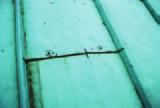
Chichester Cathedral: the wide bays used between vertical
seams allow the sheet to deflect under wind-lift which can
cause hardening of the metal and eventual cracking.
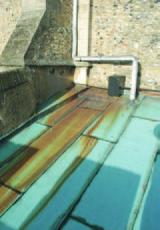
Iron-staining caused by a steel overflow pipe to the
heating system
lead and it has much greater tensile strength.
These characteristics combined mean that
standard copper sheet is thinner and lighter
than lead sheet, so it requires less structure
to support it. The greater tensile strength
reduces the likelihood of creep, making it
better-suited to more steeply pitched roofs,
such as domes and spires. Copper, with a
much higher melting point than lead, also
has greater fire resistance and was therefore
considered suitable, historically, for use on
important or valuable structures.
Corrosion of the outer surface of oxidised
copper provides a protective coating over the
metal beneath. This regulates the speed of
corrosion through the metal so that copper
sheet can last 100 years or more. The process
of corrosion also produces a patina, which is
predominantly green copper carbonate. It is
this patination that gives most historic roof
coverings their distinctive colour. Changing
climatic conditions and air pollution affect
the rate and colour of patination. The colder,
dryer and less polluted the climate, the longer
it takes for the patination layer to form.
Installation of copper sheet
roofing
Until 1870 nearly all copper sheet roofing was
laid in sheets, generally 2' by 6' in size, joined
at the sides with vertical standing seams.
Clips attached to the roof would be held
between the sheets. The upstand would then
be folded over either once or twice, to form
the seam. Horizontal joints would be folded
over flat to form welts. This is commonly
known as the traditional method.
With the development of thin sheets of
consistent thickness, a system of vertical
joints using wood-core rolls was developed.
A conical wood roll was fixed to the roof,
then sheets with their edges turned up were
placed on either side and welted together
over the roll. This method developed to use
an almost square batten with a strip laid over
the top and welted to the adjacent sheets. This