Basic HTML Version


t h e b u i l d i n g c o n s e r v a t i o n d i r e c t o r y 2 0 1 2
7 9
3.1
3.1 Structure & Fabric :
Roofing
historic copper sheet and may not match
retained elements. However, copper can be
pre-patinated to match an existing colour.
Patching small areas may be all that is
needed where the roof covering is generally
sound. The small area repairs described by
Ashurst and Ashurst in Practical Building
Conservation, Volume 4: Metals involve
hot-works. Understandably, current practice
does not favour hot-works when working on
listed buildings. A recent study of church
repairs found the techniques suggested by
Ashurst and Ashurst were rarely used despite
the likelihood that they would provide a more
durable fix.
Most small repairs are carried out using
some form of adhesive material: gluing
copper sheet with black mastic, self-adhesive
flashing tape, mastic tape and mastic beads.
None of these methods can be recommended
due to their short life span. Repairs of this
type are often applied without thoroughly
understanding the underlying fault. However,
the most common reason why these repairs
fail is that they have been applied over the
patination layer. This layer is porous so the
weathering process continues unchecked,
leading to the bond between the roof surface
and the repair patch breaking down.
At St Mary’s Church, Boxford, the
architect has devised a successful cold repair
method. The first stage is to remove the
patination layer around the area of damage
using a dilute acid solution in water. Then a
triangular patch of copper sheet is adhered to
the cleaned surface using acid-curing silicon.
The triangular patch, pointing up the roof
slope, allows water to be shed away. Although
used for replacement. This can result in a
significant visual change to the building and
the loss of copper as a historic roof covering.
Recommended Reading
J Ashurst and N Ashurst, Practical Building
Conservation, Volume 4: Metals,
English Heritage Technical Handbook,
Gower Technical Press, Aldershot, 1988
The Guide to Copper in Architecture,
Copper Development Association,
Hemel Hempstead, 2006
Copper Roofing in Detail, Copper
Development Association, Hemel
Hempstead, 2002
Copper Through the Ages, Copper
Development Association,
Radlett, Herts, 1955
Historic Buildings Factsheet 3.02,
Roofs: Metal Sheet and Asphalt,
Defence Estates, HMSO, London
F Röbbert, TECU Copper Planning, Designing
and Processing, KM Europa Metal AG,
Osnabrück, Germany, 2000
This article is an abridged version of the author’s
dissertation The Care and Conservation of
Copper Roofing to Historic Buildings, 2009.
A digital copy is available on request.
Jonathan Goode
BArch(Hons) MSc RIBA
is a chartered architect and director at
David Le Lay Architects (see page 23). He is
quinquennial inspector to a number of listed
churches in London. His practice works with
a wide range of historic property owners
to maintain and maximise the use of their
buildings. Email jg@davidlelay.co.uk
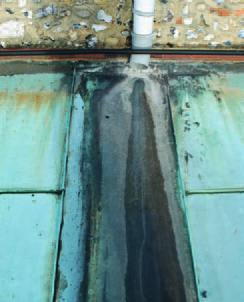
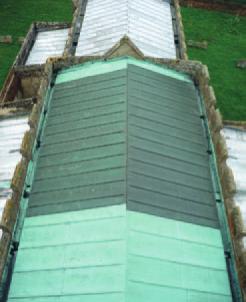
Left: Lead-staining caused by run-off froma higher lead-covered roof Right:The Church of St Mary the Virgin, Dalham, Suffolk: the roof was partially re-covered following storm damage.
The new copper may never match the original colour because the development of patina on copper depends on climatic conditions and these have changed over time.
(Photo: The Whitworth Co-Partnership LLP)
this method has not yet been extensively
trialled, repairs are currently reported to
have lasted more than ten years.
Considering replacement
A number of post-war repairs now need
significant attention after only 50 years. This
is commonly due to shortcomings in the
supporting structure, original specification
or the workmanship. It should be borne
in mind that these repairs were carried
out at a time when resources were limited
and during a period of rapid expansion
in the amount of repair and construction
being undertaken by contractors and
professionals who were unfamiliar with
the material. This was also a time of
technical development and experimentation
in the method of laying copper.
If the cause of a defect relates to the laying
or specification of the copper sheet, or relates
to some defect in the under-structure, the
problem will worsen unless it is addressed
and removal and re-laying may be the only
viable option. In these circumstances, to
conserve historic methods of installation
and appearance, the replacement works
should be laid in a manner which best
matches the original detail but overcomes any
shortcomings in the method or specification
originally used, rather than specifying the
now ubiquitous long-strip method.
Well-laid and supported copper should
reasonably last 80 years or more. The
sustainability of copper as a roofing material
is improved by suitable repair rather than
replacement. The relatively high cost of copper
can mean that other roofing materials are