Basic HTML Version


t h e b u i l d i n g c o n s e r v a t i o n d i r e c t o r y 2 0 1 2
9 3
3.2
3.2 Structure & Fabric :
Masonry
as the fuel. This has been undertaken at the
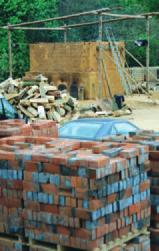
Buckinghamshire brickyard of HG Matthews
(see illustration) where the bricks lining the
fire-tunnels naturally acquire the glossy
grey ‘potash’ glaze that is commonly found
on many of the bricks in a Tudor building.
The effect, which is not achievable using
coal as the fuel, is caused by the formation of
chemicals as the timber burns. These probably
act as a flux on the surface of the hottest
bricks, allowing superficial vitrification, the
fusing of mineral crystals to form a glaze, and
binding some of the ash in the process.
Similar effects can be achieved by
employing methods once traditionally used
for the production of imitation flared ‘headers’
in brick tiles. These tiles, which are also
called mathematical tiles, were sometimes
used in the 18 and 19th centuries to face
earlier buildings to mimic the fashionable
appearance of contemporary brickwork. The
‘header’ tiles were coated with fluxes such as
alkaline potash and then re-fired. Although
less authentic than the effect of true wood
firing, the technique has been successfully
used to produce bricks for conservation work.
Mortars
A wide range of building limes is now available
for mortars for use in the repair or re-pointing
of Tudor brickwork. Lime is the product
of firing some form of calcium carbonate
(CaCO₃) at around 9000C to drive off the
carbon dioxide (CO₂) to become calcium oxide
(CaO) or ‘quicklime’ which, with added water,
is then hydrated to form either a powder (dry-
hydrate) or, with an excess of water, to form
putty. The material is now lime and it can be
used as a binder with a filler (usually sand) to
make mortar, plaster or render.
There are two basic types of building lime,
both of which are covered by BS EN 459-1:
Air lime
(sold as lime putty) is made
from a limestone containing approximately
95 per cent pure calcium carbonate. This
class of lime only hardens by carbonation,
through re-absorbing carbon dioxide from the
atmosphere to return to calcium carbonate
(but now in the form of mortar not stone) in a
process known as the ‘the lime cycle’. Air lime
is incapable of hardening below water where it
is removed from the effects of the atmosphere.
Other craft names for it are ‘high-calcium’,
‘fat’ or ‘rich’ lime, and it is often referred
to as ‘non-hydraulic’ lime or simply by the
abbreviation CL – ‘calcium lime’.
Natural hydraulic lime (NHL)
is made
from sources of calcium carbonate naturally
containing varying amounts of silica and
some alumina that, in firing, become reactive
with calcite (crystalline calcium carbonate).
The initial set that occurs arises from the
combination of these compounds with
water to form a new crystalline matrix. In
addition, the lime follows the lime cycle,
hardening as it carbonates. It is the first set
which enables these mortars to set deep
within a structure where there is little
available carbon dioxide, and even under
water (hence ‘hydraulic’). The higher the
silicate content the quicker and stronger the
set. The natural hydraulic limes currently
utilised in conservation today are divided into
three classes of ascending strength: NHL2,
NHL3.5 and NHL5 (the numerals relate to
the compressive strength in N/mm² at 28
days). These are available as bagged dry-
hydrates. The term ‘natural’ is significant as
there are now two other designated classes
of lime: hydraulic limes (HLs) which are
permitted under BS EN 549-1 to contain up
to 10 per cent undeclared content, including
cement; and ‘formulated lime’ (FLs) which
are blends of calcium hydroxide and a range
of performance enhancing materials such
as cements and pozzolana. Neither should
be used in the repair of historic fabric.
Generally, repair mortars should match
the existing as closely as possible in mineral
composition, texture and strength, except
where attributes are linked to its failure.
A preliminary analysis can be carried out as
an on-site visual appraisal using knowledge
of the local geology of historic building
limes and sands to determine a suitable
replacement. A better method is to send
mortar samples for analysis by a reputable
laboratory. The results can provide a vital
tool in accurately determining data to aid
specification, such as:
• class of binder
• aggregate type, size and grading
• ratio of binder to aggregate
• other inclusions.
Only complete sections of bed mortar
(typically 100 x 150mm) should be sent for
analysis. These are first studied under a
microscope before removing the lime binder
using ‘acid digestion’. The residue (principally
mineral aggregates) is then washed, dried and
graded within a stack of British Standard test
sieves to determine the range of aggregates.
The information revealed by these simple steps
is usually sufficient for the specification of a
replacement lime and sand mortar suitable
for its intended purpose and compatible with
the surrounding original. More sophisticated
analyses such as electron-scanning
microscopy and x-ray diffusion can also be
successfully employed.
Although lime to sand ratios are often
described as 1:3, analysis reveals that most
historic mortars were far more lime-rich, with
most ratios averaging between 1:1 and 1:2 (see
the author’s article, ‘The Myth in the Mix:
The 1:3 ratio of lime to sand’ in The Building
Conservation Directory, 2007 and online at
www.buildingconservation.com).
Re-pointing
Where Tudor brickwork is concerned, re-
pointing should never be undertaken lightly.
Re-pointing should only be considered
if the depth of erosion is greater than
the width of the joint, or if the joints are
allowing sufficient water ingress to cause
interior damp. As the thick joints on Tudor
brickwork can constitute 25 per cent of
the wall surface area, inappropriate and/
or poorly applied re-pointing can seriously
impact the aesthetics of the brickwork,
over-emphasise the joints, and detract from
the overall charm of the Tudor building.
If re-pointing is deemed necessary, joints
must be carefully cut back to a squared seating
at least 2.5 times the width of the average bed
joint thickness (38mm for a typical 15mm joint
width). Joints are then brushed or vacuumed
clean of debris and well dampened but not
saturated. The choice of lime and sand for
the mortar and mix ratio must be specified
on a ‘suitability of purpose’ criterion. The
joint profile is important too. It might be an
exposed aggregate, finished just back from the
face of the brick to match the appearance of
the surrounding mortar. On a complete re-
point of an elevation, however, an opportunity
exists to consider sympathetically recreating
the established original ‘struck’ or double-
struck’ profile.
Re-pointing must not be carried out if
there is a risk of frost and, once completed, the
re-pointed joints must be suitably protected
until they have sufficiently cured to ensure
that they are not damaged by the elements;
and particularly the effects of driving rain.
All historic brickwork is important
and deserves sympathetic treatment and
careful repair by knowledgeable and skilled
specialists. Tudor brickwork, however, is
particularly rare and deserves the highest level
of care, both for its character and its historical
significance. Fortunately, brick is a highly
durable material and if properly pointed and
suitably repaired Tudor examples should last
for many more centuries.
Gerard Lynch
MA PhD, master
brickmason and historic brickwork
consultant (see page 94), and author,
trained through the apprenticeship
system and at Bedford College where
he later became Head of Trowel Trades.
He is internationally recognised for his
extensive specialist knowledge and skills
in the conservation, repair and re-pointing
of traditional and historic brickwork.
A traditional open clamp at the brickworks of HGMatthews:
bricks from an earlier firing, with their characteristic flared
headers, are stacked in the foreground