
Cracking
Jim Allen
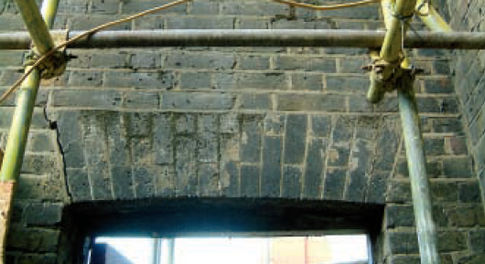 |
| A cracked gauged brick arch (Photo: Charterbuild) |
Whether dealing with the conservation of historic buildings, or more mundane commercial or institutional buildings, it is imperative that the cause of cracking in masonry structures is well understood. Perhaps one of the most significant differences between working on relatively modern structures and historic buildings is that often, in the latter case, it will not be possible to deal with the root cause. However, this does not in any way reduce the need for understanding, because a suitable repair strategy can only be determined once the cause of the problem has been identified.
Cracks arise because the real world is not static: whether at a macro or a micro level, materials respond to changes in their environment by trying to move. There are several generic causes for movement (a more specific listing would run to several pages):
-
Ground movement (beneath foundations) Examples include shrinkage in clay sub-soils (often tree-related), loss of fine particles from granular material (caused by drain failure or ground water movement for example), land slip and even the activities of burrowing animals.
-
Foundation failure Consolidation of rubble foundations, decay of soft clay brick, and attack of concrete by aggressive chemicals all fall into this category.
-
Decay of superstructure Most structures are composite, being made up of different materials each with its own life expectancy under any given environmental exposure. When one material fails prior to another, movement and cracking arise. A classic example would be the decay of timber wall plates in masonry, or the corrosion of iron cramps in stone walls.
-
Moisture movement Materials either expand or contract as they gain or lose moisture. In some cases (the expansion of new clay bricks for instance) the movement is irreversible but, if anticipated originally, the construction may have been designed to accommodate it. In others, movement caused by variations in moisture content are reversible and because of their cyclical nature, often harmless, but they can lead to progressive movement, often out of plane. Seasonal changes in timber are a good example, and of course as timber is a natural material, movement will not be uniform.
-
Thermal movement As temperature increases or decreases, materials either expand or contract. If such movements are prevented, very great stresses can occur. This form of movement is also cyclical and can lead to the progressive deterioration of structures.
-
Inherent defects Structures, particularly historic structures, often lack (by today's standards) sufficient lateral restraint of vertical elements, resulting in lateral movement. Often progressive alteration of structures can concentrate load in areas ill-suited to carry it. Movements associated with such defects are often progressive and unless arrested can eventually end in structural failure.
-
Inappropriate specification Modern repair techniques are often too strong or too rigid for the repair of structures built with pliable lime-based mortars. Pointing with Portland cement-rich mortar is a good example, as strong mixes do not behave elastically and, if overstressed, the new mortar can fracture or, more usually, the surrounding masonry fractures.
-
Deflection under load Suspended structures such as floors tend to deform under load, and even vertical elements subject to load will compress by a small amount. Any infill (which is by definition non-structural) must be detailed to accommodate such movements or cracking will occur. A classic defect of 1960s buildings is delamination of brick slips caused by the deflection of reinforced concrete supporting structures.
While not exhaustive, this list serves to illustrate the complex interactions that can occur, and the difficulties that may arise in gaining an understanding of cause.
REASONS FOR CRACKS
Cracking is an inevitable response to the inability of a structure to accommodate the movement to which it is subjected. There are two issues to be considered when assessing the reasons for cracking: the first is the nature and significance of the cause of movement (as described above); the second is the ability of the structure to accommodate movement. The latter will depend on the nature of the material or, in the case of composite materials like masonry, the nature of the combination of materials used in the structure.
For new buildings, designers can try to eliminate many of the causes of cracking and design tolerance for those factors that remain either by introducing joints, or by choosing movement-tolerant materials. The latter is the traditional approach to design, however materials such as fat lime (lime putty) and hydraulic lime can now be specified to give structures the ability to absorb considerable movement.
Existing buildings are what they are, and when considering performance an assessment must be made as to the likely cause of movement and the degree of the movement-tolerance inherent in any given structure. The cracks may be predominantly associated with an external cause (as in the case of subsidence) or with the material itself (an over-specified cement render for example).
STRATEGY FOR ASSESSMENT
 |
|
 |
|
 |
|
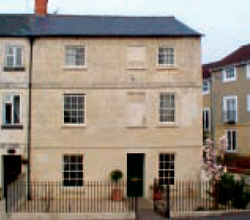
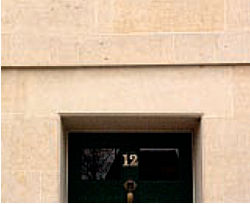
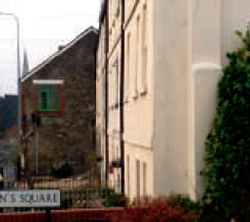
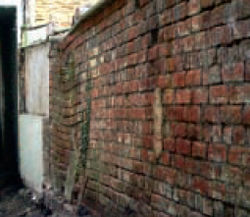
| 12 London Road, Chippenham: (top ) the front elevation showing new and old stone; (middle) detail over a door showing a lintel cut to shape to accommodate settlement; and (bottom lateral movement in the front elevation due to the decay of embedded timbers both to front and side elevation (note the buttressing). | |
 |
|
| A wall showing settlement where it was built over an old well |
Where historic buildings are concerned it is essential to employ someone with the experience and expertise to recognise the patterns of movement taking place, and who will be able to plan a programme of investigation to verify their assessments. Research is essential and can save hours of expensive time, and minimise the need for the disruption that investigations can cause.
A specialist structural engineer will be able to form an opinion on the basis of a visual inspection, but even when good archival information is available (from a previous structural survey, for example), some site investigation will still be required to tease out the various interdependencies, and to establish the most important factors at work.
This can be an iterative process as investigations can raise more questions than they answer.
STRATEGY FOR REPAIR
It is important to establish a brief before embarking on any programme of repair. On the assumption that both the cause of movement and the degree of movement-tolerance have been established, a range of options will be available. These may encompass major intervention on the one hand (and a good prospect of avoiding major future problems) to limited cosmetic action in the knowledge that further maintenance work will be required on a regular basis. The most important consideration is whether movement is likely to be progressive. If the structural condition is going to deteriorate, then for a structure to be preserved, intervention becomes essential.
Having agreed an approach to underlying problems, the result of the intervention must be assessed. For instance, new foundations can be expected to settle following underpinning, as the ground beneath consolidates. This is particularly an issue where clay forms the sub-strata. Premature or inappropriate repair of crack damage can be an expensive mistake.
In effect, the likelihood and the nature of future movements need to be assessed for the new condition created by intervention. Detailing will be dependent on the kind of movement likely to occur in the future. In most cases structures will still be subject to moisture content changes and variations in temperature, as short and long term changes in environment occur.
REPAIR DETAILS
Cracking creates an inherent weakness in a structure. This is why a superficial approach to repair, limited to filling and decorative work, will almost always fail. Even the smallest of movements will lead to further cracking.
In engineering terms, this is explained by the size of cracks in relation to the rest of the structure. Cracks are usually narrow, and if movement is concentrated at these positions of weakness, the strain will be high. The stress created by movement is a function of strain, and will vary depending on a parameter called the Young's modulus which, in effect, describes the stiffness of a material.
For this reason, materials with high values of Young's modulus, such as a rich Portland cement (OPC) mix, should not be used to repair a crack in a masonry wall, because the stresses that arise will cause the repair to fail. Materials with a low modulus, or with the ability to deform in a plastic manner, will offer better prospects for success. A high calcium hydraulic lime, for example, would be much better than OPC in an area of high strain.
Increasing the width of a repair will also reduce strain and, therefore, stress. In practical terms this can be achieved by cutting out cracks and substituting a formed joint, but this is major work and may not be acceptable visually or in terms of cost. Rebonding masonry using hydraulic or fat limes is usually preferable, as this will give the necessary plasticity, providing a mechanism to accommodate strain.
One alternative is to insert corrosion-resistant metal reinforcement (usually stainless steel) into bed joints to redistribute strain and therefore stress over a wider area, thus reducing the risk of failure. Care must be taken to vary the width of reinforcement across the crack as abruptly terminating a bar in a wall or mesh in a render in parallel lines on either side of the crack can also cause stress concentrations leading to further cracks.
Such techniques require the basic form of construction to be robust and in relatively good condition. This is not always the case, and sometimes it is necessary to carry out remedial work to stabilise a structure before it can be repaired. To assess this need, the basic form of construction must be understood, and the degree of distortion estimated. Generating cross sections to show the deflection and deformation can be helpful, allowing the extent of voids and other defects to be estimated and taken into account.
Where voids are suspected, the use of instruments such as boroscopes can be invaluable to see inside structures to verify the extent of the problems. There are other more sophisticated methods of non-destructive investigation that can be employed, including radar and thermography, but these can be expensive and complex to interpret. These methods are discussed further in 'Non-Destructive Investigations', a Building Conservation Directory article by Robert Demaus, also available on this website.
The response to voids is usually either reconstruction (often unavoidable) or grouting to fill them with cementitious material. Grouting requires the voids to be accessed by drilling holes in the structure through which the grout can be poured. There is no single 'best way' to approach grouting, but some methods are better than others.
In particular:
- use trials to find the best grout mix
- use rounded fine aggregates rather than sharp sands
- make several holes to access voids
- start below and work up; grout appearing in the next hole is a sign of success
- pre-wetting of the wall will prevent moisture-loss from the grout and reduce clogging of the grout points with dust
- grout can exert high levels of hydrostatic pressure, so limit the pour height and the pressure head used
- where walls are in poor condition it may be preferable to slowly feed the grout into the wall using clay applied to the wall and shaped into cups
- grout can take time to penetrate walls
- use a grout mix that is compatible with the fabric of the wall
- consider the future performance of the wall when specifying the work.
These comments are from an engineering perspective. There will be other factors influencing the specification for repair, and it may be appropriate to depart from the 'ideal' engineering solution.
The successful repair of cracks in masonry structures requires a fundamental understanding of the reasons for the cracking. Intervention must respect the structure, and it is important to assess the likelihood of progressive movement. An appropriate repair will accommodate future movements in the wall, but may require stabilisation works if it is to be successful.