
Non-Destructive Investigations
Where
decay or structural problems are suspected but are hidden by fine decorative
finishes or buried within structural elements, the use of conventional
investigation techniques can result in extensive and unnecessary damage.
Robert
Demaus introduces the principal non-destructive alternatives available
today
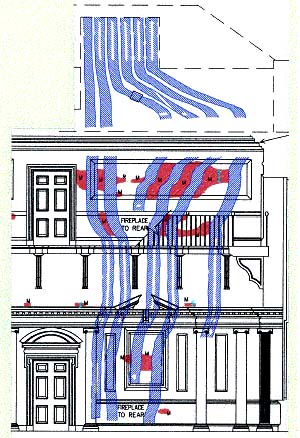 Impulse
Radar: Part of a survey showing the location of flues and areas
of defective brickwork behind fine decorative finishes (GB Geotechnics
Ltd) Impulse
Radar: Part of a survey showing the location of flues and areas
of defective brickwork behind fine decorative finishes (GB Geotechnics
Ltd)
|
It has been a century or more since doctors routinely cut open their patients to find out what was, or was not, wrong: such operations often harmed the patient more than the problems they were trying to cure. It would now be unthinkable to adopt such a brutal approach to the care of patients. However, we continue to treat buildings in just such a cavalier way, embarking on major disruptive and destructive surgery without bothering to obtain an accurate diagnosis of the problem beforehand.
It is sometimes thought that the cost of modern non-destructive building diagnostics is too high, but how much does it cost to strip out and then reinstate window linings or cornices to check lintels, or to remove and replace oak panelling to check walls? How much does it cost to renew timbers that may look decayed, but which are perfectly capable of continuing the job? Conversely, inadequate investigation may result in additional costs and delays to the completion of a project if hidden faults are uncovered; and structural failure may result if they are not. How much unnecessary work is done "to be on the safe side"? The right method of assessment, used at the right time, generally saves considerably more money than it costs.
The essential basic tools for non-destructive investigation remain good eyes, an open mind and a profound knowledge and understanding of both original construction methods and materials, and historical repair techniques. The various techniques briefly described in this article are not a replacement for that knowledge and understanding, but an additional and sometimes very powerful tool which can add greatly to the information needed to select the most appropriate, conservative and cost-effective course of action.
IMPULSE RADAR
Equipment developed from military and geo-technical applications has been used with great success in the location and measurement of voids, internal cracks, old chimney flues and other discontinuities in mass walls, and beneath floors. It is also used for location of cramps and failures in stone structures. Essentially the technique involves the transmission of pulsed radio energy from an antenna held against the surface and the reflected energy is picked up by another antenna. As some energy is reflected in varying proportions by inconsistencies within the material, a profile of the structure below the surface can be analysed. Continuous readings are taken and the variations recorded for later analysis. However, interpretation of the resultant data is very complex, and a high level of expertise is required if mistakes are to be avoided. Assessment by impulse radar is relatively expensive, but it can provide extremely valuable information on the original structure of a building, its historical development and its present condition. It can also be used to check that remedial work such as pressure grouting has been effective.
ENDOSCOPY
Endoscopy is simply an extension of the essential visual survey into areas inaccessible to the naked eye. The equipment ranges from relatively simple borescopes consisting of a light source, a small diameter rigid tube with built-in optics and an eye-piece, to complex controllable systems with numerous specialised attachments. By drilling a hole, (normally less than 12mm) and inserting the tube, it is possible to inspect voids under floors or behind panelling for example. Any hidden problems such as fungal growth can, in theory, be identified. The more sophisticated and expensive equipment is fully flexible and can be steered by wires built into the casing. Systems are available down to 6mm diameter, and more specialised systems down to less than 2mm. It is possible to attach still or video cameras to the eye-piece to record the findings. The theory is fairly simple, but in practice it can be very difficult to retain a sense of scale of the image observed, and keep track of the location and orientation of the tip. The focal range, depth of field and strength of light is greatly reduced in the smaller diameter systems. It is not unknown for insulation lagging to be mis-identified as dry-rot!
ULTRASONICS
Ultrasound is a widely used technique for non-destructive assessment throughout medical and industrial fields. In historic buildings, its particular applications are the assessment of timber, stone and ceramic materials, and it can also be used on concrete and metals. In timber, the technique is capable of quickly locating areas of decay and structural weakness hidden within, assessing the extent of decay visible on the surface, and measuring the depth and extent of fractures. It is particularly useful for the assessment of the structural integrity of timber joints. In stone, fault planes and zones of weakness within large blocks can be checked, as well as the depth of surface cracks and weathering decay, fire damage and the effectiveness of consolidation and repair, and the bond between individual stones in, for example, a column. A specific application is the assessment of weakness and potential failure in statuary.
In some applications, particularly where timber is concerned, access is required to opposing sides of the material being tested, which can be a major limitation. However, where usable it is fast, reliable and inexpensive. Unlike medical, and some industrial applications, the equipment used for buildings assessment does not produce a picture, and a high level of experience and skill is required to interpret the results. It cannot be used where there are a number of discontinuities such as across a random rubble wall, as the signal is too scattered by the various interfaces. It is totally non-destructive, leaves no mark and can be used on very fragile stone or painted timber surfaces.
MICRO-DRILLING
This technique, which is specifically for the assessment of timber, is perhaps the most accurate practical method currently available. A fine drill probe linked to a computer penetrates up to 200mm into the timber, and records faults and variations due to decay or other defects by measuring the speed of penetration. Extensions are available which allow penetration to any depth. A hole of just 1mm in diameter is left, similar to the exit hole left by Anobium punctatum, the common furniture beetle. This technique is capable of accurately measuring the severity and extent of decay, the ratio of sound to decayed timber remaining, and its position within the cross-section. This is extremely valuable to engineers in assessing whether a timber can continue to fulfil its structural role, even if some decay is present, and allows more conservative repairs to be designed. It can be used to assess timber behind surface finishes such as decorative plaster, oak panelling, window linings and render. The information obtained from the micro-drill is easier to interpret than some of the other techniques discussed, but nonetheless, embarrassing and expensive mistakes in interpretation can be made by the inexperienced. Particular caution is needed when assessing softwoods as there is a tendency for the drill to track round the softer growth and indicate significantly weaker timber than is actually the case: it can also be difficult to differentiate between narrow shakes and large voids, and where possible such testing should be cross-checked with another system such as ultrasound.
MOISTURE MEASUREMENT
The measurement and monitoring of moisture and its effect is a complex and important topic that is frequently misunderstood. A considerable proportion of the remedial treatments specified for damp problems are unnecessary or mis-applied, and often counter-productive, introducing more serious problems that may remain hidden for many years.
Simple electrical resistance meters are cheap and widely used, but the information obtained from them can be wildly inaccurate and often of little value. They can measure the moisture content on, or just below the surface of timber, but this does not necessarily give any indication of the moisture deep within. Old surface treatments, whether protective or decorative, can change the resistivity of the timber and give misleading results. On walls, salts in brickwork, foil behind plasterboard, high carbon content, condensation and other factors can give false readings. The results therefore need to be treated with great caution, but some useful information can be obtained.
Carbide meters (for walling materials) or laboratory testing of samples is needed for accurate and reliable results. It is often the changes in moisture levels that are of greatest significance: these can be monitored remotely by small and fairly cheap sensors inserted deep into timbers and masonry and wired back to a central point, to give early warning of changes in moisture before any damage is done. This is the best method of providing long-term protection.
INFRA-RED THERMOGRAPHY
Very sophisticated equipment is now available which can measure and record minute variations in the infra-red radiation which is emitted by all structures. As the level of radiation varies measurably according to the material's composition and temperature, infra-red thermography can provide an astonishing amount of information on the structure and condition behind the surface and within the fabric of a building. This powerful technique is the subject of an on-going programme of research. Apart from the obvious and established use of locating and defining heat loss (which in itself can be very important in an old building) applications include the location and/or assessment of the following:
- Structural timber frames behind render, weather-boarding plaster, etc
- Structural joints, infilled openings, etc behind render on masonry walls
- Bond failure and moisture ingress in renders, pargetting and harling
- Lintels, structural failures, snapped headers, etc in brickwork
- Variations
in moisture levels.
The assessment is very quick and usually requires no expensive access equipment or scaffolds as most of the work can be carried out from ground level. The speed with which an entire street can be assessed makes it a valuable aid to historical recording. The images can be stored on computer disc and printed out in colour. However, infra-red thermography is very sensitive to weather conditions - rain or bright sun on a wall to be investigated may prevent any successful assessment, and the temperature gradient required sometimes means that more information on heated buildings can be obtained in winter, and unheated ones (such as churches) may be better surveyed at night when the day's solar gain provides sufficient gradation.
To return briefly to the medical analogies referred to at the beginning of this article, a general practitioner is expected to have a wide knowledge of symptoms and possible remedies, and, though aware of the various techniques which are available, cannot be expected to carry them out: their application and interpretation is left to a specialist with expertise in that particular field. The same approach must be taken with the diagnosis of building faults, but never expect a consultant with a financial interest in recommending extensive works, or one particular remedial treatment, to be objective, or even accurate.
The above is only a brief summary of some of the more generally useful or readily available techniques. The monitoring of structural movement also provides some insight into conditions beneath the surface of a structure and are described in the article by Clive Richardson. Other techniques, such as X-ray radiography, magnetometry, and sniffer dogs trained to detect dry rot each have their specific uses, and can yield valuable information which other systems may not. The equipment described is constantly being updated, and a great deal of research and development is being carried out. Many of these techniques, whilst extremely valuable used in isolation, become even more powerful when used in combination: thermography, for example, can locate all the structural timbers behind a pargetted elevation, and the micro-drill then used to assess their condition without removal of any of the pargetting. If no decay is found, the building can be left alone with no damage or disruption. If pockets of decay are found, localised repair (akin perhaps to keyhole surgery) can be carried out, and most of the pargetting left in place. The savings, both in cost and loss of original or historic material, are considerable.