
Masonry Cleaning
Chris Daniels
 |
|
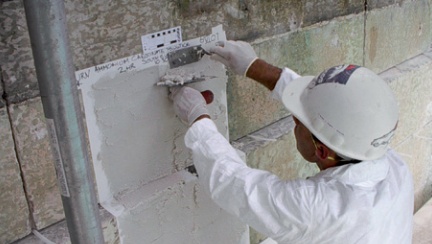
| Chemical cleaning should be tested on trial areas under controlled conditions (and with the benefit of the appropriate protective clothing) as in this poultice trial. |
The cleaning of masonry facades, whether of stone, brick or terrracotta, is the most visible aspect of building conservation work. When it isn’t carried out correctly, it has the capacity to cause damage either immediately, while cleaning is in progress, or over a period of time after the restoration work has been completed.
Sadly, abundant evidence of the harm caused by the inappropriate removal of dirt and stains still does not prevent those who are unqualified and inexperienced from continuing to damage our built heritage.
This article is not the place to find answers to all the dilemmas posed by masonry cleaning (and you won’t find them on the label of proprietary cleaning materials either). The aim here is to create an awareness of the fact that, as with all heritage conservation, challenges are only resolved through careful investigation, identification and trial by suitably qualified and experienced professionals.
IS MASONRY CLEANING NECESSARY?
Before any cleaning takes place crucial questions should be answered to the satisfaction of everyone involved. Obviously the major one is: why clean? That is to say: is the cleaning going to benefit the building and, more importantly, is it necessary?
 |
||
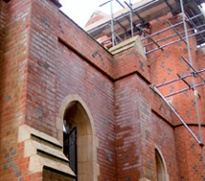
| Inappropriate cleaning methods produced the insoluble white bloom visible on the surface of this brickwork. | ||
 |
||
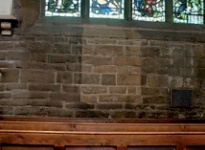
| This steam-cleaned panel was presented as a desirable outcome during consultations on the cleaning of a church interior. Sadly, full records had not been kept so the exact method was a mystery. |
While good maintenance will keep a building free from the accumulation of dirt, it will allow natural weathering to proceed, whereas the abrasive or corrosive actions of many cleaning methods can remove or destroy the protective surface that can form on masonry with the unsurprising result that the building, once cleaned, doesn’t stay that way. This isn’t a case of it raining straight after you’ve cleaned the car: agents of decay and soiling can attack and gain a foothold on a freshly cleaned surface far more easily than on one that has its own collection of dirt, a process clearly demonstrated by the speedy loss of the pristine finish.
The answer the enterprising contractor might suggest is to apply a ‘protective’ coating. Wrong answer! Any protective finish designed to change the way the surface absorbs moisture and dirt will also change the way it releases moisture. The effects can be complex but, for this reason alone, all coatings should be avoided.(1)
WHAT IS THE DIRT AND WHAT IS IT ATTACHED TO?
In a nutshell, dirt can be defined as unwanted material on the surface of a material. It is not only necessary to understand the nature of the dirt and how to get rid of it, but also what’s it doing, and how removing it will affect the underlying material.
Deciding whether a building can be safely cleaned thus requires knowledge of both the dirt and the material it is attached to. The building’s history should be taken into consideration as should the question of whether the removal of the dirt is likely to affect the masonry and the other substrates. Even the most monolithic building will have a mortar different from the stone, whilst many historic buildings comprise a variety of materials often dating from different episodes in its history.
Common sense would dictate that due to the huge variety of stones, bricks and other materials used in buildings, one type of cleaning is not going to be universally suitable. Unfortunately, common sense does not always prevail, and cleaning methods appropriate for one substrate have often been used on all the surfaces of a building and, progressively but illogically, on all the buildings in a particular area, regardless of the material, and then on all buildings of the same material, regardless of their different locations.
WHAT IS THE DESIRED RESULT?
The objectives of masonry cleaning vary widely. Property owners and investors may want pristine stonework to justify the money they have spent; surveyors and occasionally archaeologists may prefer clean surfaces for the ease of ‘reading’ the building; town planners may want to present well-maintained heritage townscapes; conservationists may want only harmful material removed to protect historic fabric; and contractors may well want to showcase the work they have done. If the building is to be cleaned, it is important that all parties agree what is to be expected of the process.
 |
|
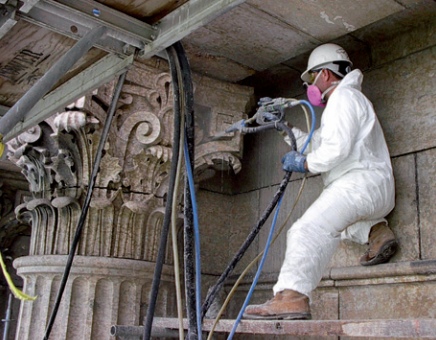
| Possibly the most destructive method used in the past, the grit blaster (below) has been superseded by gentler systems (above). |
While the light weathering of stone to break down the fresh surface of newly worked stone can be seen as providing character to a building, the accumulation of layers of soot or surface treatments detract from the aesthetic quality of the structure and will be seen as a valid reason for cleaning. It is imperative, then, that the stone is only cleaned of harmful materials by using the least aggressive methods to achieve the desired result.
The phrase ‘desired result’ is crucial here. It refers to the level of cleanliness reached that has been approved by those responsible for the project outcome. Measuring how much cleaning is necessary and deciding what methods to use are tasks that should be completed before the project goes to tender, as it should be the contractor’s role to fulfil a requirement rather than set a level.
Pre-project trials should be compulsory for work of this type and should be undertaken by skilled and experienced conservation contractors or accredited conservators to ensure that the work is appropriate, non-destructive and practical. The company carrying out the trials should be obliged to compile a report covering all aspects of the building, material, tests carried out and recommendations. These should be discussed with the client to ensure that the likely results are understood and accepted. Only when the standard has been agreed is it possible to go to tender, as this defines the quality of the work required from the contractors, so all are tendering to the same specifications. This process also ensures that all subsequent cleaning can be measured against the standard, thus preventing hidden extras from forcing up the budget.
MASONRY CLEANING CHECKLIST
Cleaning projects prescribed solely on the appearance of the building and the aesthetic considerations of the client rather than investigation and fact are not going to be effective. Before the scaffold goes up certain criteria should be satisfied:
- What is the material of construction? This
may seem obvious in the masonry world
but those with experience will agree that in
this rocky little isle there is a huge variety
of stone used in construction. Historically,
it was not unusual for any handy materials
to be used, be they from a field, quarry,
tumbledown building or even a ship’s
ballast. Mistaking one stone for another
and applying the ‘right’ cleaning agent
to the wrong stone can be disastrous.
 |
|
| Grit blasting | |
 |
|
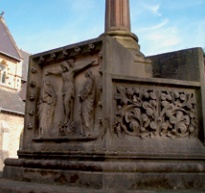
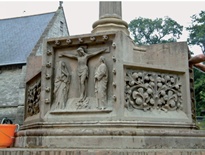
| Wrongly identified as limestone, this sandstone memorial narrowly escaped an aggressive cleaning method before correct analysis determined the material (below: after cleaning). | |
 |
- What is the dirt in question? Remember
the saying: ‘dirt is material in the wrong
place’. There are many types of soiling and correct identification is crucial. It is not sufficient to rely
on identification by the naked eye alone: correct identification
depends on a thorough process of examination to ascertain the
true nature of the dirt. If, for example, the soiling is biological,
should it be treated as a protected species (which many lichens are), or
as a disfiguring colonisation that is actively consuming the stone
and possibly providing the foundation for further staining?
- Where does the soiling originate? Determining whether the dirt
is material leached out of the stone by chemical reaction or an
accumulation on the surface produced by airborne deposition
influences the approach. The building may have design faults,
poor maintenance may have created environments which
promote the accumulation of soiling, or the umbra of trees
located close to walls may be encouraging algal staining.
- Is the dirt harming the building or is it a symptom of
some other process of decay or neglect that needs to be
addressed before effective cleaning can be carried out?
- Can the dirt be removed without harming the fabric of
the building? This is probably the most important of all
these questions, bringing together all the other strands
within this necessarily interventive area of work.
Conservation principles dictate that the method used should be
the least aggressive to reach the desired level of cleaning, whereas
the contractor may wish to use the strongest available method to
ensure the cleaning gets rid of everything quickly and efficiently
(and therefore cheaply). Masonry provides a porous surface for
dirt to inhabit. Unless this dirt can be persuaded to come out
(by poulticing or washing), physically removing it will inevitably
involve some loss of stone.
- How clean should the building be? The natural weathered
patina of stones is probably their best loved feature, caused by
the gentle polishing of the surface by the elements. Even the
most mild abrasive will remove this and once the surface is
dry it will be cleaner but dull. Is this what’s wanted? Another
problem is that cleaning the building too aggressively can cause
disharmony with a surrounding townscape of dirtier buildings,
while leaving a dirty facade can have the same effect.
- Once the criteria for cleaning have been determined, the project
team should be introduced to a sample of cleaning that must be
agreed on and adhered to for the whole term of the project.
- Will the effect of the cleaning last and is it safe? Since cleaned
buildings get dirtier faster, the cleaner it is the sooner it will
become dirty again. However, there is a more serious problem
in that the materials used can harm the stone over time causing
minerals to migrate, change colour or disintegrate. The best tool
to counter this is communication: look around and ask questions
of other practitioners and heritage bodies. The conservation
profession is dedicated to education and progress through the
dissemination of experience and information so there should be
no obstacle to obtaining records of previous cleaning, the materials
used and the effects produced during and after the clean.
- Water is the most widely used cleaning agent and rightly so as it is extremely effective. Conversely, it is also the force behind the majority of decay problems in buildings. If it is used unwisely the building could be clean outside but rotting inside.
It is inevitable that buildings will get dirty and if this is detrimental to
the wellbeing of the structure or detracts from its aesthetic statement it
may be appropriate to clean it. Before cleaning takes place, everything
must be known regarding the relevant materials, techniques and effects.
~~~
Notes
(1) For a summary of the issues see Elizabeth Garrod’s article on Stone Consolidation.