T W E N T Y F I R S T E D I T I O N
T H E B U I L D I N G C O N S E R VAT I O N D I R E C T O R Y 2 0 1 4
1 8 3
USEFUL INFORMATION
6
owned by a company registered in Panama,
and only the determined effort of local people
over many years persuaded Hastings Borough
Council, and ultimately the government, to
compulsorily purchase it for a community-led
trust to own and manage, following a major
restoration scheme which is being funded by
the Heritage Lottery Fund, the Architectural
Heritage Fund and many others.
A further, and growing, category of
historic buildings at risk is made up of those
where the use has been deemed redundant
by the owner, often a public body. This
might be a Carnegie library which the local
authority has decided to close and replace
with a brand new glass and steel ‘knowledge
hub’, with banks of PCs and not many books.
Or it could be a fire station, Victorian school,
town hall or swimming baths where the cost
of modernisation and adaptation is seen as
prohibitive. In the ideal scenario the public
body that owns the building has thought
through the ramifications of its decision to
close it and has an asset disposal strategy
in place, involving consultation with the
local community and even giving options to
community and voluntary sector groups to
take on the building for their own uses under
the asset transfer legislation. Sadly this is not
always the case and some public buildings
are simply abandoned while others are sold
on the open market, often to be turned into
expensive flats – far from the civic purpose for
which they were originally intended.
The Architectural Heritage Fund
(AHF) sees many cases where people come
together specifically because of concerns
about a prominent at risk building in their
local area. The AHF then suggests who else
they should talk to, always starting with the
local authority which, as outlined above,
has the powers to try to deal with owners
and can advise on planning issues. The
AHF’s other principal concerns, even at this
early stage, are whether an economically
viable use is likely to be identified for the
building and how the capital works may
be funded. AHF grant funding is geared
towards helping groups to ascertain the
answers to these vital questions, initially
through a short study called a viability
assessment. This should look at the building’s
structural issues, its current and potential
value, ownership and the willingness or
otherwise of the owner to negotiate on a
disposal, and, perhaps most importantly, the
potential use and long-term sustainability.
Of course the AHF is by no means the
only funding body that can help community
groups and others tackling historic buildings
at risk. The Funds for Historic Buildings
website (see further information) is a free
database listing all the major funding sources
and can be searched according to building
type, location and ownership, including
private ownership. Financial help for private
individuals, however, is scarce because most
charitable trusts will only fund other charities
or not-for-profit organisations.
The Heritage Lottery Fund (HLF) is by
far the largest supporter of projects tackling
buildings at risk, and in April 2013 it launched
the Heritage Enterprise scheme, specifically
aimed at encouraging communities to work
with developers to find commercially viable
solutions for large at risk buildings. At the
same time the HLF also introduced start-up
grants of up to £10,000 intended to help new
groups at the outset of their projects.
The Joint Committee of the National
Amenity Societies, which brings together the
likes of the Ancient Monuments Society, the
Victorian Society and the Twentieth Century
Society, runs another valuable website,
Heritage Help (see further information).
This contains short articles on some key
issues for owners of listed buildings,
campaigners and community groups and
also acts as a gateway, signposting users to
the main sources of information on topics
such as planning, maintenance and funding.
Buildingconservation.com also provides an
extensive list of free articles including many
on funding, legislation and the work of the
major heritage amenity societies.
So there is plenty of information and
advice available, but what is the picture like
when it comes to trying to tackle all those
buildings at risk on the various lists and
registers? First of all, it is worth remembering
that many are not ‘buildings’, as such,
but would be more accurately deemed
‘structures’. These might, for example, include
gateposts, walls, fountains, monuments and
consolidated ruins – none of them capable
of what the AHF would term ‘beneficial
reuse’. It is often challenging to persuade
an owner to invest in the maintenance of
such structures and hence they tend to
fall into disrepair and become at risk.
There are also buildings which have
been on these registers since they were
first compiled. These are the ones where
the problems are seemingly so intractable
that a solution seems virtually impossible.
However, in time and with the right
momentum behind them, the seemingly
impossible can become the next major
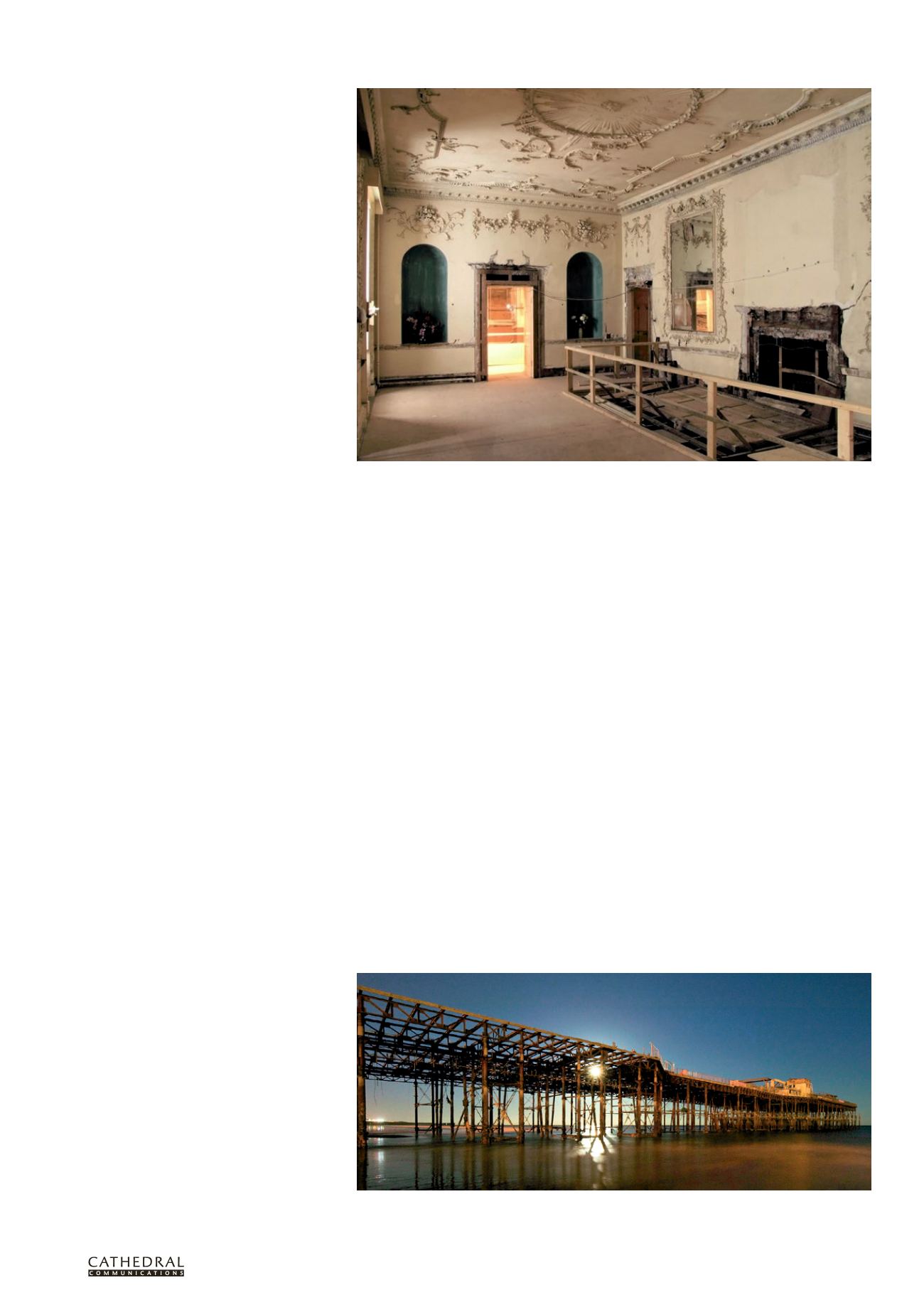
heritage project. Hastings Pier, particularly
after a disastrous fire in 2010, looked as if
it might be consigned to a similar fate to
Brighton’s West Pier, but the determination
of a local trust has ensured a potentially
happy ending to this particular heritage
story. Two other heritage causes célèbres,
Mavisbank House outside Edinburgh, and
Wentworth Woodhouse in South Yorkshire,
are now the subject of renewed schemes
for restoration and reuse, having also been
written off by many over the years.
Poltimore House, near Exeter: despite setbacks including the discovery of asbestos, efforts continue to save this
extraordinary Grade II* building.
Hastings Pier following a devastating fire in October 2010


