T W E N T Y F I R S T E D I T I O N
T H E B U I L D I N G C O N S E R VAT I O N D I R E C T O R Y 2 0 1 4
1 5 3
4.2
SERVICES & TREATMENT :
HEATING & LIGHTING SER VICES
while fire doors are manually closed en-
route. Solutions like these will retain the
authenticity, appearance and value of the
heritage asset.
Another curatorial duty is to produce,
manage and regularly test damage-limitation
measures (Holden, 2010) and emergency plans
(Holden, 2004). Museum professionals should
seek to reduce fire risk at every opportunity
through regular review of procedures,
systems and training. In the event of fire
their role is to facilitate the progress of the
incident by advising the emergency services
on aspects as diverse as room layout, systems
infrastructures, priority salvage, storage and
care of retrieved items, and afterwards deal
with site security and inventory checking.
A key factor of emergency response is working
closely with the fire service. Familiarisation
with property, chattels and property teams
can only be a good thing. Support from local
gas fired boilers and giving our storage
water reservoir a structural inspection.
As with all efforts to manage fire risk,
the effectiveness of any solution will rely
on the amount of care that is put into its
preparation. The tasks of trying to predict
how fires might start and spread in large
historic properties and of designing suitable
countermeasures are fraught with difficulty
– seemingly endless possibilities and
permutations must be taken into account.
It is, perhaps, an unusual kind of work
that demands so much effort but which all
involved hope never to see in action.
Recommended Reading
P Holden, ‘Heaven Helps Those Who Help
Themselves: The Realities of Disaster
Planning’, Journal of the Society of
Archivists, Vol 25, No 1, 2004
P Holden, ‘Damage Limitation, Planning and
Training at Lanhydrock House, Cornwall’
in S Kidd, Fire Safety Management in
Traditional Buildings, Part 2, Annex II,
Historic Scotland, Edinburgh, 2010
PAUL HOLDEN
MA FSA is house and
and lead tradesman at Winchester College,
he has been at Lanhydrock for 14 years
during which time he has overseen many
significant projects including, between
2011 and 2013, the implementation of
works arising from the fire risk assessment.
He is also an architectural historian and
the author of two books and numerous
scholarly articles.
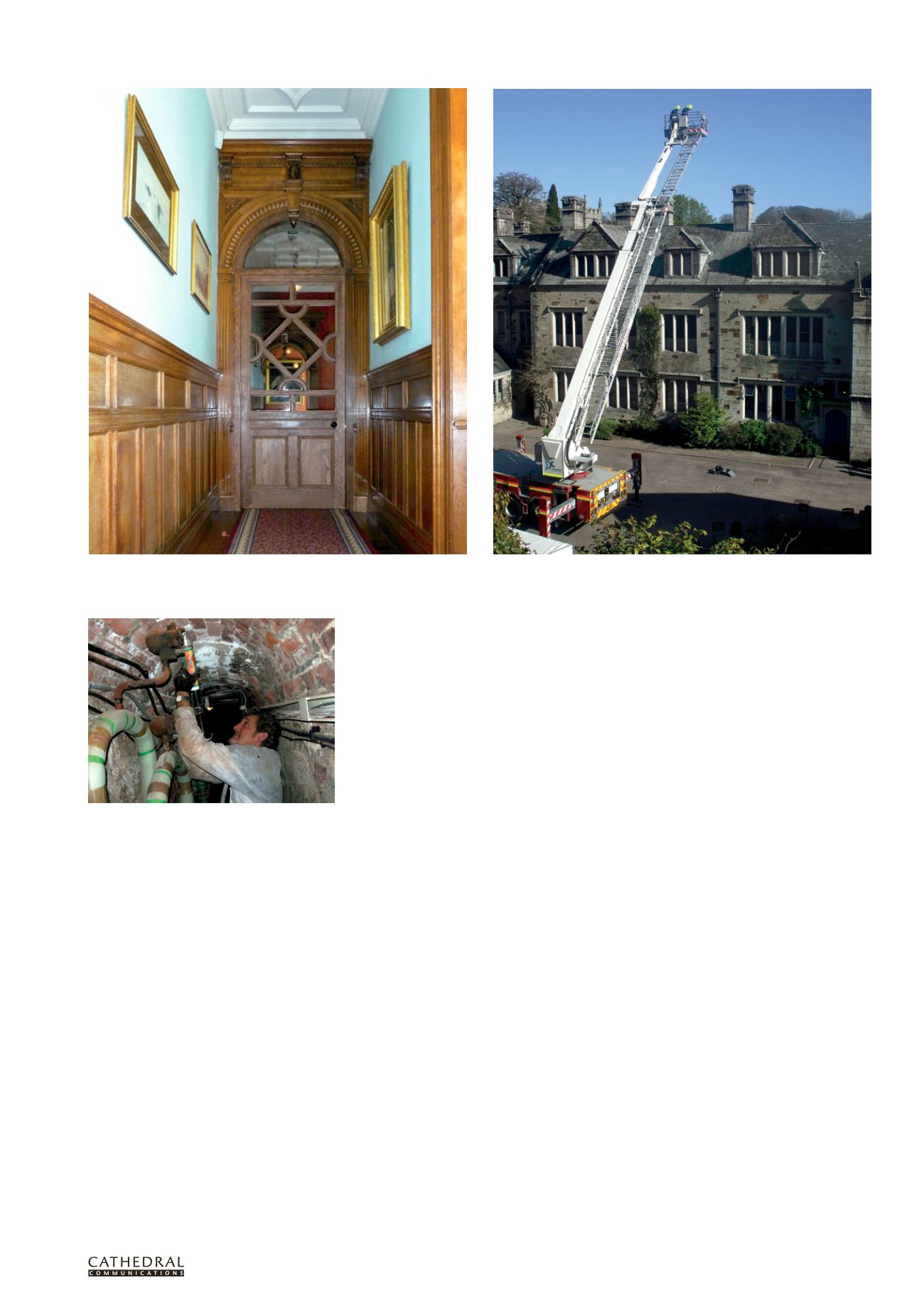
One of three new fire doors installed into the property: the doors won an award
for their design and manufacture.
One of the regular fire exercises that take place at Lanhydrock: close links with
Cornwall Fire and Rescue Service have reaped many benefits including the
creation of a detailed fire salvage plan.
Sealing all breaches between the tunnels and
the ground floor created a single horizontal fire
compartment. All work was carried out by the
National Trust’s own direct labour team.
crews will allow rehearsal and familiarisation
towards the emergency procedure plan.
Likewise, the infrastructure to support
fire and rescue systems must be assessed,
for example the installation of deep hard-
standings in our courtyard to accommodate
specialist high-level cranes, rehearsing
tunnel rescue and rope techniques and
drawing back-up water supplies from external
sources. Regular visits from each duty watch
have kept plans fresh and well rehearsed.
THE BOTTOM LINE
The success of any project relies on the
co-operation of conservation, heritage and
fire specialists, in our case the National
Trust building team with support from
ASG Security, Simon Brewer Carpentry,
Chubb Fire and Security, Cornwall Council,
Cornwall Fire and Rescue Service, English
Heritage, International Passive Fire Ltd, and
Pearn and Proctor Architects.
In responding to the fire risk assessment
we have made well-informed decisions that
were based on good practice and sound
research. At the outset it was decided
that the project team should maintain
meticulous records of the works in order
to be accountable for the changes we, as
custodians, were making to our heritage.
The result is a comprehensive ‘as built’
documents record, both in textual and
photographic form, showing the ‘before’
and ‘after’ stages of the project and clearly
demonstrating the logic that we have
applied in implementing change. We
are working on phase 3 of the project,
which may include changing our natural


